

18
1 Surface Thermodynamics of Solid Electrode
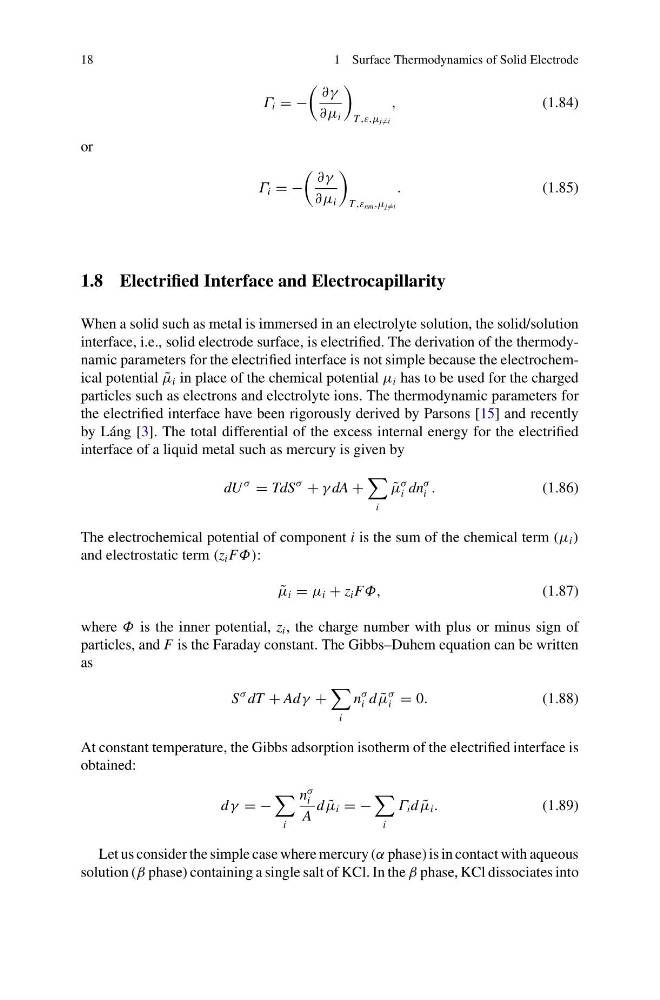
Γ i = −
∂γ
∂μ i
T ,ε,μ j =i
,
(1.84)
or
Γ i = −
∂γ
∂μ i
T ,ε nm ,μ j =i
.
(1.85)
1.8 Electrified Interface and Electrocapillarity
When a solid such as metal is immersed in an electrolyte solution, the solid/solution
interface, i.e., solid electrode surface, is electrified. The derivation of the thermodynamic parameters for the electrified interface is not simple because the electrochemical potential ˜
μ i in place of the chemical potential μ i has to be used for the charged
particles such as electrons and electrolyte ions. The thermodynamic parameters for
the electrified interface have been rigorously derived by Parsons [15] and recently
by Láng [3]. The total differential of the excess internal energy for the electrified
interface of a liquid metal such as mercury is given by
dU
σ
= TdS
σ
+ γ dA +
i
˜
μ
σ
i dn
σ
i .
(1.86)
The electrochemical potential of component i is the sum of the chemical term (μ i )
and electrostatic term (z i FΦ):
˜
μ i = μ i + z i FΦ,
(1.87)
where Φ is the inner potential, z i , the charge number with plus or minus sign of
particles, and F is the Faraday constant. The Gibbs–Duhem equation can be written
as
S
σ dT + Ad γ +
i
n
σ
i d ˜
μ
σ
i = 0.
(1.88)
At constant temperature, the Gibbs adsorption isotherm of the electrified interface is
obtained:
d γ = −
i
n
σ
i
A
d ˜
μ i = −
i
Γ i d ˜
μ i .
(1.89)
Let us consider the simple case where mercury (α phase) is in contact with aqueous
solution (β phase) containing a single salt of KCl. In the β phase, KCl dissociates into
1 Surface Thermodynamics of Solid Electrode
Γ i = −
∂γ
∂μ i
T ,ε,μ j =i
,
(1.84)
or
Γ i = −
∂γ
∂μ i
T ,ε nm ,μ j =i
.
(1.85)
1.8 Electrified Interface and Electrocapillarity
When a solid such as metal is immersed in an electrolyte solution, the solid/solution
interface, i.e., solid electrode surface, is electrified. The derivation of the thermodynamic parameters for the electrified interface is not simple because the electrochemical potential ˜
μ i in place of the chemical potential μ i has to be used for the charged
particles such as electrons and electrolyte ions. The thermodynamic parameters for
the electrified interface have been rigorously derived by Parsons [15] and recently
by Láng [3]. The total differential of the excess internal energy for the electrified
interface of a liquid metal such as mercury is given by
dU
σ
= TdS
σ
+ γ dA +
i
˜
μ
σ
i dn
σ
i .
(1.86)
The electrochemical potential of component i is the sum of the chemical term (μ i )
and electrostatic term (z i FΦ):
˜
μ i = μ i + z i FΦ,
(1.87)
where Φ is the inner potential, z i , the charge number with plus or minus sign of
particles, and F is the Faraday constant. The Gibbs–Duhem equation can be written
as
S
σ dT + Ad γ +
i
n
σ
i d ˜
μ
σ
i = 0.
(1.88)
At constant temperature, the Gibbs adsorption isotherm of the electrified interface is
obtained:
d γ = −
i
n
σ
i
A
d ˜
μ i = −
i
Γ i d ˜
μ i .
(1.89)
Let us consider the simple case where mercury (α phase) is in contact with aqueous
solution (β phase) containing a single salt of KCl. In the β phase, KCl dissociates into