

1.7 Gibbs–Duhem Equation of Solid Surface
17
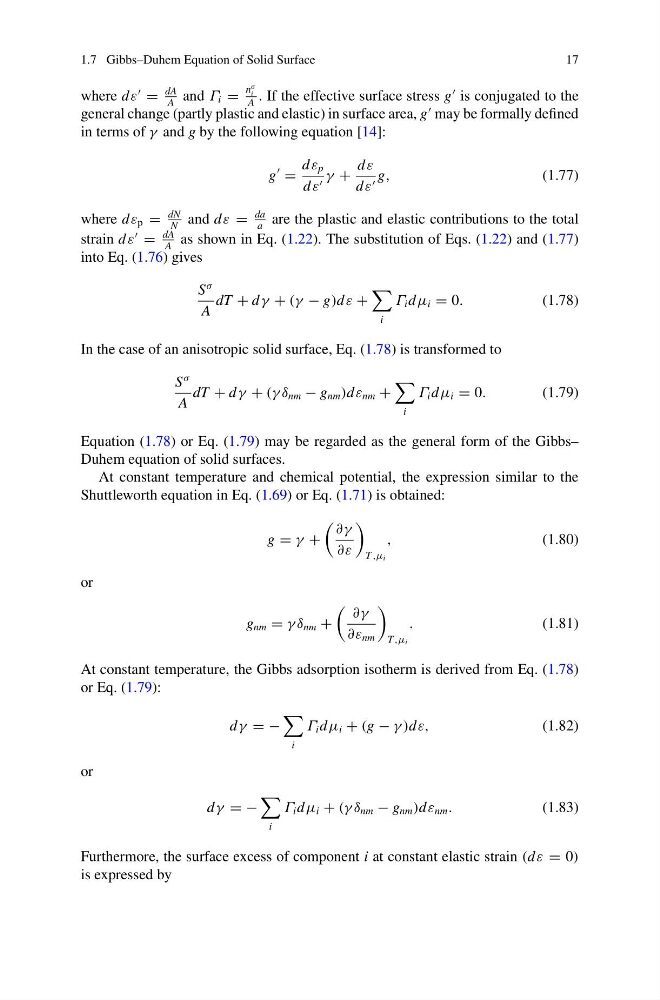
where d ε
=
dA
A
and Γ i =
n
σ
i
A
. If the effective surface stress g
is conjugated to the
general change (partly plastic and elastic) in surface area, g
may be formally defined
in terms of γ and g by the following equation [14]:
g
=
d ε p
d ε γ +
d ε
d ε g,
(1.77)
where d ε p =
dN
N
and d ε =
da
a
are the plastic and elastic contributions to the total
strain d ε
=
dA
A
as shown in Eq. (1.22). The substitution of Eqs. (1.22) and (1.77)
into Eq. (1.76) gives
S
σ
A
dT + d γ + (γ − g)d ε +
i
Γ i d μ i = 0.
(1.78)
In the case of an anisotropic solid surface, Eq. (1.78) is transformed to
S
σ
A
dT + d γ + (γ δ nm − g nm )d ε nm +
i
Γ i d μ i = 0.
(1.79)
Equation (1.78) or Eq. (1.79) may be regarded as the general form of the Gibbs–
Duhem equation of solid surfaces.
At constant temperature and chemical potential, the expression similar to the
Shuttleworth equation in Eq. (1.69) or Eq. (1.71) is obtained:
g = γ +
∂γ
∂ε
T ,μ i
,
(1.80)
or
g nm = γ δ nm +
∂γ
∂ε nm
T ,μ i
.
(1.81)
At constant temperature, the Gibbs adsorption isotherm is derived from Eq. (1.78)
or Eq. (1.79):
d γ = −
i
Γ i d μ i + (g − γ )d ε,
(1.82)
or
d γ = −
i
Γ i d μ i + (γ δ nm − g nm )d ε nm .
(1.83)
Furthermore, the surface excess of component i at constant elastic strain (d ε = 0)
is expressed by
17
where d ε
=
dA
A
and Γ i =
n
σ
i
A
. If the effective surface stress g
is conjugated to the
general change (partly plastic and elastic) in surface area, g
may be formally defined
in terms of γ and g by the following equation [14]:
g
=
d ε p
d ε γ +
d ε
d ε g,
(1.77)
where d ε p =
dN
N
and d ε =
da
a
are the plastic and elastic contributions to the total
strain d ε
=
dA
A
as shown in Eq. (1.22). The substitution of Eqs. (1.22) and (1.77)
into Eq. (1.76) gives
S
σ
A
dT + d γ + (γ − g)d ε +
i
Γ i d μ i = 0.
(1.78)
In the case of an anisotropic solid surface, Eq. (1.78) is transformed to
S
σ
A
dT + d γ + (γ δ nm − g nm )d ε nm +
i
Γ i d μ i = 0.
(1.79)
Equation (1.78) or Eq. (1.79) may be regarded as the general form of the Gibbs–
Duhem equation of solid surfaces.
At constant temperature and chemical potential, the expression similar to the
Shuttleworth equation in Eq. (1.69) or Eq. (1.71) is obtained:
g = γ +
∂γ
∂ε
T ,μ i
,
(1.80)
or
g nm = γ δ nm +
∂γ
∂ε nm
T ,μ i
.
(1.81)
At constant temperature, the Gibbs adsorption isotherm is derived from Eq. (1.78)
or Eq. (1.79):
d γ = −
i
Γ i d μ i + (g − γ )d ε,
(1.82)
or
d γ = −
i
Γ i d μ i + (γ δ nm − g nm )d ε nm .
(1.83)
Furthermore, the surface excess of component i at constant elastic strain (d ε = 0)
is expressed by