

16
1 Surface Thermodynamics of Solid Electrode
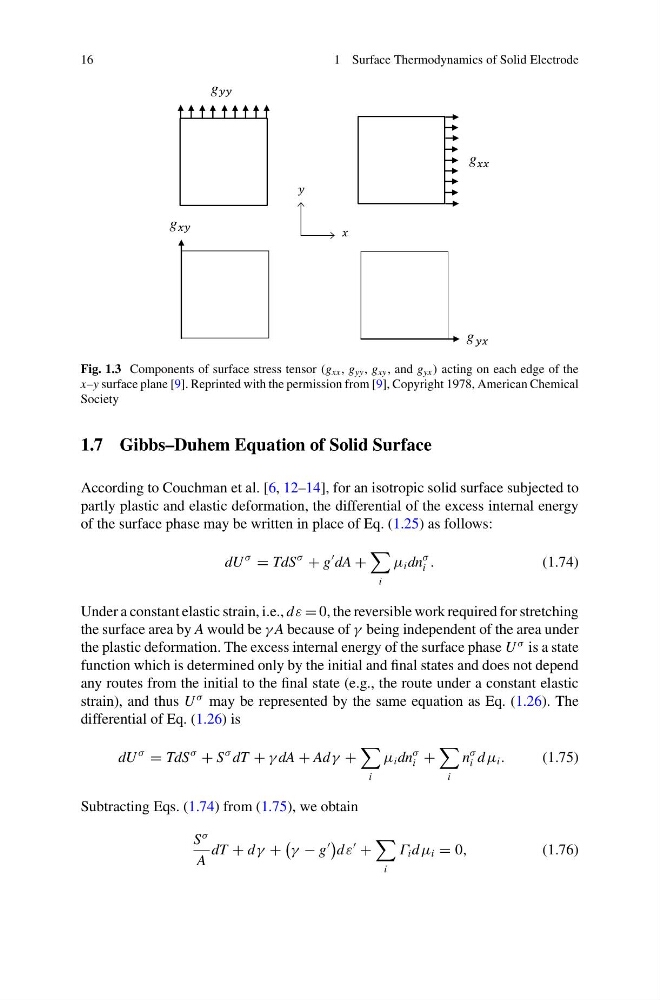
Fig. 1.3 Components of surface stress tensor (g xx , g yy , g xy , and g yx ) acting on each edge of the
x–y surface plane [9]. Reprinted with the permission from [9], Copyright 1978, American Chemical
Society
1.7 Gibbs–Duhem Equation of Solid Surface
According to Couchman et al. [6, 12–14], for an isotropic solid surface subjected to
partly plastic and elastic deformation, the differential of the excess internal energy
of the surface phase may be written in place of Eq. (1.25) as follows:
dU
σ
= TdS
σ
+ g
dA +
i
μ i dn
σ
i .
(1.74)
Under a constant elastic strain, i.e., d ε = 0, the reversible work required for stretching
the surface area by A would be γ A because of γ being independent of the area under
the plastic deformation. The excess internal energy of the surface phase U
σ is a state
function which is determined only by the initial and final states and does not depend
any routes from the initial to the final state (e.g., the route under a constant elastic
strain), and thus U
σ may be represented by the same equation as Eq. (1.26). The
differential of Eq. (1.26) is
dU
σ
= TdS
σ
+ S
σ dT + γ dA + Ad γ +
i
μ i dn
σ
i +
i
n
σ
i d μ i .
(1.75)
Subtracting Eqs. (1.74) from (1.75), we obtain
S
σ
A
dT + d γ +
γ − g
d ε
+
i
Γ i d μ i = 0,
(1.76)
1 Surface Thermodynamics of Solid Electrode
Fig. 1.3 Components of surface stress tensor (g xx , g yy , g xy , and g yx ) acting on each edge of the
x–y surface plane [9]. Reprinted with the permission from [9], Copyright 1978, American Chemical
Society
1.7 Gibbs–Duhem Equation of Solid Surface
According to Couchman et al. [6, 12–14], for an isotropic solid surface subjected to
partly plastic and elastic deformation, the differential of the excess internal energy
of the surface phase may be written in place of Eq. (1.25) as follows:
dU
σ
= TdS
σ
+ g
dA +
i
μ i dn
σ
i .
(1.74)
Under a constant elastic strain, i.e., d ε = 0, the reversible work required for stretching
the surface area by A would be γ A because of γ being independent of the area under
the plastic deformation. The excess internal energy of the surface phase U
σ is a state
function which is determined only by the initial and final states and does not depend
any routes from the initial to the final state (e.g., the route under a constant elastic
strain), and thus U
σ may be represented by the same equation as Eq. (1.26). The
differential of Eq. (1.26) is
dU
σ
= TdS
σ
+ S
σ dT + γ dA + Ad γ +
i
μ i dn
σ
i +
i
n
σ
i d μ i .
(1.75)
Subtracting Eqs. (1.74) from (1.75), we obtain
S
σ
A
dT + d γ +
γ − g
d ε
+
i
Γ i d μ i = 0,
(1.76)