

7.4 Nano-Mechanical Properties of Passive Metal Surfaces Obtained …
207
Cr 2 O
2−
7 + 8H
+
+ 6e
−
→ Cr 2 O 3 + 4H 2 O,
(7.34)
and
2Fe + 3H 2 O → Fe 2 O 3 + 6H
+
+ 6e
−
,
(7.35)
where e
− is the electron which participates in cathodic reaction of Eq. (7.34) and in
anodic reaction of Eq. (7.35). As a result of the above coupled reactions, trivalent
chromium is incorporated in the passive film. The significant amount of chromium
in the passive film on the polycrystalline iron after the chromate treatment has been
confirmed by Auger electron spectroscopy (AES) [59, 60]. It is well known that the
high corrosion resistivities of alloys containing Cr component are caused by the Cr
enrichment in the passive films [61]. As shown in the load-depth curves in Figs. 7.19
and 7.21, the values of
h f
h max
exceed 0.8, which may arise the issue of pile-up. Iron and
steels are work-hardening materials in contrast to soft materials such as copper and
aluminum. In the case where the Fe (100) and (110) specimens are work hardened
during the loading required for 5 s up to each L max , the influence of the pile-up on
H and E s should be very small [2, 42, 49].
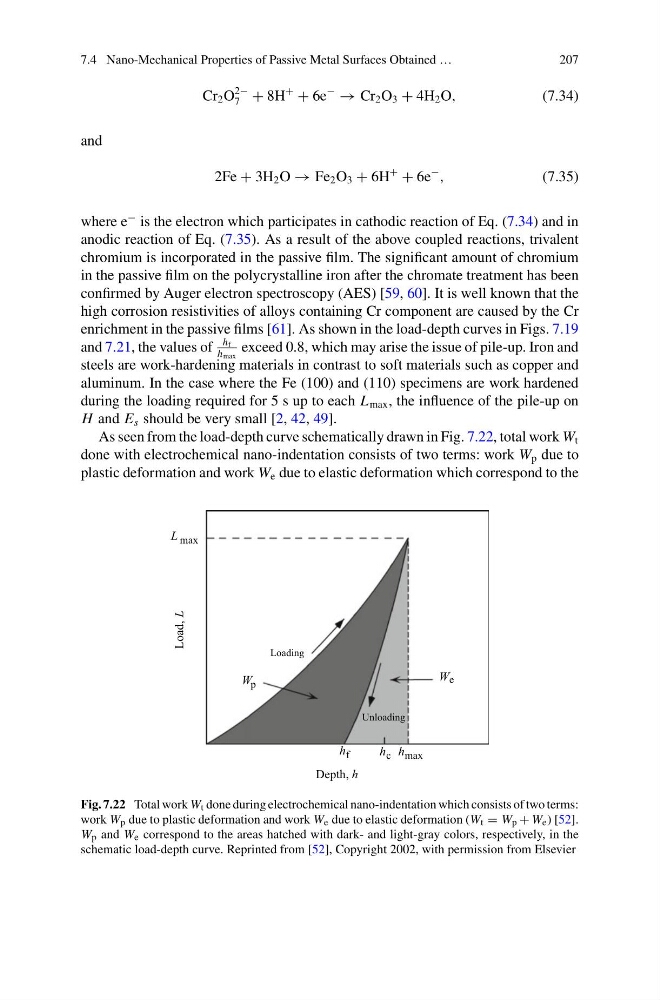
As seen from the load-depth curve schematically drawn in Fig. 7.22, total work W t
done with electrochemical nano-indentation consists of two terms: work W p due to
plastic deformation and work W e due to elastic deformation which correspond to the
Unloading
Loading
L max
W p
h f
h c h max
W e
Depth, h
Load,
L
Fig. 7.22 Total work W t done during electrochemical nano-indentation which consists of two terms:
work W p due to plastic deformation and work W e due to elastic deformation (W t = W p + W e ) [52].
W p and W e correspond to the areas hatched with dark- and light-gray colors, respectively, in the
schematic load-depth curve. Reprinted from [52], Copyright 2002, with permission from Elsevier
207
Cr 2 O
2−
7 + 8H
+
+ 6e
−
→ Cr 2 O 3 + 4H 2 O,
(7.34)
and
2Fe + 3H 2 O → Fe 2 O 3 + 6H
+
+ 6e
−
,
(7.35)
where e
− is the electron which participates in cathodic reaction of Eq. (7.34) and in
anodic reaction of Eq. (7.35). As a result of the above coupled reactions, trivalent
chromium is incorporated in the passive film. The significant amount of chromium
in the passive film on the polycrystalline iron after the chromate treatment has been
confirmed by Auger electron spectroscopy (AES) [59, 60]. It is well known that the
high corrosion resistivities of alloys containing Cr component are caused by the Cr
enrichment in the passive films [61]. As shown in the load-depth curves in Figs. 7.19
and 7.21, the values of
h f
h max
exceed 0.8, which may arise the issue of pile-up. Iron and
steels are work-hardening materials in contrast to soft materials such as copper and
aluminum. In the case where the Fe (100) and (110) specimens are work hardened
during the loading required for 5 s up to each L max , the influence of the pile-up on
H and E s should be very small [2, 42, 49].
As seen from the load-depth curve schematically drawn in Fig. 7.22, total work W t
done with electrochemical nano-indentation consists of two terms: work W p due to
plastic deformation and work W e due to elastic deformation which correspond to the
Unloading
Loading
L max
W p
h f
h c h max
W e
Depth, h
Load,
L
Fig. 7.22 Total work W t done during electrochemical nano-indentation which consists of two terms:
work W p due to plastic deformation and work W e due to elastic deformation (W t = W p + W e ) [52].
W p and W e correspond to the areas hatched with dark- and light-gray colors, respectively, in the
schematic load-depth curve. Reprinted from [52], Copyright 2002, with permission from Elsevier