

206
7 Nano-Mechanical Properties of Solid Surfaces Obtained …
600
400
200
0
Load,
L / µN
120
100
80
60
40
20
0
Depth h / nm
Fe (100)
pH 8.4 borate solution
0.25 V (SHE)
without chromate
with chromate
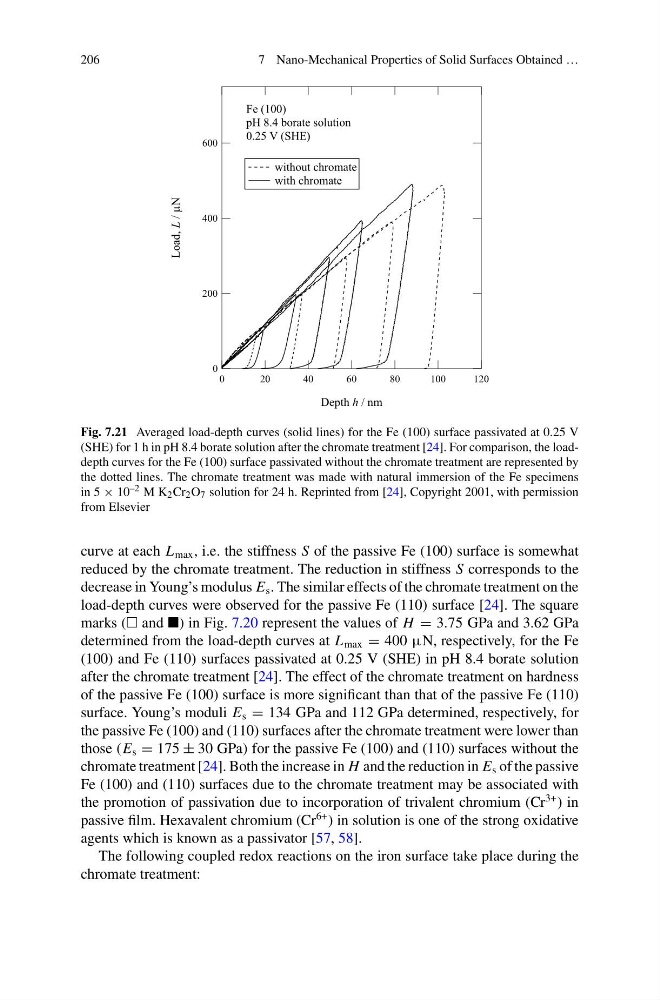
Fig. 7.21 Averaged load-depth curves (solid lines) for the Fe (100) surface passivated at 0.25 V
(SHE) for 1 h in pH 8.4 borate solution after the chromate treatment [24]. For comparison, the loaddepth curves for the Fe (100) surface passivated without the chromate treatment are represented by
the dotted lines. The chromate treatment was made with natural immersion of the Fe specimens
in 5 × 10 –2 M K 2 Cr 2 O 7 solution for 24 h. Reprinted from [24], Copyright 2001, with permission
from Elsevier
curve at each L max , i.e. the stiffness S of the passive Fe (100) surface is somewhat
reduced by the chromate treatment. The reduction in stiffness S corresponds to the
decrease in Young’s modulus E s . The similar effects of the chromate treatment on the
load-depth curves were observed for the passive Fe (110) surface [24]. The square
marks ( and ) in Fig. 7.20 represent the values of H = 3.75 GPa and 3.62 GPa
determined from the load-depth curves at L max = 400 µN, respectively, for the Fe
(100) and Fe (110) surfaces passivated at 0.25 V (SHE) in pH 8.4 borate solution
after the chromate treatment [24]. The effect of the chromate treatment on hardness
of the passive Fe (100) surface is more significant than that of the passive Fe (110)
surface. Young’s moduli E s = 134 GPa and 112 GPa determined, respectively, for
the passive Fe (100) and (110) surfaces after the chromate treatment were lower than
those (E s = 175 ± 30 GPa) for the passive Fe (100) and (110) surfaces without the
chromate treatment [24]. Both the increase in H and the reduction in E s of the passive
Fe (100) and (110) surfaces due to the chromate treatment may be associated with
the promotion of passivation due to incorporation of trivalent chromium (Cr
3+ ) in
passive film. Hexavalent chromium (Cr
6+ ) in solution is one of the strong oxidative
agents which is known as a passivator [57, 58].
The following coupled redox reactions on the iron surface take place during the
chromate treatment:
7 Nano-Mechanical Properties of Solid Surfaces Obtained …
600
400
200
0
Load,
L / µN
120
100
80
60
40
20
0
Depth h / nm
Fe (100)
pH 8.4 borate solution
0.25 V (SHE)
without chromate
with chromate
Fig. 7.21 Averaged load-depth curves (solid lines) for the Fe (100) surface passivated at 0.25 V
(SHE) for 1 h in pH 8.4 borate solution after the chromate treatment [24]. For comparison, the loaddepth curves for the Fe (100) surface passivated without the chromate treatment are represented by
the dotted lines. The chromate treatment was made with natural immersion of the Fe specimens
in 5 × 10 –2 M K 2 Cr 2 O 7 solution for 24 h. Reprinted from [24], Copyright 2001, with permission
from Elsevier
curve at each L max , i.e. the stiffness S of the passive Fe (100) surface is somewhat
reduced by the chromate treatment. The reduction in stiffness S corresponds to the
decrease in Young’s modulus E s . The similar effects of the chromate treatment on the
load-depth curves were observed for the passive Fe (110) surface [24]. The square
marks ( and ) in Fig. 7.20 represent the values of H = 3.75 GPa and 3.62 GPa
determined from the load-depth curves at L max = 400 µN, respectively, for the Fe
(100) and Fe (110) surfaces passivated at 0.25 V (SHE) in pH 8.4 borate solution
after the chromate treatment [24]. The effect of the chromate treatment on hardness
of the passive Fe (100) surface is more significant than that of the passive Fe (110)
surface. Young’s moduli E s = 134 GPa and 112 GPa determined, respectively, for
the passive Fe (100) and (110) surfaces after the chromate treatment were lower than
those (E s = 175 ± 30 GPa) for the passive Fe (100) and (110) surfaces without the
chromate treatment [24]. Both the increase in H and the reduction in E s of the passive
Fe (100) and (110) surfaces due to the chromate treatment may be associated with
the promotion of passivation due to incorporation of trivalent chromium (Cr
3+ ) in
passive film. Hexavalent chromium (Cr
6+ ) in solution is one of the strong oxidative
agents which is known as a passivator [57, 58].
The following coupled redox reactions on the iron surface take place during the
chromate treatment: