

55
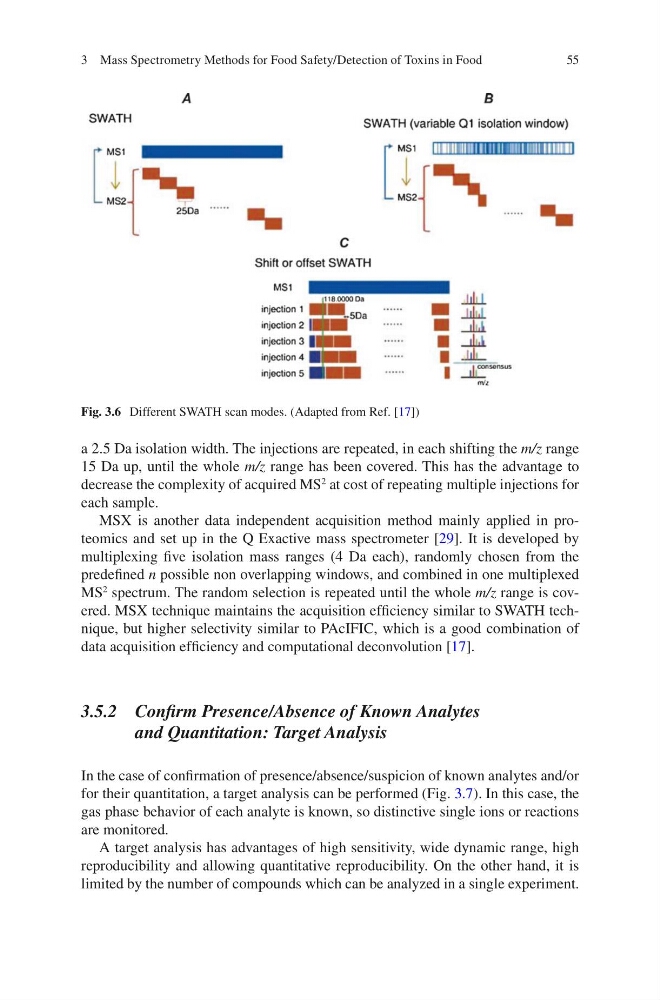
a 2.5 Da isolation width. The injections are repeated, in each shifting the m/z range
15 Da up, until the whole m/z range has been covered. This has the advantage to
decrease the complexity of acquired MS
2
at cost of repeating multiple injections for
each sample.
MSX is another data independent acquisition method mainly applied in proteomics and set up in the Q Exactive mass spectrometer [29]. It is developed by
multiplexing five isolation mass ranges (4 Da each), randomly chosen from the
predefined n possible non overlapping windows, and combined in one multiplexed
MS
2
spectrum. The random selection is repeated until the whole m/z range is covered. MSX technique maintains the acquisition efficiency similar to SWATH technique, but higher selectivity similar to PAcIFIC, which is a good combination of
data acquisition efficiency and computational deconvolution [17].
3.5.2 Confirm Presence/Absence of Known Analytes
and Quantitation: Target Analysis
In the case of confirmation of presence/absence/suspicion of known analytes and/or
for their quantitation, a target analysis can be performed (Fig. 3.7). In this case, the
gas phase behavior of each analyte is known, so distinctive single ions or reactions
are monitored.
A target analysis has advantages of high sensitivity, wide dynamic range, high
reproducibility and allowing quantitative reproducibility. On the other hand, it is
limited by the number of compounds which can be analyzed in a single experiment.
Fig. 3.6 Different SWATH scan modes. (Adapted from Ref. [17])
3 Mass Spectrometry Methods for Food Safety/Detection of Toxins in Food
a 2.5 Da isolation width. The injections are repeated, in each shifting the m/z range
15 Da up, until the whole m/z range has been covered. This has the advantage to
decrease the complexity of acquired MS
2
at cost of repeating multiple injections for
each sample.
MSX is another data independent acquisition method mainly applied in proteomics and set up in the Q Exactive mass spectrometer [29]. It is developed by
multiplexing five isolation mass ranges (4 Da each), randomly chosen from the
predefined n possible non overlapping windows, and combined in one multiplexed
MS
2
spectrum. The random selection is repeated until the whole m/z range is covered. MSX technique maintains the acquisition efficiency similar to SWATH technique, but higher selectivity similar to PAcIFIC, which is a good combination of
data acquisition efficiency and computational deconvolution [17].
3.5.2 Confirm Presence/Absence of Known Analytes
and Quantitation: Target Analysis
In the case of confirmation of presence/absence/suspicion of known analytes and/or
for their quantitation, a target analysis can be performed (Fig. 3.7). In this case, the
gas phase behavior of each analyte is known, so distinctive single ions or reactions
are monitored.
A target analysis has advantages of high sensitivity, wide dynamic range, high
reproducibility and allowing quantitative reproducibility. On the other hand, it is
limited by the number of compounds which can be analyzed in a single experiment.
Fig. 3.6 Different SWATH scan modes. (Adapted from Ref. [17])
3 Mass Spectrometry Methods for Food Safety/Detection of Toxins in Food