

54
quadrupole analyzer is stepped continuously across the whole selected m/z range
with a medium width mass window (20–30 Da) for precursor ion selection. Precursor
ions are then transmitted to the collision cell, submitted to collision-induced dissociations and the resulting product ions are analyzed sequentially in high resolution
by the ToF analyzer (Fig. 3.6).
The quadrupole isolation window can be (i) fixed (e.g. 25 Da width) (Fig. 3.6A);
(ii) variable, with different isolation width based on equalizing the distribution of
either the precursor ion population or the total ion current (Fig. 3.6B) [26], (iii)
sequentially shifted with a small overlapping mass range (e.g. 5 Da), referred to as
shift or offset SWATH, typically requiring five repetitive injections so to reconstruct
more accurately the precursor/product ion relationship and improve the accuracy of
compound identification and quantification (Fig. 3.6C) [27].
Other DIA methods are PAcIFIC and MSX, both applied in proteomics.
PAcIFIC, referred as precursor acquisition independent from ion count, has been
developed on a LTQ-Orbitrap instrument and requires multiple injections for one
sample analysis [28].
In the first injection, the ion trap performs MS
2
spectra at every m/z value at each
of ten continuous intervals (each with a 1.5 Da width) across a range of 15 Da using
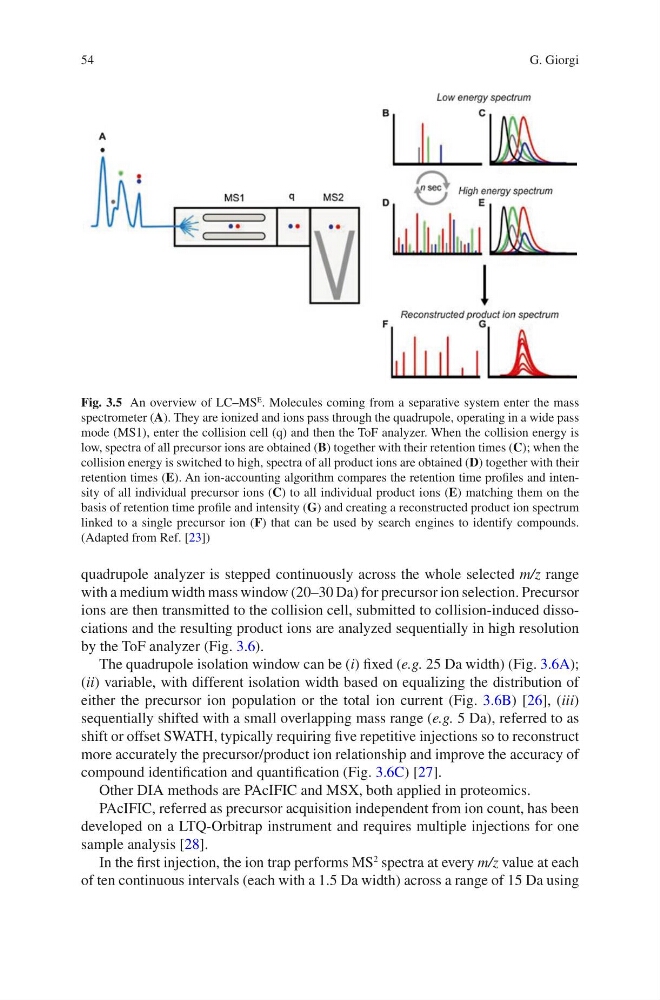
Fig. 3.5 An overview of LC–MS
E . Molecules coming from a separative system enter the mass
spectrometer (A). They are ionized and ions pass through the quadrupole, operating in a wide pass
mode (MS1), enter the collision cell (q) and then the ToF analyzer. When the collision energy is
low, spectra of all precursor ions are obtained (B) together with their retention times (C); when the
collision energy is switched to high, spectra of all product ions are obtained (D) together with their
retention times (E). An ion-accounting algorithm compares the retention time profiles and intensity of all individual precursor ions (C) to all individual product ions (E) matching them on the
basis of retention time profile and intensity (G) and creating a reconstructed product ion spectrum
linked to a single precursor ion (F) that can be used by search engines to identify compounds.
(Adapted from Ref. [23])
G. Giorgi
quadrupole analyzer is stepped continuously across the whole selected m/z range
with a medium width mass window (20–30 Da) for precursor ion selection. Precursor
ions are then transmitted to the collision cell, submitted to collision-induced dissociations and the resulting product ions are analyzed sequentially in high resolution
by the ToF analyzer (Fig. 3.6).
The quadrupole isolation window can be (i) fixed (e.g. 25 Da width) (Fig. 3.6A);
(ii) variable, with different isolation width based on equalizing the distribution of
either the precursor ion population or the total ion current (Fig. 3.6B) [26], (iii)
sequentially shifted with a small overlapping mass range (e.g. 5 Da), referred to as
shift or offset SWATH, typically requiring five repetitive injections so to reconstruct
more accurately the precursor/product ion relationship and improve the accuracy of
compound identification and quantification (Fig. 3.6C) [27].
Other DIA methods are PAcIFIC and MSX, both applied in proteomics.
PAcIFIC, referred as precursor acquisition independent from ion count, has been
developed on a LTQ-Orbitrap instrument and requires multiple injections for one
sample analysis [28].
In the first injection, the ion trap performs MS
2
spectra at every m/z value at each
of ten continuous intervals (each with a 1.5 Da width) across a range of 15 Da using
Fig. 3.5 An overview of LC–MS
E . Molecules coming from a separative system enter the mass
spectrometer (A). They are ionized and ions pass through the quadrupole, operating in a wide pass
mode (MS1), enter the collision cell (q) and then the ToF analyzer. When the collision energy is
low, spectra of all precursor ions are obtained (B) together with their retention times (C); when the
collision energy is switched to high, spectra of all product ions are obtained (D) together with their
retention times (E). An ion-accounting algorithm compares the retention time profiles and intensity of all individual precursor ions (C) to all individual product ions (E) matching them on the
basis of retention time profile and intensity (G) and creating a reconstructed product ion spectrum
linked to a single precursor ion (F) that can be used by search engines to identify compounds.
(Adapted from Ref. [23])
G. Giorgi