

53
spectrum contains all product ions, regardless of what the precursor ion is. It follows
that the MS
2
spectrum is nonselective and it may lack specificity if more than one
compound enters the ion source at the same time. It follows that these techniques
generally require efficient chromatographic separations.
The produced data sets are very large, including a huge number of ions produced
by also a huge number of analytes, which have to be entirely processed with appropriate algorithms and data analysis strategies.
The MS
All
scan mode, also referred as MS
E
[20], or All Ion Fragmentation (AIF)
[21, 22] consists of two parallel alternating scan functions operating in a QqToF
mass spectrometer: in the first, all ions coming from the ion source within a wide
mass range (e.g. m/z 100–1000) are transmitted all together through a quadrupole,
operating in a wide pass mode, to the collision cell, which has a low collision energy,
so to avoid fragmentation, and finally to the ToF mass analyzer. All these ions form
the precursor ion spectrum. The second scan function acquires data over the same
mass range, but the collision energy is high (20–40 eV, for example) so to obtain
product ions which are analyzed by the ToF analyzer. The result is a nonselective
product ion spectrum of all precursor ions. By using a ToF analyzer, high resolution
spectra are obtained for both the precursor ion and the product ion spectra.
If an efficient separative system, such as GC, HPLC or ion mobility, is coupled
to MS, in most cases, the predominant fragment ions are produced by a single precursor ion.
The entire data set is then mined post-acquisition by assigning product ion spectra to their associated precursor ion peaks. This is done by aligning the precursor ion
spectrum of each component with its corresponding product ion spectrum by retention time.
A scheme of the LC-MS
E
method is depicted in Fig. 3.5.
SWATH (sequential window acquisition of all theoretical fragment-ion spectra)
analysis is implemented on a QqToF instrumentation [24, 25]. In this technique, the
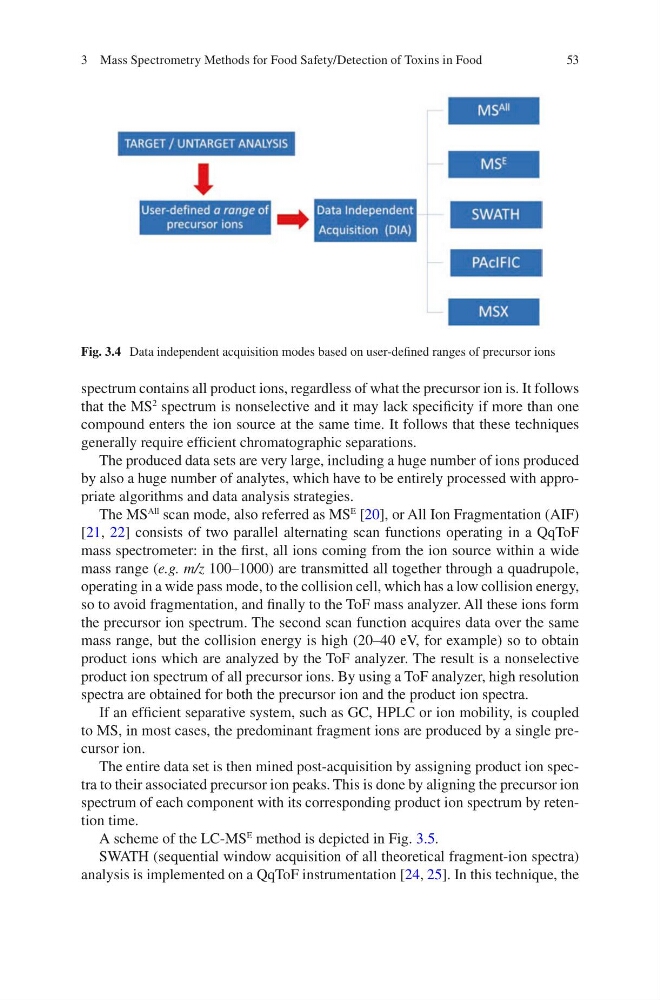
Fig. 3.4 Data independent acquisition modes based on user-defined ranges of precursor ions
3 Mass Spectrometry Methods for Food Safety/Detection of Toxins in Food
spectrum contains all product ions, regardless of what the precursor ion is. It follows
that the MS
2
spectrum is nonselective and it may lack specificity if more than one
compound enters the ion source at the same time. It follows that these techniques
generally require efficient chromatographic separations.
The produced data sets are very large, including a huge number of ions produced
by also a huge number of analytes, which have to be entirely processed with appropriate algorithms and data analysis strategies.
The MS
All
scan mode, also referred as MS
E
[20], or All Ion Fragmentation (AIF)
[21, 22] consists of two parallel alternating scan functions operating in a QqToF
mass spectrometer: in the first, all ions coming from the ion source within a wide
mass range (e.g. m/z 100–1000) are transmitted all together through a quadrupole,
operating in a wide pass mode, to the collision cell, which has a low collision energy,
so to avoid fragmentation, and finally to the ToF mass analyzer. All these ions form
the precursor ion spectrum. The second scan function acquires data over the same
mass range, but the collision energy is high (20–40 eV, for example) so to obtain
product ions which are analyzed by the ToF analyzer. The result is a nonselective
product ion spectrum of all precursor ions. By using a ToF analyzer, high resolution
spectra are obtained for both the precursor ion and the product ion spectra.
If an efficient separative system, such as GC, HPLC or ion mobility, is coupled
to MS, in most cases, the predominant fragment ions are produced by a single precursor ion.
The entire data set is then mined post-acquisition by assigning product ion spectra to their associated precursor ion peaks. This is done by aligning the precursor ion
spectrum of each component with its corresponding product ion spectrum by retention time.
A scheme of the LC-MS
E
method is depicted in Fig. 3.5.
SWATH (sequential window acquisition of all theoretical fragment-ion spectra)
analysis is implemented on a QqToF instrumentation [24, 25]. In this technique, the
Fig. 3.4 Data independent acquisition modes based on user-defined ranges of precursor ions
3 Mass Spectrometry Methods for Food Safety/Detection of Toxins in Food