

52
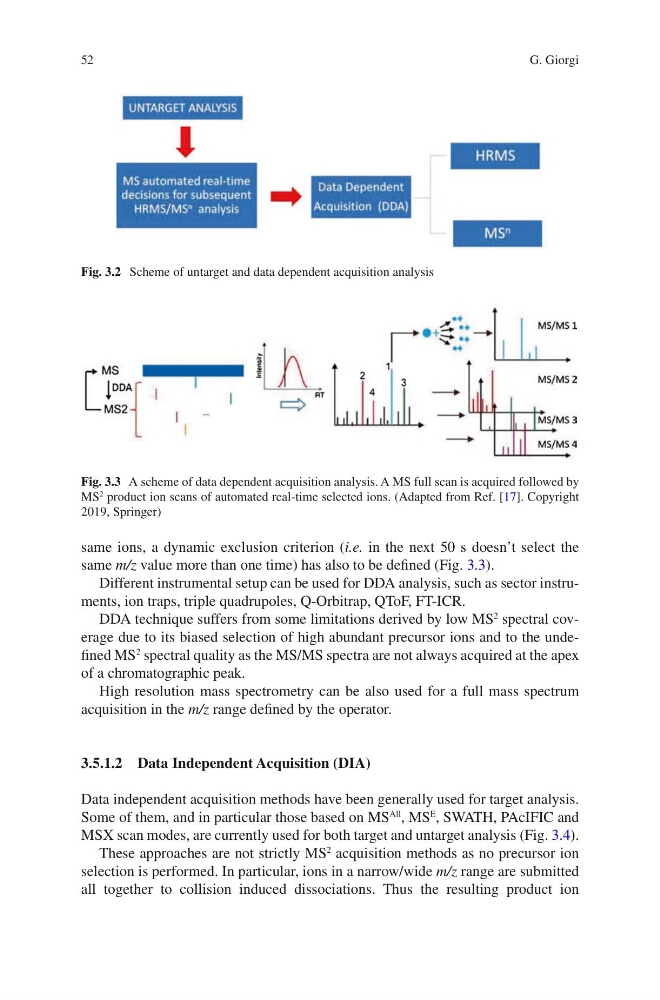
same ions, a dynamic exclusion criterion (i.e. in the next 50 s doesn’t select the
same m/z value more than one time) has also to be defined (Fig. 3.3).
Different instrumental setup can be used for DDA analysis, such as sector instruments, ion traps, triple quadrupoles, Q-Orbitrap, QToF, FT-ICR.
DDA technique suffers from some limitations derived by low MS
2
spectral coverage due to its biased selection of high abundant precursor ions and to the undefined MS
2
spectral quality as the MS/MS spectra are not always acquired at the apex
of a chromatographic peak.
High resolution mass spectrometry can be also used for a full mass spectrum
acquisition in the m/z range defined by the operator.
3.5.1.2 Data Independent Acquisition (DIA)
Data independent acquisition methods have been generally used for target analysis.
Some of them, and in particular those based on MS
All
, MS
E
, SWATH, PAcIFIC and
MSX scan modes, are currently used for both target and untarget analysis (Fig. 3.4).
These approaches are not strictly MS
2
acquisition methods as no precursor ion
selection is performed. In particular, ions in a narrow/wide m/z range are submitted
all together to collision induced dissociations. Thus the resulting product ion
Fig. 3.2 Scheme of untarget and data dependent acquisition analysis
Fig. 3.3 A scheme of data dependent acquisition analysis. A MS full scan is acquired followed by
MS
2 product ion scans of automated real-time selected ions. (Adapted from Ref. [17]. Copyright
2019, Springer)
G. Giorgi
same ions, a dynamic exclusion criterion (i.e. in the next 50 s doesn’t select the
same m/z value more than one time) has also to be defined (Fig. 3.3).
Different instrumental setup can be used for DDA analysis, such as sector instruments, ion traps, triple quadrupoles, Q-Orbitrap, QToF, FT-ICR.
DDA technique suffers from some limitations derived by low MS
2
spectral coverage due to its biased selection of high abundant precursor ions and to the undefined MS
2
spectral quality as the MS/MS spectra are not always acquired at the apex
of a chromatographic peak.
High resolution mass spectrometry can be also used for a full mass spectrum
acquisition in the m/z range defined by the operator.
3.5.1.2 Data Independent Acquisition (DIA)
Data independent acquisition methods have been generally used for target analysis.
Some of them, and in particular those based on MS
All
, MS
E
, SWATH, PAcIFIC and
MSX scan modes, are currently used for both target and untarget analysis (Fig. 3.4).
These approaches are not strictly MS
2
acquisition methods as no precursor ion
selection is performed. In particular, ions in a narrow/wide m/z range are submitted
all together to collision induced dissociations. Thus the resulting product ion
Fig. 3.2 Scheme of untarget and data dependent acquisition analysis
Fig. 3.3 A scheme of data dependent acquisition analysis. A MS full scan is acquired followed by
MS
2 product ion scans of automated real-time selected ions. (Adapted from Ref. [17]. Copyright
2019, Springer)
G. Giorgi