

39
experiment, whereas probe-target interactions have not happened, the initial RU
value relates to the initial critical angle. The difference in refractive index Δ nd arise
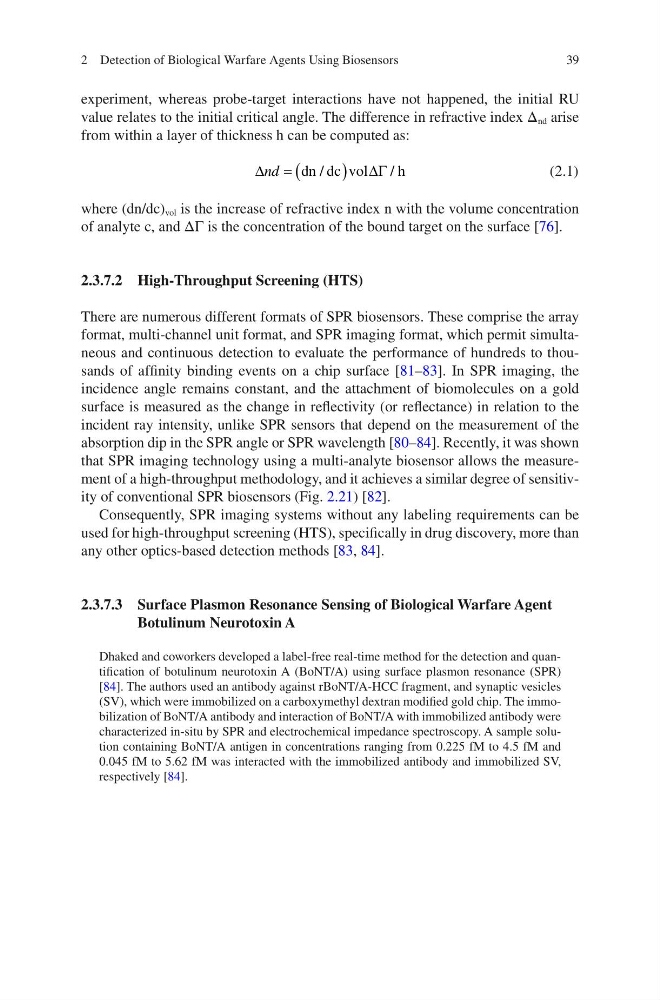
from within a layer of thickness h can be computed as:
'
' *
nd
dn dc vol
h
/
/
(2.1)
where (dn/dc) vol is the increase of refractive index n with the volume concentration
of analyte c, and ΔΓ is the concentration of the bound target on the surface [76].
2.3.7.2 High-Throughput Screening (HTS)
There are numerous different formats of SPR biosensors. These comprise the array
format, multi-channel unit format, and SPR imaging format, which permit simultaneous and continuous detection to evaluate the performance of hundreds to thousands of affinity binding events on a chip surface [81–83]. In SPR imaging, the
incidence angle remains constant, and the attachment of biomolecules on a gold
surface is measured as the change in reflectivity (or reflectance) in relation to the
incident ray intensity, unlike SPR sensors that depend on the measurement of the
absorption dip in the SPR angle or SPR wavelength [80–84]. Recently, it was shown
that SPR imaging technology using a multi-analyte biosensor allows the measurement of a high-throughput methodology, and it achieves a similar degree of sensitivity of conventional SPR biosensors (Fig. 2.21) [82].
Consequently, SPR imaging systems without any labeling requirements can be
used for high-throughput screening (HTS), specifically in drug discovery, more than
any other optics-based detection methods [83, 84].
2.3.7.3 Surface Plasmon Resonance Sensing of Biological Warfare Agent
Botulinum Neurotoxin A
Dhaked and coworkers developed a label-free real-time method for the detection and quantification of botulinum neurotoxin A (BoNT/A) using surface plasmon resonance (SPR)
[84]. The authors used an antibody against rBoNT/A-HCC fragment, and synaptic vesicles
(SV), which were immobilized on a carboxymethyl dextran modified gold chip. The immobilization of BoNT/A antibody and interaction of BoNT/A with immobilized antibody were
characterized in-situ by SPR and electrochemical impedance spectroscopy. A sample solution containing BoNT/A antigen in concentrations ranging from 0.225 fM to 4.5 fM and
0.045 fM to 5.62 fM was interacted with the immobilized antibody and immobilized SV,
respectively [84].
2 Detection of Biological Warfare Agents Using Biosensors
experiment, whereas probe-target interactions have not happened, the initial RU
value relates to the initial critical angle. The difference in refractive index Δ nd arise
from within a layer of thickness h can be computed as:
'
' *
nd
dn dc vol
h
/
/
(2.1)
where (dn/dc) vol is the increase of refractive index n with the volume concentration
of analyte c, and ΔΓ is the concentration of the bound target on the surface [76].
2.3.7.2 High-Throughput Screening (HTS)
There are numerous different formats of SPR biosensors. These comprise the array
format, multi-channel unit format, and SPR imaging format, which permit simultaneous and continuous detection to evaluate the performance of hundreds to thousands of affinity binding events on a chip surface [81–83]. In SPR imaging, the
incidence angle remains constant, and the attachment of biomolecules on a gold
surface is measured as the change in reflectivity (or reflectance) in relation to the
incident ray intensity, unlike SPR sensors that depend on the measurement of the
absorption dip in the SPR angle or SPR wavelength [80–84]. Recently, it was shown
that SPR imaging technology using a multi-analyte biosensor allows the measurement of a high-throughput methodology, and it achieves a similar degree of sensitivity of conventional SPR biosensors (Fig. 2.21) [82].
Consequently, SPR imaging systems without any labeling requirements can be
used for high-throughput screening (HTS), specifically in drug discovery, more than
any other optics-based detection methods [83, 84].
2.3.7.3 Surface Plasmon Resonance Sensing of Biological Warfare Agent
Botulinum Neurotoxin A
Dhaked and coworkers developed a label-free real-time method for the detection and quantification of botulinum neurotoxin A (BoNT/A) using surface plasmon resonance (SPR)
[84]. The authors used an antibody against rBoNT/A-HCC fragment, and synaptic vesicles
(SV), which were immobilized on a carboxymethyl dextran modified gold chip. The immobilization of BoNT/A antibody and interaction of BoNT/A with immobilized antibody were
characterized in-situ by SPR and electrochemical impedance spectroscopy. A sample solution containing BoNT/A antigen in concentrations ranging from 0.225 fM to 4.5 fM and
0.045 fM to 5.62 fM was interacted with the immobilized antibody and immobilized SV,
respectively [84].
2 Detection of Biological Warfare Agents Using Biosensors