

30
2.3.5.2 Toxin Detection
A novel effective method described by Petrovick et al. for the immobilization of a
toxin was to obtain it on beads coated with antibodies against that specific toxin
[58]. The antibody-coated beads were then incubated in a solution containing the
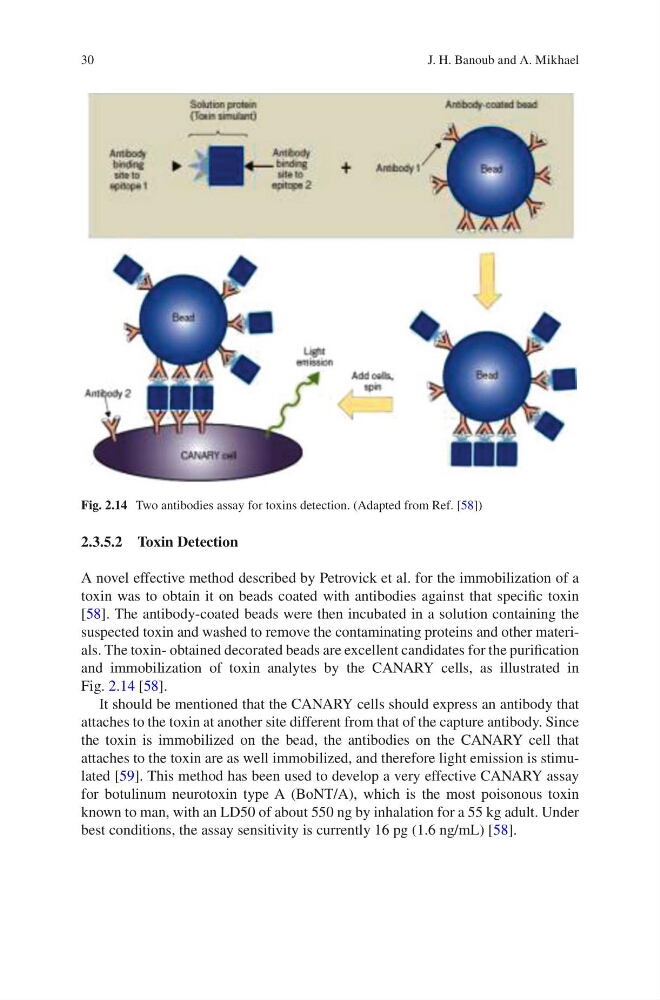
suspected toxin and washed to remove the contaminating proteins and other materials. The toxin- obtained decorated beads are excellent candidates for the purification
and immobilization of toxin analytes by the CANARY cells, as illustrated in
Fig. 2.14 [58].
It should be mentioned that the CANARY cells should express an antibody that
attaches to the toxin at another site different from that of the capture antibody. Since
the toxin is immobilized on the bead, the antibodies on the CANARY cell that
attaches to the toxin are as well immobilized, and therefore light emission is stimulated [59]. This method has been used to develop a very effective CANARY assay
for botulinum neurotoxin type A (BoNT/A), which is the most poisonous toxin
known to man, with an LD50 of about 550 ng by inhalation for a 55 kg adult. Under
best conditions, the assay sensitivity is currently 16 pg (1.6 ng/mL) [58].
Fig. 2.14 Two antibodies assay for toxins detection. (Adapted from Ref. [58])
J. H. Banoub and A. Mikhael
2.3.5.2 Toxin Detection
A novel effective method described by Petrovick et al. for the immobilization of a
toxin was to obtain it on beads coated with antibodies against that specific toxin
[58]. The antibody-coated beads were then incubated in a solution containing the
suspected toxin and washed to remove the contaminating proteins and other materials. The toxin- obtained decorated beads are excellent candidates for the purification
and immobilization of toxin analytes by the CANARY cells, as illustrated in
Fig. 2.14 [58].
It should be mentioned that the CANARY cells should express an antibody that
attaches to the toxin at another site different from that of the capture antibody. Since
the toxin is immobilized on the bead, the antibodies on the CANARY cell that
attaches to the toxin are as well immobilized, and therefore light emission is stimulated [59]. This method has been used to develop a very effective CANARY assay
for botulinum neurotoxin type A (BoNT/A), which is the most poisonous toxin
known to man, with an LD50 of about 550 ng by inhalation for a 55 kg adult. Under
best conditions, the assay sensitivity is currently 16 pg (1.6 ng/mL) [58].
Fig. 2.14 Two antibodies assay for toxins detection. (Adapted from Ref. [58])
J. H. Banoub and A. Mikhael