

29
pathogen to the cell surface antibodies causes an increase in intracellular Ca levels,
resulting in the emission of light from the cytosolic aequorin [59–63].
Two regular genetic modifications enable engineered B-cell lines to express
cytosolic aequorin, as well as membrane-bound antibodies specific for pathogens of
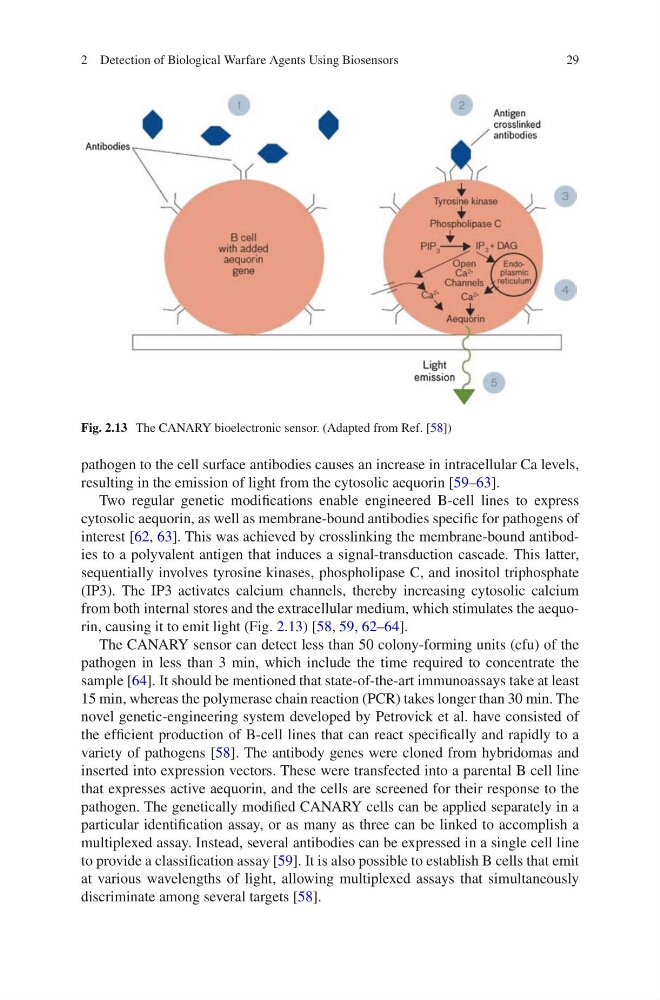
interest [62, 63]. This was achieved by crosslinking the membrane-bound antibodies to a polyvalent antigen that induces a signal-transduction cascade. This latter,
sequentially involves tyrosine kinases, phospholipase C, and inositol triphosphate
(IP3). The IP3 activates calcium channels, thereby increasing cytosolic calcium
from both internal stores and the extracellular medium, which stimulates the aequorin, causing it to emit light (Fig. 2.13) [58, 59, 62–64].
The CANARY sensor can detect less than 50 colony-forming units (cfu) of the
pathogen in less than 3 min, which include the time required to concentrate the
sample [64]. It should be mentioned that state-of-the-art immunoassays take at least
15 min, whereas the polymerase chain reaction (PCR) takes longer than 30 min. The
novel genetic-engineering system developed by Petrovick et al. have consisted of
the efficient production of B-cell lines that can react specifically and rapidly to a
variety of pathogens [58]. The antibody genes were cloned from hybridomas and
inserted into expression vectors. These were transfected into a parental B cell line
that expresses active aequorin, and the cells are screened for their response to the
pathogen. The genetically modified CANARY cells can be applied separately in a
particular identification assay, or as many as three can be linked to accomplish a
multiplexed assay. Instead, several antibodies can be expressed in a single cell line
to provide a classification assay [59]. It is also possible to establish B cells that emit
at various wavelengths of light, allowing multiplexed assays that simultaneously
discriminate among several targets [58].
Fig. 2.13 The CANARY bioelectronic sensor. (Adapted from Ref. [58])
2 Detection of Biological Warfare Agents Using Biosensors
pathogen to the cell surface antibodies causes an increase in intracellular Ca levels,
resulting in the emission of light from the cytosolic aequorin [59–63].
Two regular genetic modifications enable engineered B-cell lines to express
cytosolic aequorin, as well as membrane-bound antibodies specific for pathogens of
interest [62, 63]. This was achieved by crosslinking the membrane-bound antibodies to a polyvalent antigen that induces a signal-transduction cascade. This latter,
sequentially involves tyrosine kinases, phospholipase C, and inositol triphosphate
(IP3). The IP3 activates calcium channels, thereby increasing cytosolic calcium
from both internal stores and the extracellular medium, which stimulates the aequorin, causing it to emit light (Fig. 2.13) [58, 59, 62–64].
The CANARY sensor can detect less than 50 colony-forming units (cfu) of the
pathogen in less than 3 min, which include the time required to concentrate the
sample [64]. It should be mentioned that state-of-the-art immunoassays take at least
15 min, whereas the polymerase chain reaction (PCR) takes longer than 30 min. The
novel genetic-engineering system developed by Petrovick et al. have consisted of
the efficient production of B-cell lines that can react specifically and rapidly to a
variety of pathogens [58]. The antibody genes were cloned from hybridomas and
inserted into expression vectors. These were transfected into a parental B cell line
that expresses active aequorin, and the cells are screened for their response to the
pathogen. The genetically modified CANARY cells can be applied separately in a
particular identification assay, or as many as three can be linked to accomplish a
multiplexed assay. Instead, several antibodies can be expressed in a single cell line
to provide a classification assay [59]. It is also possible to establish B cells that emit
at various wavelengths of light, allowing multiplexed assays that simultaneously
discriminate among several targets [58].
Fig. 2.13 The CANARY bioelectronic sensor. (Adapted from Ref. [58])
2 Detection of Biological Warfare Agents Using Biosensors