

31
2.3.5.3 Detection of the DNA Sequence
The detection of soluble macromolecules has another remarkable application,
which is the identification of DNA and RNA sequences. The capability to identify
nucleic acid (NA: DNA or RNA) sequences is central in the deduction of the first
hard NA sequence information, concerning a new or genetically modified pathogen
[58]. It is crucial to develop assays that have the flexibility to respond quickly to
new threats. For this reason, developing NA probes allow for the rapid and quick
examination of the actual genetics of the target organism [58]. When the NA
sequence of a pathogen is revealed, multiple short probes are created that bind
adjacent to each other along a specific sequence on the target NA [59]. Consequently,
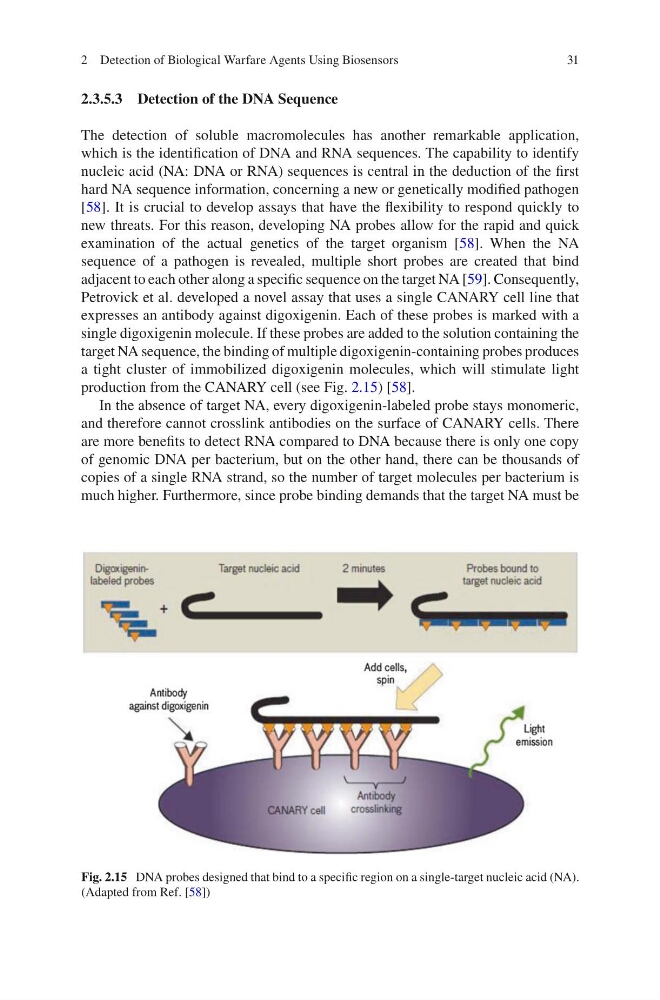
Petrovick et al. developed a novel assay that uses a single CANARY cell line that
expresses an antibody against digoxigenin. Each of these probes is marked with a
single digoxigenin molecule. If these probes are added to the solution containing the
target NA sequence, the binding of multiple digoxigenin-containing probes produces
a tight cluster of immobilized digoxigenin molecules, which will stimulate light
production from the CANARY cell (see Fig. 2.15) [58].
In the absence of target NA, every digoxigenin-labeled probe stays monomeric,
and therefore cannot crosslink antibodies on the surface of CANARY cells. There
are more benefits to detect RNA compared to DNA because there is only one copy
of genomic DNA per bacterium, but on the other hand, there can be thousands of
copies of a single RNA strand, so the number of target molecules per bacterium is
much higher. Furthermore, since probe binding demands that the target NA must be
Fig. 2.15 DNA probes designed that bind to a specific region on a single-target nucleic acid (NA).
(Adapted from Ref. [58])
2 Detection of Biological Warfare Agents Using Biosensors
2.3.5.3 Detection of the DNA Sequence
The detection of soluble macromolecules has another remarkable application,
which is the identification of DNA and RNA sequences. The capability to identify
nucleic acid (NA: DNA or RNA) sequences is central in the deduction of the first
hard NA sequence information, concerning a new or genetically modified pathogen
[58]. It is crucial to develop assays that have the flexibility to respond quickly to
new threats. For this reason, developing NA probes allow for the rapid and quick
examination of the actual genetics of the target organism [58]. When the NA
sequence of a pathogen is revealed, multiple short probes are created that bind
adjacent to each other along a specific sequence on the target NA [59]. Consequently,
Petrovick et al. developed a novel assay that uses a single CANARY cell line that
expresses an antibody against digoxigenin. Each of these probes is marked with a
single digoxigenin molecule. If these probes are added to the solution containing the
target NA sequence, the binding of multiple digoxigenin-containing probes produces
a tight cluster of immobilized digoxigenin molecules, which will stimulate light
production from the CANARY cell (see Fig. 2.15) [58].
In the absence of target NA, every digoxigenin-labeled probe stays monomeric,
and therefore cannot crosslink antibodies on the surface of CANARY cells. There
are more benefits to detect RNA compared to DNA because there is only one copy
of genomic DNA per bacterium, but on the other hand, there can be thousands of
copies of a single RNA strand, so the number of target molecules per bacterium is
much higher. Furthermore, since probe binding demands that the target NA must be
Fig. 2.15 DNA probes designed that bind to a specific region on a single-target nucleic acid (NA).
(Adapted from Ref. [58])
2 Detection of Biological Warfare Agents Using Biosensors