

20
sensing platform for the sensing of infectious agents. The obtainable sensitivity
approached 1 bacterium∕μL-a clinically acceptable limit-and the AMPs allowed for
sufficient selectivity to differentiate pathogenic and Gram-negative bacteria while
retaining broadband detection capabilities [25–28]. In addition, the simulated water
sampling chip, which consisted of a microfluidic flow cell integrated onto the hybrid
sensor, demonstrated the potential of real-time on-chip monitoring of the interaction
of E. coli cells with the antimicrobial peptides [25].
2.3.2 NRL Array Biosensor for Toxin Detection
This following part discusses the progress made with the NRL Array Biosensor,
which is a portable device for rapid and simultaneous detection of multiple targets,
which was developed, automated and miniaturized for operation at the point-of-use
by the US Navy Research Laboratories. This Array Biosensor has been used for the
quantitative immunoassays versus a broad number of toxins, and for its usefulness
as semi-selective molecules which can be used as alternative recognition moieties
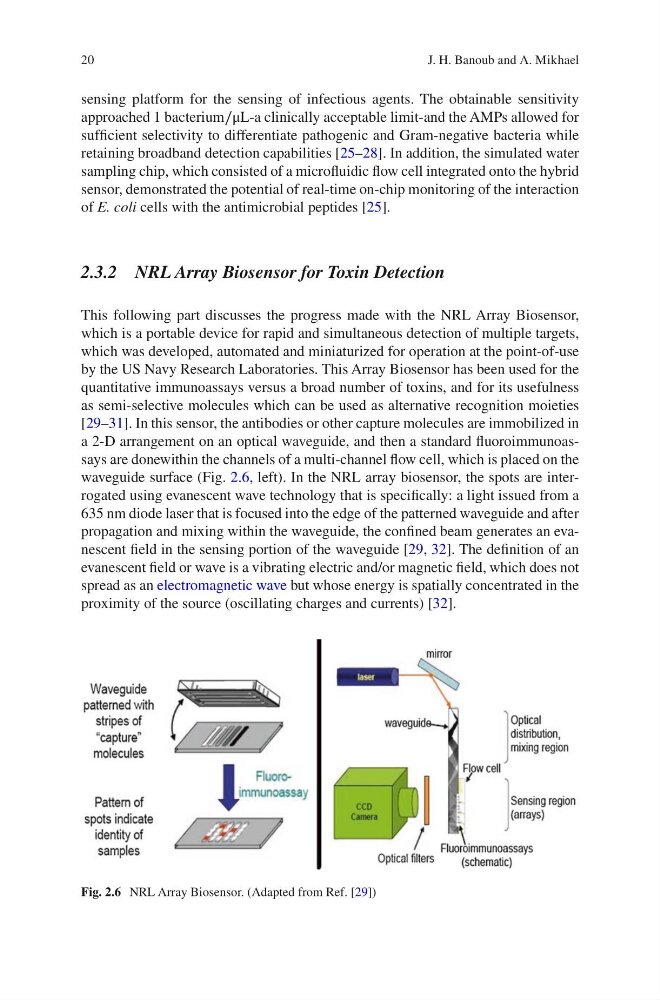
[29–31]. In this sensor, the antibodies or other capture molecules are immobilized in
a 2-D arrangement on an optical waveguide, and then a standard fluoroimmunoassays are donewithin the channels of a multi-channel flow cell, which is placed on the
waveguide surface (Fig. 2.6, left). In the NRL array biosensor, the spots are interrogated using evanescent wave technology that is specifically: a light issued from a
635 nm diode laser that is focused into the edge of the patterned waveguide and after
propagation and mixing within the waveguide, the confined beam generates an evanescent field in the sensing portion of the waveguide [29, 32]. The definition of an
evanescent field or wave is a vibrating electric and/or magnetic field, which does not
spread as an electromagnetic wave but whose energy is spatially concentrated in the
proximity of the source (oscillating charges and currents) [32].
Fig. 2.6 NRL Array Biosensor. (Adapted from Ref. [29])
J. H. Banoub and A. Mikhael
sensing platform for the sensing of infectious agents. The obtainable sensitivity
approached 1 bacterium∕μL-a clinically acceptable limit-and the AMPs allowed for
sufficient selectivity to differentiate pathogenic and Gram-negative bacteria while
retaining broadband detection capabilities [25–28]. In addition, the simulated water
sampling chip, which consisted of a microfluidic flow cell integrated onto the hybrid
sensor, demonstrated the potential of real-time on-chip monitoring of the interaction
of E. coli cells with the antimicrobial peptides [25].
2.3.2 NRL Array Biosensor for Toxin Detection
This following part discusses the progress made with the NRL Array Biosensor,
which is a portable device for rapid and simultaneous detection of multiple targets,
which was developed, automated and miniaturized for operation at the point-of-use
by the US Navy Research Laboratories. This Array Biosensor has been used for the
quantitative immunoassays versus a broad number of toxins, and for its usefulness
as semi-selective molecules which can be used as alternative recognition moieties
[29–31]. In this sensor, the antibodies or other capture molecules are immobilized in
a 2-D arrangement on an optical waveguide, and then a standard fluoroimmunoassays are donewithin the channels of a multi-channel flow cell, which is placed on the
waveguide surface (Fig. 2.6, left). In the NRL array biosensor, the spots are interrogated using evanescent wave technology that is specifically: a light issued from a
635 nm diode laser that is focused into the edge of the patterned waveguide and after
propagation and mixing within the waveguide, the confined beam generates an evanescent field in the sensing portion of the waveguide [29, 32]. The definition of an
evanescent field or wave is a vibrating electric and/or magnetic field, which does not
spread as an electromagnetic wave but whose energy is spatially concentrated in the
proximity of the source (oscillating charges and currents) [32].
Fig. 2.6 NRL Array Biosensor. (Adapted from Ref. [29])
J. H. Banoub and A. Mikhael