

17
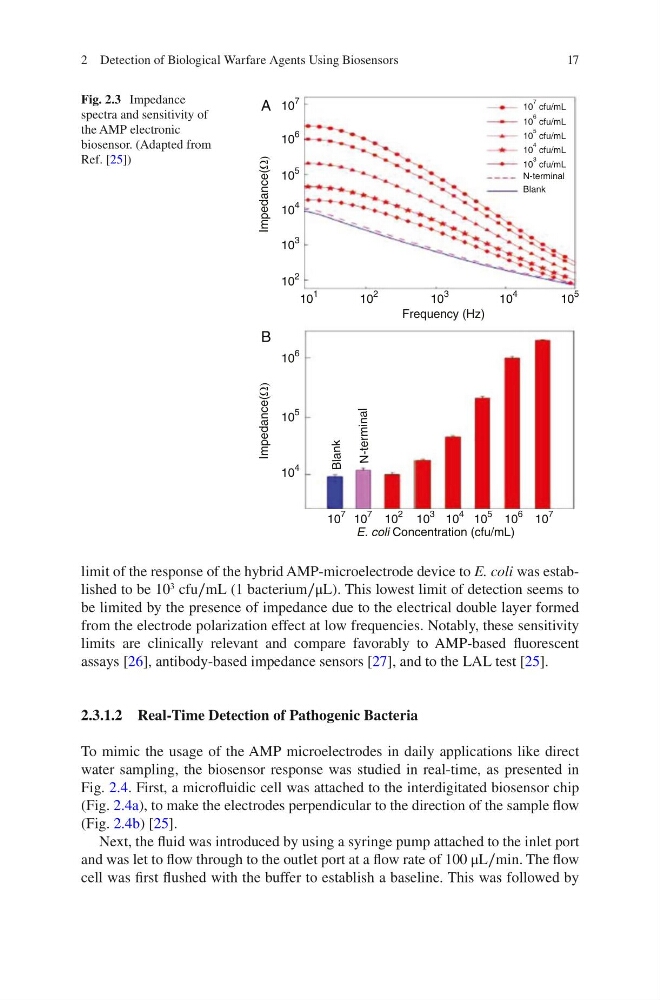
limit of the response of the hybrid AMP-microelectrode device to E. coli was established to be 10
3
cfu∕mL (1 bacterium∕μL). This lowest limit of detection seems to
be limited by the presence of impedance due to the electrical double layer formed
from the electrode polarization effect at low frequencies. Notably, these sensitivity
limits are clinically relevant and compare favorably to AMP-based fluorescent
assays [26], antibody-based impedance sensors [27], and to the LAL test [25].
2.3.1.2 Real-Time Detection of Pathogenic Bacteria
To mimic the usage of the AMP microelectrodes in daily applications like direct
water sampling, the biosensor response was studied in real-time, as presented in
Fig. 2.4. First, a microfluidic cell was attached to the interdigitated biosensor chip
(Fig. 2.4a), to make the electrodes perpendicular to the direction of the sample flow
(Fig. 2.4b) [25].
Next, the fluid was introduced by using a syringe pump attached to the inlet port
and was let to flow through to the outlet port at a flow rate of 100 μL∕min. The flow
cell was first flushed with the buffer to establish a baseline. This was followed by
10
7
10
7 10
7 10
2 10
3 10
4 10
5 10
6 10
7
10
6
10
6
10
5
10
5
10
4
10
4
10
3
10
2
10
1
10
2
10
3
10
4
10
5
10
7 cfu/mL
10
6 cfu/mL
10
5 cfu/mL
10
4 cfu/mL
10
3 cfu/mL
N-terminal
Blank
Frequency (Hz)
E. coli Concentration (cfu/mL)
Impedance(Ω)
Impedance(Ω)
A
B
Blank
N-termin
al
Fig. 2.3 Impedance
spectra and sensitivity of
the AMP electronic
biosensor. (Adapted from
Ref. [25])
2 Detection of Biological Warfare Agents Using Biosensors
limit of the response of the hybrid AMP-microelectrode device to E. coli was established to be 10
3
cfu∕mL (1 bacterium∕μL). This lowest limit of detection seems to
be limited by the presence of impedance due to the electrical double layer formed
from the electrode polarization effect at low frequencies. Notably, these sensitivity
limits are clinically relevant and compare favorably to AMP-based fluorescent
assays [26], antibody-based impedance sensors [27], and to the LAL test [25].
2.3.1.2 Real-Time Detection of Pathogenic Bacteria
To mimic the usage of the AMP microelectrodes in daily applications like direct
water sampling, the biosensor response was studied in real-time, as presented in
Fig. 2.4. First, a microfluidic cell was attached to the interdigitated biosensor chip
(Fig. 2.4a), to make the electrodes perpendicular to the direction of the sample flow
(Fig. 2.4b) [25].
Next, the fluid was introduced by using a syringe pump attached to the inlet port
and was let to flow through to the outlet port at a flow rate of 100 μL∕min. The flow
cell was first flushed with the buffer to establish a baseline. This was followed by
10
7
10
7 10
7 10
2 10
3 10
4 10
5 10
6 10
7
10
6
10
6
10
5
10
5
10
4
10
4
10
3
10
2
10
1
10
2
10
3
10
4
10
5
10
7 cfu/mL
10
6 cfu/mL
10
5 cfu/mL
10
4 cfu/mL
10
3 cfu/mL
N-terminal
Blank
Frequency (Hz)
E. coli Concentration (cfu/mL)
Impedance(Ω)
Impedance(Ω)
A
B
Blank
N-termin
al
Fig. 2.3 Impedance
spectra and sensitivity of
the AMP electronic
biosensor. (Adapted from
Ref. [25])
2 Detection of Biological Warfare Agents Using Biosensors