

16
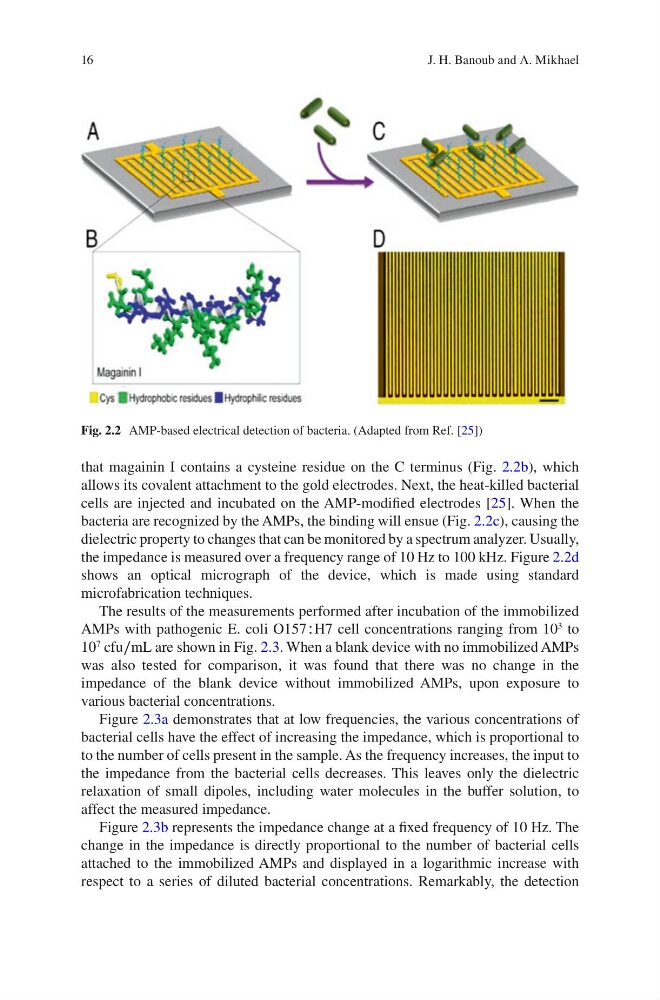
that magainin I contains a cysteine residue on the C terminus (Fig. 2.2b), which
allows its covalent attachment to the gold electrodes. Next, the heat-killed bacterial
cells are injected and incubated on the AMP-modified electrodes [25]. When the
bacteria are recognized by the AMPs, the binding will ensue (Fig. 2.2c), causing the
dielectric property to changes that can be monitored by a spectrum analyzer. Usually,
the impedance is measured over a frequency range of 10 Hz to 100 kHz. Figure 2.2d
shows an optical micrograph of the device, which is made using standard
microfabrication techniques.
The results of the measurements performed after incubation of the immobilized
AMPs with pathogenic E. coli O157∶H7 cell concentrations ranging from 10
3
to
10
7
cfu∕mL are shown in Fig. 2.3. When a blank device with no immobilized AMPs
was also tested for comparison, it was found that there was no change in the
impedance of the blank device without immobilized AMPs, upon exposure to
various bacterial concentrations.
Figure 2.3a demonstrates that at low frequencies, the various concentrations of
bacterial cells have the effect of increasing the impedance, which is proportional to
to the number of cells present in the sample. As the frequency increases, the input to
the impedance from the bacterial cells decreases. This leaves only the dielectric
relaxation of small dipoles, including water molecules in the buffer solution, to
affect the measured impedance.
Figure 2.3b represents the impedance change at a fixed frequency of 10 Hz. The
change in the impedance is directly proportional to the number of bacterial cells
attached to the immobilized AMPs and displayed in a logarithmic increase with
respect to a series of diluted bacterial concentrations. Remarkably, the detection
Fig. 2.2 AMP-based electrical detection of bacteria. (Adapted from Ref. [25])
J. H. Banoub and A. Mikhael
that magainin I contains a cysteine residue on the C terminus (Fig. 2.2b), which
allows its covalent attachment to the gold electrodes. Next, the heat-killed bacterial
cells are injected and incubated on the AMP-modified electrodes [25]. When the
bacteria are recognized by the AMPs, the binding will ensue (Fig. 2.2c), causing the
dielectric property to changes that can be monitored by a spectrum analyzer. Usually,
the impedance is measured over a frequency range of 10 Hz to 100 kHz. Figure 2.2d
shows an optical micrograph of the device, which is made using standard
microfabrication techniques.
The results of the measurements performed after incubation of the immobilized
AMPs with pathogenic E. coli O157∶H7 cell concentrations ranging from 10
3
to
10
7
cfu∕mL are shown in Fig. 2.3. When a blank device with no immobilized AMPs
was also tested for comparison, it was found that there was no change in the
impedance of the blank device without immobilized AMPs, upon exposure to
various bacterial concentrations.
Figure 2.3a demonstrates that at low frequencies, the various concentrations of
bacterial cells have the effect of increasing the impedance, which is proportional to
to the number of cells present in the sample. As the frequency increases, the input to
the impedance from the bacterial cells decreases. This leaves only the dielectric
relaxation of small dipoles, including water molecules in the buffer solution, to
affect the measured impedance.
Figure 2.3b represents the impedance change at a fixed frequency of 10 Hz. The
change in the impedance is directly proportional to the number of bacterial cells
attached to the immobilized AMPs and displayed in a logarithmic increase with
respect to a series of diluted bacterial concentrations. Remarkably, the detection
Fig. 2.2 AMP-based electrical detection of bacteria. (Adapted from Ref. [25])
J. H. Banoub and A. Mikhael