

170
10.6 Conclusion
Both the male and female male reproductive systems appear to be one of, if not
the key target of environmental toxicants. In the male, acute toxicants exposure
will have an immediate effect leading to apoptosis and necrosis of testicular cells,
but that stays relatively rare. The general public is rather exposed chronically to
sub- lethal doses [68]. Thus, chronic and low-level exposure to toxicants with very
long half-lives could cause long-term unwanted health effects in humans.
Assessing the effects of a mixture of environmental toxicants on male reproductive functions is now becoming a priority for scientists. However, these studies are
inherently difficult to perform. Thanks to recent developments in Omics technologies and quantification methods developed in IMS unique perspectives are now
open for the discovery of alterations in molecular biomarkers (e.g., proteins,
metabolites) that could help for a better understanding of toxicity mechanisms on
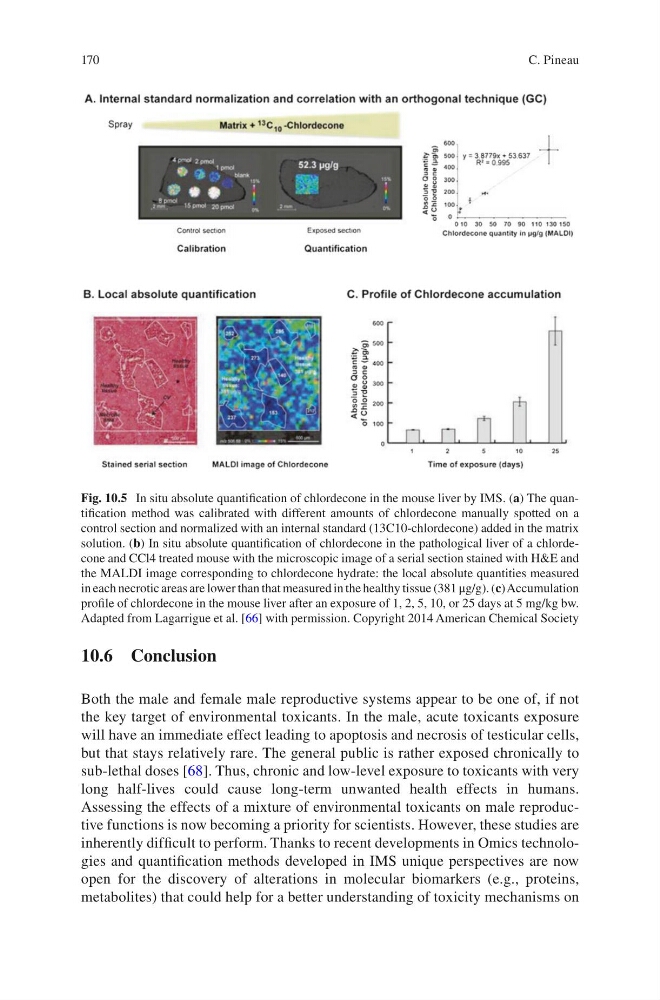
Fig. 10.5 In situ absolute quantification of chlordecone in the mouse liver by IMS. (a) The quantification method was calibrated with different amounts of chlordecone manually spotted on a
control section and normalized with an internal standard (13C10-chlordecone) added in the matrix
solution. (b) In situ absolute quantification of chlordecone in the pathological liver of a chlordecone and CCl4 treated mouse with the microscopic image of a serial section stained with H&E and
the MALDI image corresponding to chlordecone hydrate: the local absolute quantities measured
in each necrotic areas are lower than that measured in the healthy tissue (381 μg/g). (c) Accumulation
profile of chlordecone in the mouse liver after an exposure of 1, 2, 5, 10, or 25 days at 5 mg/kg bw.
Adapted from Lagarrigue et al. [66] with permission. Copyright 2014 American Chemical Society
C. Pineau
10.6 Conclusion
Both the male and female male reproductive systems appear to be one of, if not
the key target of environmental toxicants. In the male, acute toxicants exposure
will have an immediate effect leading to apoptosis and necrosis of testicular cells,
but that stays relatively rare. The general public is rather exposed chronically to
sub- lethal doses [68]. Thus, chronic and low-level exposure to toxicants with very
long half-lives could cause long-term unwanted health effects in humans.
Assessing the effects of a mixture of environmental toxicants on male reproductive functions is now becoming a priority for scientists. However, these studies are
inherently difficult to perform. Thanks to recent developments in Omics technologies and quantification methods developed in IMS unique perspectives are now
open for the discovery of alterations in molecular biomarkers (e.g., proteins,
metabolites) that could help for a better understanding of toxicity mechanisms on
Fig. 10.5 In situ absolute quantification of chlordecone in the mouse liver by IMS. (a) The quantification method was calibrated with different amounts of chlordecone manually spotted on a
control section and normalized with an internal standard (13C10-chlordecone) added in the matrix
solution. (b) In situ absolute quantification of chlordecone in the pathological liver of a chlordecone and CCl4 treated mouse with the microscopic image of a serial section stained with H&E and
the MALDI image corresponding to chlordecone hydrate: the local absolute quantities measured
in each necrotic areas are lower than that measured in the healthy tissue (381 μg/g). (c) Accumulation
profile of chlordecone in the mouse liver after an exposure of 1, 2, 5, 10, or 25 days at 5 mg/kg bw.
Adapted from Lagarrigue et al. [66] with permission. Copyright 2014 American Chemical Society
C. Pineau