

149
phospholipids in the membrane removing the polar head group of the phospholipid.
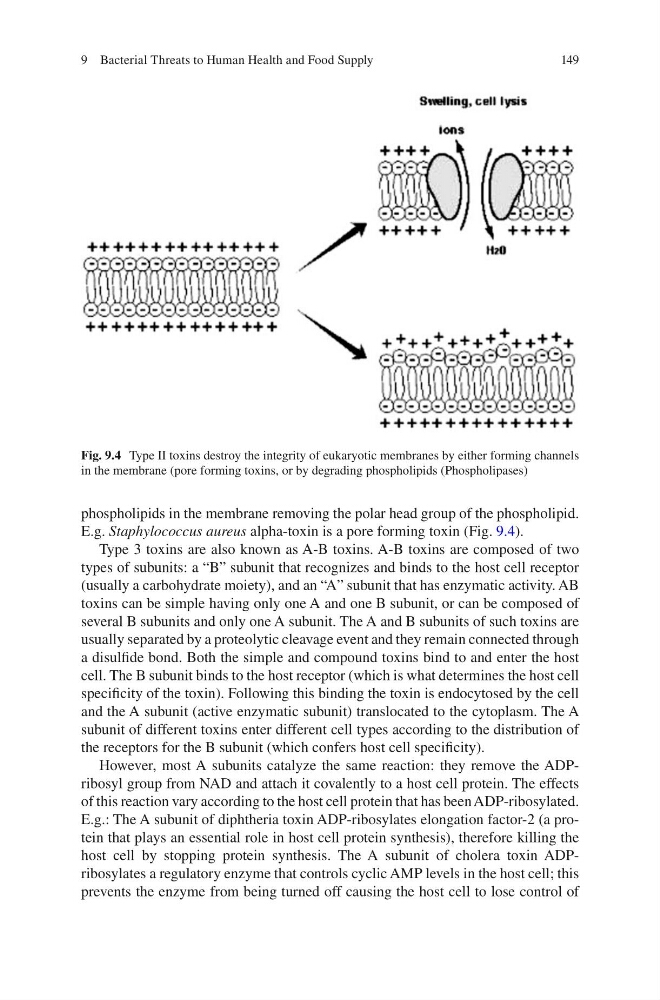
E.g. Staphylococcus aureus alpha-toxin is a pore forming toxin (Fig. 9.4).
Type 3 toxins are also known as A-B toxins. A-B toxins are composed of two
types of subunits: a “B” subunit that recognizes and binds to the host cell receptor
(usually a carbohydrate moiety), and an “A” subunit that has enzymatic activity. AB
toxins can be simple having only one A and one B subunit, or can be composed of
several B subunits and only one A subunit. The A and B subunits of such toxins are
usually separated by a proteolytic cleavage event and they remain connected through
a disulfide bond. Both the simple and compound toxins bind to and enter the host
cell. The B subunit binds to the host receptor (which is what determines the host cell
specificity of the toxin). Following this binding the toxin is endocytosed by the cell
and the A subunit (active enzymatic subunit) translocated to the cytoplasm. The A
subunit of different toxins enter different cell types according to the distribution of
the receptors for the B subunit (which confers host cell specificity).
However, most A subunits catalyze the same reaction: they remove the ADPribosyl group from NAD and attach it covalently to a host cell protein. The effects
of this reaction vary according to the host cell protein that has been ADP-ribosylated.
E.g.: The A subunit of diphtheria toxin ADP-ribosylates elongation factor-2 (a protein that plays an essential role in host cell protein synthesis), therefore killing the
host cell by stopping protein synthesis. The A subunit of cholera toxin ADPribosylates a regulatory enzyme that controls cyclic AMP levels in the host cell; this
prevents the enzyme from being turned off causing the host cell to lose control of
Fig. 9.4 Type II toxins destroy the integrity of eukaryotic membranes by either forming channels
in the membrane (pore forming toxins, or by degrading phospholipids (Phospholipases)
9 Bacterial Threats to Human Health and Food Supply
phospholipids in the membrane removing the polar head group of the phospholipid.
E.g. Staphylococcus aureus alpha-toxin is a pore forming toxin (Fig. 9.4).
Type 3 toxins are also known as A-B toxins. A-B toxins are composed of two
types of subunits: a “B” subunit that recognizes and binds to the host cell receptor
(usually a carbohydrate moiety), and an “A” subunit that has enzymatic activity. AB
toxins can be simple having only one A and one B subunit, or can be composed of
several B subunits and only one A subunit. The A and B subunits of such toxins are
usually separated by a proteolytic cleavage event and they remain connected through
a disulfide bond. Both the simple and compound toxins bind to and enter the host
cell. The B subunit binds to the host receptor (which is what determines the host cell
specificity of the toxin). Following this binding the toxin is endocytosed by the cell
and the A subunit (active enzymatic subunit) translocated to the cytoplasm. The A
subunit of different toxins enter different cell types according to the distribution of
the receptors for the B subunit (which confers host cell specificity).
However, most A subunits catalyze the same reaction: they remove the ADPribosyl group from NAD and attach it covalently to a host cell protein. The effects
of this reaction vary according to the host cell protein that has been ADP-ribosylated.
E.g.: The A subunit of diphtheria toxin ADP-ribosylates elongation factor-2 (a protein that plays an essential role in host cell protein synthesis), therefore killing the
host cell by stopping protein synthesis. The A subunit of cholera toxin ADPribosylates a regulatory enzyme that controls cyclic AMP levels in the host cell; this
prevents the enzyme from being turned off causing the host cell to lose control of
Fig. 9.4 Type II toxins destroy the integrity of eukaryotic membranes by either forming channels
in the membrane (pore forming toxins, or by degrading phospholipids (Phospholipases)
9 Bacterial Threats to Human Health and Food Supply