

148
diphteria toxin, cholerae toxin, Shiga toxin) and plasmids (e.g. heat stable toxin and
heat labile toxin from enterotoxigenic E. coli).
There are three main types of bacterial toxins, classified in Toxins 1–3 according
to the location of their target in the host cells:
Type I toxins bind to targets on cell surface and are not translocated into the cell.
E.g. superantigens. Superantigens bind to the Major Histocompatibility Complex
(MHC) class II of macrophages and the receptors on T cells that interact with
MHC. In a normal scenario, macrophages process protein antigens by cleaving
them into peptides and display one of these resulting peptides in a complex with
MHC class II on the macrophage surface. This peptide-MHC class II complex is
recognized by few helper T cells, which have receptors able to recognize it.
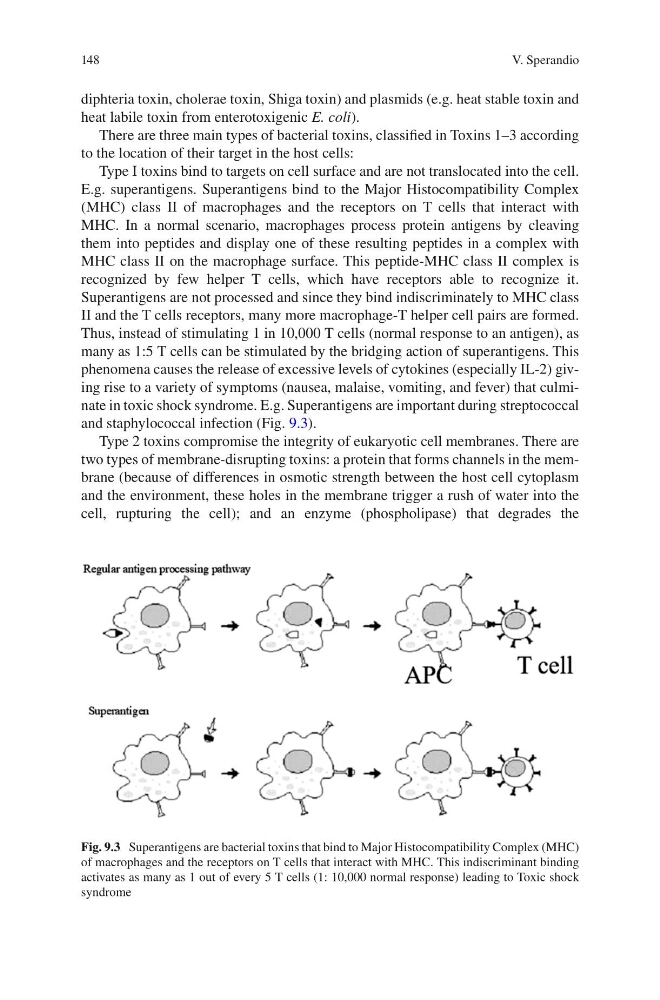
Superantigens are not processed and since they bind indiscriminately to MHC class
II and the T cells receptors, many more macrophage-T helper cell pairs are formed.
Thus, instead of stimulating 1 in 10,000 T cells (normal response to an antigen), as
many as 1:5 T cells can be stimulated by the bridging action of superantigens. This
phenomena causes the release of excessive levels of cytokines (especially IL-2) giving rise to a variety of symptoms (nausea, malaise, vomiting, and fever) that culminate in toxic shock syndrome. E.g. Superantigens are important during streptococcal
and staphylococcal infection (Fig. 9.3).
Type 2 toxins compromise the integrity of eukaryotic cell membranes. There are
two types of membrane-disrupting toxins: a protein that forms channels in the membrane (because of differences in osmotic strength between the host cell cytoplasm
and the environment, these holes in the membrane trigger a rush of water into the
cell, rupturing the cell); and an enzyme (phospholipase) that degrades the
Fig. 9.3 Superantigens are bacterial toxins that bind to Major Histocompatibility Complex (MHC)
of macrophages and the receptors on T cells that interact with MHC. This indiscriminant binding
activates as many as 1 out of every 5 T cells (1: 10,000 normal response) leading to Toxic shock
syndrome
V. Sperandio
diphteria toxin, cholerae toxin, Shiga toxin) and plasmids (e.g. heat stable toxin and
heat labile toxin from enterotoxigenic E. coli).
There are three main types of bacterial toxins, classified in Toxins 1–3 according
to the location of their target in the host cells:
Type I toxins bind to targets on cell surface and are not translocated into the cell.
E.g. superantigens. Superantigens bind to the Major Histocompatibility Complex
(MHC) class II of macrophages and the receptors on T cells that interact with
MHC. In a normal scenario, macrophages process protein antigens by cleaving
them into peptides and display one of these resulting peptides in a complex with
MHC class II on the macrophage surface. This peptide-MHC class II complex is
recognized by few helper T cells, which have receptors able to recognize it.
Superantigens are not processed and since they bind indiscriminately to MHC class
II and the T cells receptors, many more macrophage-T helper cell pairs are formed.
Thus, instead of stimulating 1 in 10,000 T cells (normal response to an antigen), as
many as 1:5 T cells can be stimulated by the bridging action of superantigens. This
phenomena causes the release of excessive levels of cytokines (especially IL-2) giving rise to a variety of symptoms (nausea, malaise, vomiting, and fever) that culminate in toxic shock syndrome. E.g. Superantigens are important during streptococcal
and staphylococcal infection (Fig. 9.3).
Type 2 toxins compromise the integrity of eukaryotic cell membranes. There are
two types of membrane-disrupting toxins: a protein that forms channels in the membrane (because of differences in osmotic strength between the host cell cytoplasm
and the environment, these holes in the membrane trigger a rush of water into the
cell, rupturing the cell); and an enzyme (phospholipase) that degrades the
Fig. 9.3 Superantigens are bacterial toxins that bind to Major Histocompatibility Complex (MHC)
of macrophages and the receptors on T cells that interact with MHC. This indiscriminant binding
activates as many as 1 out of every 5 T cells (1: 10,000 normal response) leading to Toxic shock
syndrome
V. Sperandio