

150
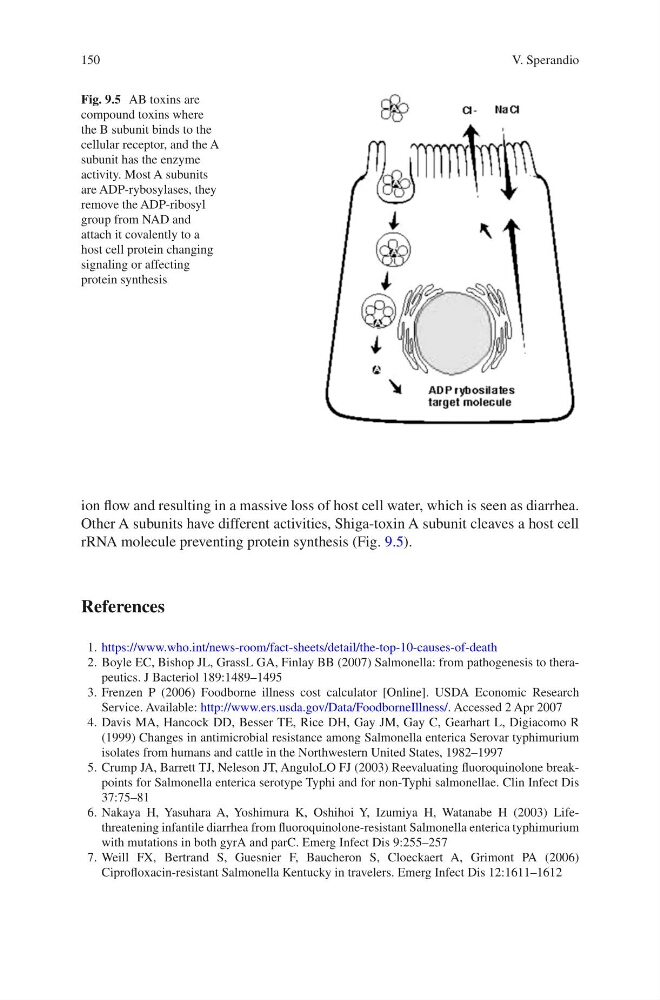
ion flow and resulting in a massive loss of host cell water, which is seen as diarrhea.
Other A subunits have different activities, Shiga-toxin A subunit cleaves a host cell
rRNA molecule preventing protein synthesis (Fig. 9.5).
References
1. https://www.who.int/news-room/fact-sheets/detail/the-top-10-causes-of-death
2. Boyle EC, Bishop JL, GrassL GA, Finlay BB (2007) Salmonella: from pathogenesis to therapeutics. J Bacteriol 189:1489–1495
3. Frenzen P (2006) Foodborne illness cost calculator [Online]. USDA Economic Research
Service. Available: http://www.ers.usda.gov/Data/FoodborneIllness/. Accessed 2 Apr 2007
4. Davis MA, Hancock DD, Besser TE, Rice DH, Gay JM, Gay C, Gearhart L, Digiacomo R
(1999) Changes in antimicrobial resistance among Salmonella enterica Serovar typhimurium
isolates from humans and cattle in the Northwestern United States, 1982–1997
5. Crump JA, Barrett TJ, Neleson JT, AnguloLO FJ (2003) Reevaluating fluoroquinolone breakpoints for Salmonella enterica serotype Typhi and for non-Typhi salmonellae. Clin Infect Dis
37:75–81
6. Nakaya H, Yasuhara A, Yoshimura K, Oshihoi Y, Izumiya H, Watanabe H (2003) Lifethreatening infantile diarrhea from fluoroquinolone-resistant Salmonella enterica typhimurium
with mutations in both gyrA and parC. Emerg Infect Dis 9:255–257
7. Weill FX, Bertrand S, Guesnier F, Baucheron S, Cloeckaert A, Grimont PA (2006)
Ciprofloxacin-resistant Salmonella Kentucky in travelers. Emerg Infect Dis 12:1611–1612
Fig. 9.5 AB toxins are
compound toxins where
the B subunit binds to the
cellular receptor, and the A
subunit has the enzyme
activity. Most A subunits
are ADP- rybosylases, they
remove the ADP-ribosyl
group from NAD and
attach it covalently to a
host cell protein changing
signaling or affecting
protein synthesis
V. Sperandio
ion flow and resulting in a massive loss of host cell water, which is seen as diarrhea.
Other A subunits have different activities, Shiga-toxin A subunit cleaves a host cell
rRNA molecule preventing protein synthesis (Fig. 9.5).
References
1. https://www.who.int/news-room/fact-sheets/detail/the-top-10-causes-of-death
2. Boyle EC, Bishop JL, GrassL GA, Finlay BB (2007) Salmonella: from pathogenesis to therapeutics. J Bacteriol 189:1489–1495
3. Frenzen P (2006) Foodborne illness cost calculator [Online]. USDA Economic Research
Service. Available: http://www.ers.usda.gov/Data/FoodborneIllness/. Accessed 2 Apr 2007
4. Davis MA, Hancock DD, Besser TE, Rice DH, Gay JM, Gay C, Gearhart L, Digiacomo R
(1999) Changes in antimicrobial resistance among Salmonella enterica Serovar typhimurium
isolates from humans and cattle in the Northwestern United States, 1982–1997
5. Crump JA, Barrett TJ, Neleson JT, AnguloLO FJ (2003) Reevaluating fluoroquinolone breakpoints for Salmonella enterica serotype Typhi and for non-Typhi salmonellae. Clin Infect Dis
37:75–81
6. Nakaya H, Yasuhara A, Yoshimura K, Oshihoi Y, Izumiya H, Watanabe H (2003) Lifethreatening infantile diarrhea from fluoroquinolone-resistant Salmonella enterica typhimurium
with mutations in both gyrA and parC. Emerg Infect Dis 9:255–257
7. Weill FX, Bertrand S, Guesnier F, Baucheron S, Cloeckaert A, Grimont PA (2006)
Ciprofloxacin-resistant Salmonella Kentucky in travelers. Emerg Infect Dis 12:1611–1612
Fig. 9.5 AB toxins are
compound toxins where
the B subunit binds to the
cellular receptor, and the A
subunit has the enzyme
activity. Most A subunits
are ADP- rybosylases, they
remove the ADP-ribosyl
group from NAD and
attach it covalently to a
host cell protein changing
signaling or affecting
protein synthesis
V. Sperandio