

96
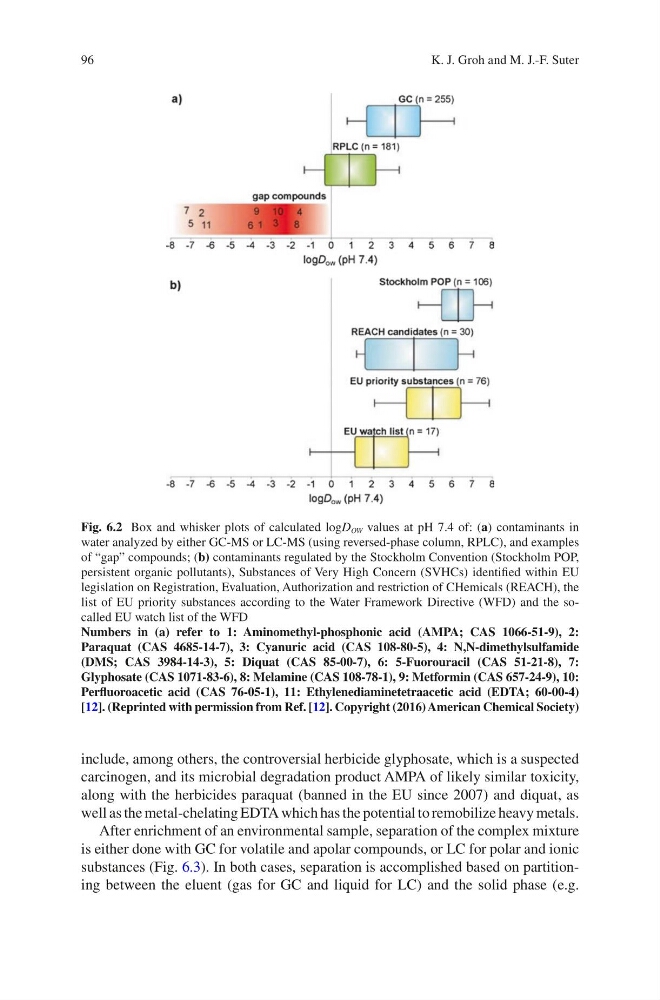
include, among others, the controversial herbicide glyphosate, which is a suspected
carcinogen, and its microbial degradation product AMPA of likely similar toxicity,
along with the herbicides paraquat (banned in the EU since 2007) and diquat, as
well as the metal-chelating EDTA which has the potential to remobilize heavy metals.
After enrichment of an environmental sample, separation of the complex mixture
is either done with GC for volatile and apolar compounds, or LC for polar and ionic
substances (Fig. 6.3). In both cases, separation is accomplished based on partitioning between the eluent (gas for GC and liquid for LC) and the solid phase (e.g.
Fig. 6.2 Box and whisker plots of calculated logD OW values at pH 7.4 of: (a) contaminants in
water analyzed by either GC-MS or LC-MS (using reversed-phase column, RPLC), and examples
of “gap” compounds; (b) contaminants regulated by the Stockholm Convention (Stockholm POP,
persistent organic pollutants), Substances of Very High Concern (SVHCs) identified within EU
legislation on Registration, Evaluation, Authorization and restriction of CHemicals (REACH), the
list of EU priority substances according to the Water Framework Directive (WFD) and the socalled EU watch list of the WFD
Numbers in (a) refer to 1: Aminomethyl-phosphonic acid (AMPA; CAS 1066-51-9), 2:
Paraquat (CAS 4685-14-7), 3: Cyanuric acid (CAS 108-80-5), 4: N,N-dimethylsulfamide
(DMS; CAS 3984-14-3), 5: Diquat (CAS 85-00-7), 6: 5-Fuorouracil (CAS 51-21-8), 7:
Glyphosate (CAS 1071-83-6), 8: Melamine (CAS 108-78-1), 9: Metformin (CAS 657-24-9), 10:
Perfluoroacetic acid (CAS 76-05-1), 11: Ethylenediaminetetraacetic acid (EDTA; 60-00-4)
[12]. (Reprinted with permission from Ref. [12]. Copyright (2016) American Chemical Society)
K. J. Groh and M. J.-F. Suter
include, among others, the controversial herbicide glyphosate, which is a suspected
carcinogen, and its microbial degradation product AMPA of likely similar toxicity,
along with the herbicides paraquat (banned in the EU since 2007) and diquat, as
well as the metal-chelating EDTA which has the potential to remobilize heavy metals.
After enrichment of an environmental sample, separation of the complex mixture
is either done with GC for volatile and apolar compounds, or LC for polar and ionic
substances (Fig. 6.3). In both cases, separation is accomplished based on partitioning between the eluent (gas for GC and liquid for LC) and the solid phase (e.g.
Fig. 6.2 Box and whisker plots of calculated logD OW values at pH 7.4 of: (a) contaminants in
water analyzed by either GC-MS or LC-MS (using reversed-phase column, RPLC), and examples
of “gap” compounds; (b) contaminants regulated by the Stockholm Convention (Stockholm POP,
persistent organic pollutants), Substances of Very High Concern (SVHCs) identified within EU
legislation on Registration, Evaluation, Authorization and restriction of CHemicals (REACH), the
list of EU priority substances according to the Water Framework Directive (WFD) and the socalled EU watch list of the WFD
Numbers in (a) refer to 1: Aminomethyl-phosphonic acid (AMPA; CAS 1066-51-9), 2:
Paraquat (CAS 4685-14-7), 3: Cyanuric acid (CAS 108-80-5), 4: N,N-dimethylsulfamide
(DMS; CAS 3984-14-3), 5: Diquat (CAS 85-00-7), 6: 5-Fuorouracil (CAS 51-21-8), 7:
Glyphosate (CAS 1071-83-6), 8: Melamine (CAS 108-78-1), 9: Metformin (CAS 657-24-9), 10:
Perfluoroacetic acid (CAS 76-05-1), 11: Ethylenediaminetetraacetic acid (EDTA; 60-00-4)
[12]. (Reprinted with permission from Ref. [12]. Copyright (2016) American Chemical Society)
K. J. Groh and M. J.-F. Suter