

97
siloxane copolymers for GC and mixed mode for LC), with choice of method
depending on the specific application.
Identification and quantification then is performed using mass spectrometers,
fitted with an EI or CI source for volatiles and GC coupling, or an ESI source for
polar and ionic substances and coupling to high performance LC (HPLC). The
major analytical features of EI- and ESI-based analysis are summarized in Table 6.1.
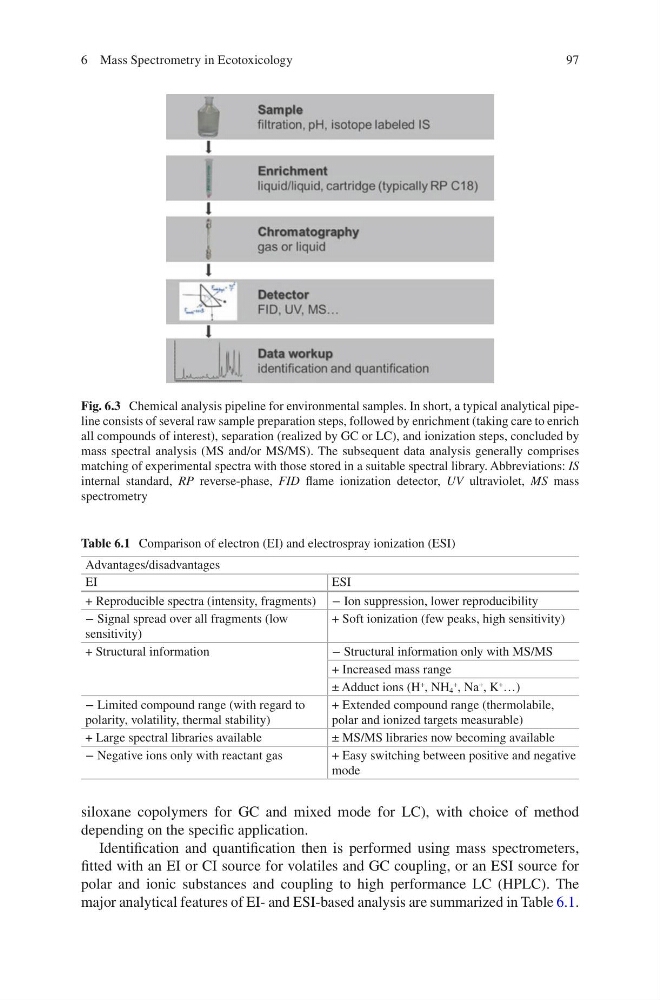
Fig. 6.3 Chemical analysis pipeline for environmental samples. In short, a typical analytical pipeline consists of several raw sample preparation steps, followed by enrichment (taking care to enrich
all compounds of interest), separation (realized by GC or LC), and ionization steps, concluded by
mass spectral analysis (MS and/or MS/MS). The subsequent data analysis generally comprises
matching of experimental spectra with those stored in a suitable spectral library. Abbreviations: IS
internal standard, RP reverse-phase, FID flame ionization detector, UV ultraviolet, MS mass
spectrometry
Table 6.1 Comparison of electron (EI) and electrospray ionization (ESI)
Advantages/disadvantages
EI
ESI
+ Reproducible spectra (intensity, fragments) − Ion suppression, lower reproducibility
− Signal spread over all fragments (low
sensitivity)
+ Soft ionization (few peaks, high sensitivity)
+ Structural information
− Structural information only with MS/MS
+ Increased mass range
± Adduct ions (H
+ , NH 4
+
, Na
+
, K
+ …)
− Limited compound range (with regard to
polarity, volatility, thermal stability)
+ Extended compound range (thermolabile,
polar and ionized targets measurable)
+ Large spectral libraries available
± MS/MS libraries now becoming available
− Negative ions only with reactant gas
+ Easy switching between positive and negative
mode
6 Mass Spectrometry in Ecotoxicology
siloxane copolymers for GC and mixed mode for LC), with choice of method
depending on the specific application.
Identification and quantification then is performed using mass spectrometers,
fitted with an EI or CI source for volatiles and GC coupling, or an ESI source for
polar and ionic substances and coupling to high performance LC (HPLC). The
major analytical features of EI- and ESI-based analysis are summarized in Table 6.1.
Fig. 6.3 Chemical analysis pipeline for environmental samples. In short, a typical analytical pipeline consists of several raw sample preparation steps, followed by enrichment (taking care to enrich
all compounds of interest), separation (realized by GC or LC), and ionization steps, concluded by
mass spectral analysis (MS and/or MS/MS). The subsequent data analysis generally comprises
matching of experimental spectra with those stored in a suitable spectral library. Abbreviations: IS
internal standard, RP reverse-phase, FID flame ionization detector, UV ultraviolet, MS mass
spectrometry
Table 6.1 Comparison of electron (EI) and electrospray ionization (ESI)
Advantages/disadvantages
EI
ESI
+ Reproducible spectra (intensity, fragments) − Ion suppression, lower reproducibility
− Signal spread over all fragments (low
sensitivity)
+ Soft ionization (few peaks, high sensitivity)
+ Structural information
− Structural information only with MS/MS
+ Increased mass range
± Adduct ions (H
+ , NH 4
+
, Na
+
, K
+ …)
− Limited compound range (with regard to
polarity, volatility, thermal stability)
+ Extended compound range (thermolabile,
polar and ionized targets measurable)
+ Large spectral libraries available
± MS/MS libraries now becoming available
− Negative ions only with reactant gas
+ Easy switching between positive and negative
mode
6 Mass Spectrometry in Ecotoxicology