

87
spectrometer (QMS), the DART-QMS combination is a compact, affordable and
versatile analytical tool.
The DART ion source has been used to analyze a wide range of analytes in a
diverse array of sample types and for a plethora of objectives. DART, or more specifically the DART ion source, ionizes almost anything placed in front of the source.
Notably, DART can be used to sample directly from surfaces such as glass, TLC
plates, concrete, paper, or currency without requiring wipes or solvent extraction.
Similarly, drugs can be detected directly, in pill form, simply by placing the pill in
the line of the DART source for a few seconds to minutes. Biological fluids have
been analyzed directly without extraction or other processing: e.g., by dipping a
glass rod in raw urine and simply placing the rod in front of the DART source. Meat,
fruit and vegetables have all be analyzed directly. Analysis of synthetic materials,
including reaction mixtures, polymers, adhesives, whether sticky and/or contaminated, can be carried out with little or no sample preparation [4, 5].
Just a small subset of the types of samples and applications tested through the
application of DART- and DESI-MS are included in the Table 5.2 below. (Information
in Table 5.2 is primarily based on references [4] and [5].)
5.4 Special Consideration in Quantitative Applications by
DART and DESI
DART/DESI can also be used for quantitative analysis. In common with many other
mass spectrometric techniques, the absolute abundance of ion currents produced by
DART depends on multiple factors, but notably in the case of DART and DESI, on
the positioning of the sample target in the gas stream, the nature of the sample
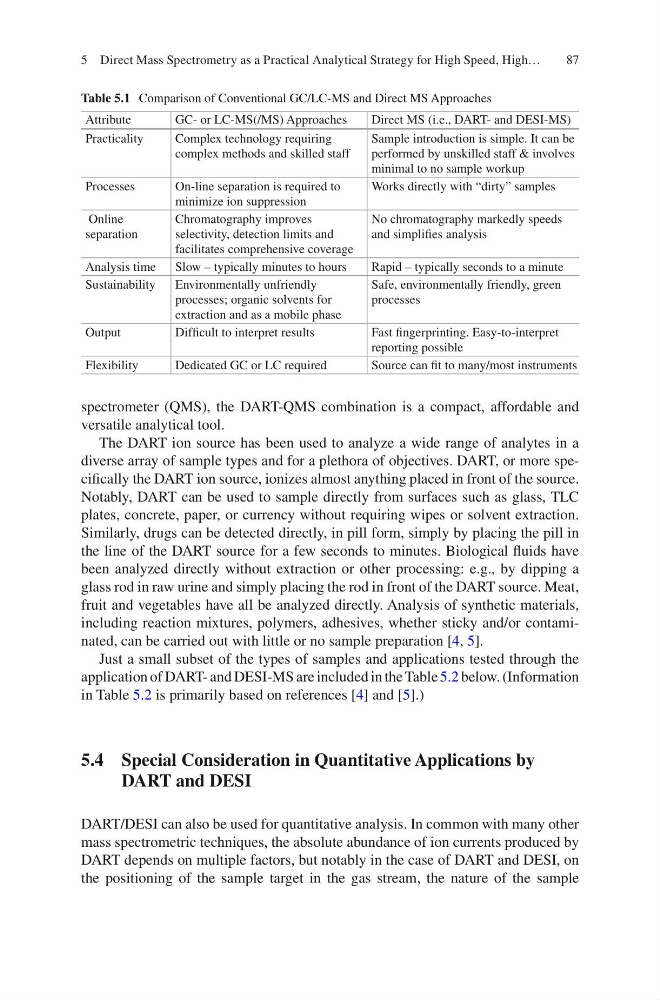
Table 5.1 Comparison of Conventional GC/LC-MS and Direct MS Approaches
Attribute
GC- or LC-MS(/MS) Approaches
Direct MS (i.e., DART- and DESI-MS)
Practicality
Complex technology requiring
complex methods and skilled staff
Sample introduction is simple. It can be
performed by unskilled staff & involves
minimal to no sample workup
Processes
On-line separation is required to
minimize ion suppression
Works directly with “dirty” samples
Online
separation
Chromatography improves
selectivity, detection limits and
facilitates comprehensive coverage
No chromatography markedly speeds
and simplifies analysis
Analysis time
Slow – typically minutes to hours
Rapid – typically seconds to a minute
Sustainability
Environmentally unfriendly
processes; organic solvents for
extraction and as a mobile phase
Safe, environmentally friendly, green
processes
Output
Difficult to interpret results
Fast fingerprinting. Easy-to-interpret
reporting possible
Flexibility
Dedicated GC or LC required
Source can fit to many/most instruments
5 Direct Mass Spectrometry as a Practical Analytical Strategy for High Speed, High…
spectrometer (QMS), the DART-QMS combination is a compact, affordable and
versatile analytical tool.
The DART ion source has been used to analyze a wide range of analytes in a
diverse array of sample types and for a plethora of objectives. DART, or more specifically the DART ion source, ionizes almost anything placed in front of the source.
Notably, DART can be used to sample directly from surfaces such as glass, TLC
plates, concrete, paper, or currency without requiring wipes or solvent extraction.
Similarly, drugs can be detected directly, in pill form, simply by placing the pill in
the line of the DART source for a few seconds to minutes. Biological fluids have
been analyzed directly without extraction or other processing: e.g., by dipping a
glass rod in raw urine and simply placing the rod in front of the DART source. Meat,
fruit and vegetables have all be analyzed directly. Analysis of synthetic materials,
including reaction mixtures, polymers, adhesives, whether sticky and/or contaminated, can be carried out with little or no sample preparation [4, 5].
Just a small subset of the types of samples and applications tested through the
application of DART- and DESI-MS are included in the Table 5.2 below. (Information
in Table 5.2 is primarily based on references [4] and [5].)
5.4 Special Consideration in Quantitative Applications by
DART and DESI
DART/DESI can also be used for quantitative analysis. In common with many other
mass spectrometric techniques, the absolute abundance of ion currents produced by
DART depends on multiple factors, but notably in the case of DART and DESI, on
the positioning of the sample target in the gas stream, the nature of the sample
Table 5.1 Comparison of Conventional GC/LC-MS and Direct MS Approaches
Attribute
GC- or LC-MS(/MS) Approaches
Direct MS (i.e., DART- and DESI-MS)
Practicality
Complex technology requiring
complex methods and skilled staff
Sample introduction is simple. It can be
performed by unskilled staff & involves
minimal to no sample workup
Processes
On-line separation is required to
minimize ion suppression
Works directly with “dirty” samples
Online
separation
Chromatography improves
selectivity, detection limits and
facilitates comprehensive coverage
No chromatography markedly speeds
and simplifies analysis
Analysis time
Slow – typically minutes to hours
Rapid – typically seconds to a minute
Sustainability
Environmentally unfriendly
processes; organic solvents for
extraction and as a mobile phase
Safe, environmentally friendly, green
processes
Output
Difficult to interpret results
Fast fingerprinting. Easy-to-interpret
reporting possible
Flexibility
Dedicated GC or LC required
Source can fit to many/most instruments
5 Direct Mass Spectrometry as a Practical Analytical Strategy for High Speed, High…