

86
(EESI), fused droplet ESI (FDESI), direct analysis in real time (DART), desorption
electrospray ionization (DESI), desorption atmospheric pressure photoionization
(DAPPI) and laser ablation electrospray ionization (LAESI). Many of these ionization strategies have been summarized and discussed in an excellent review by
Monge and colleagues [1]. These D-MS approaches not only bring the power of
mass spectrometric qualitative analysis and quantification, but they also offer the
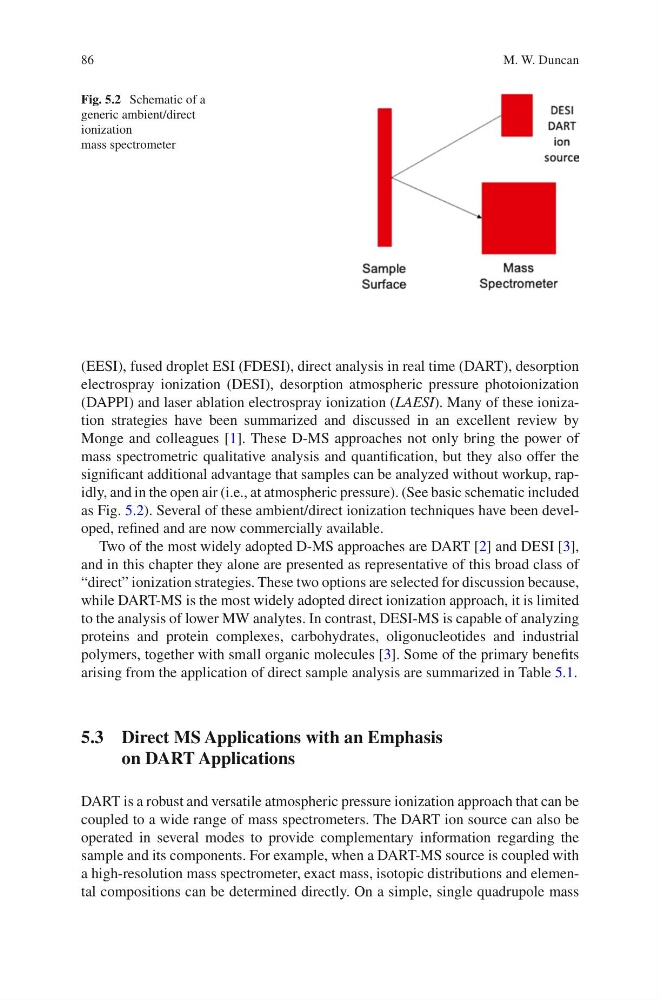
significant additional advantage that samples can be analyzed without workup, rapidly, and in the open air (i.e., at atmospheric pressure). (See basic schematic included
as Fig. 5.2). Several of these ambient/direct ionization techniques have been developed, refined and are now commercially available.
Two of the most widely adopted D-MS approaches are DART [2] and DESI [3],
and in this chapter they alone are presented as representative of this broad class of
“direct” ionization strategies. These two options are selected for discussion because,
while DART-MS is the most widely adopted direct ionization approach, it is limited
to the analysis of lower MW analytes. In contrast, DESI-MS is capable of analyzing
proteins and protein complexes, carbohydrates, oligonucleotides and industrial
polymers, together with small organic molecules [3]. Some of the primary benefits
arising from the application of direct sample analysis are summarized in Table 5.1.
5.3 Direct MS Applications with an Emphasis
on DART Applications
DART is a robust and versatile atmospheric pressure ionization approach that can be
coupled to a wide range of mass spectrometers. The DART ion source can also be
operated in several modes to provide complementary information regarding the
sample and its components. For example, when a DART-MS source is coupled with
a high-resolution mass spectrometer, exact mass, isotopic distributions and elemental compositions can be determined directly. On a simple, single quadrupole mass
Fig. 5.2 Schematic of a
generic ambient/direct
ionization
mass spectrometer
M. W. Duncan
(EESI), fused droplet ESI (FDESI), direct analysis in real time (DART), desorption
electrospray ionization (DESI), desorption atmospheric pressure photoionization
(DAPPI) and laser ablation electrospray ionization (LAESI). Many of these ionization strategies have been summarized and discussed in an excellent review by
Monge and colleagues [1]. These D-MS approaches not only bring the power of
mass spectrometric qualitative analysis and quantification, but they also offer the
significant additional advantage that samples can be analyzed without workup, rapidly, and in the open air (i.e., at atmospheric pressure). (See basic schematic included
as Fig. 5.2). Several of these ambient/direct ionization techniques have been developed, refined and are now commercially available.
Two of the most widely adopted D-MS approaches are DART [2] and DESI [3],
and in this chapter they alone are presented as representative of this broad class of
“direct” ionization strategies. These two options are selected for discussion because,
while DART-MS is the most widely adopted direct ionization approach, it is limited
to the analysis of lower MW analytes. In contrast, DESI-MS is capable of analyzing
proteins and protein complexes, carbohydrates, oligonucleotides and industrial
polymers, together with small organic molecules [3]. Some of the primary benefits
arising from the application of direct sample analysis are summarized in Table 5.1.
5.3 Direct MS Applications with an Emphasis
on DART Applications
DART is a robust and versatile atmospheric pressure ionization approach that can be
coupled to a wide range of mass spectrometers. The DART ion source can also be
operated in several modes to provide complementary information regarding the
sample and its components. For example, when a DART-MS source is coupled with
a high-resolution mass spectrometer, exact mass, isotopic distributions and elemental compositions can be determined directly. On a simple, single quadrupole mass
Fig. 5.2 Schematic of a
generic ambient/direct
ionization
mass spectrometer
M. W. Duncan