

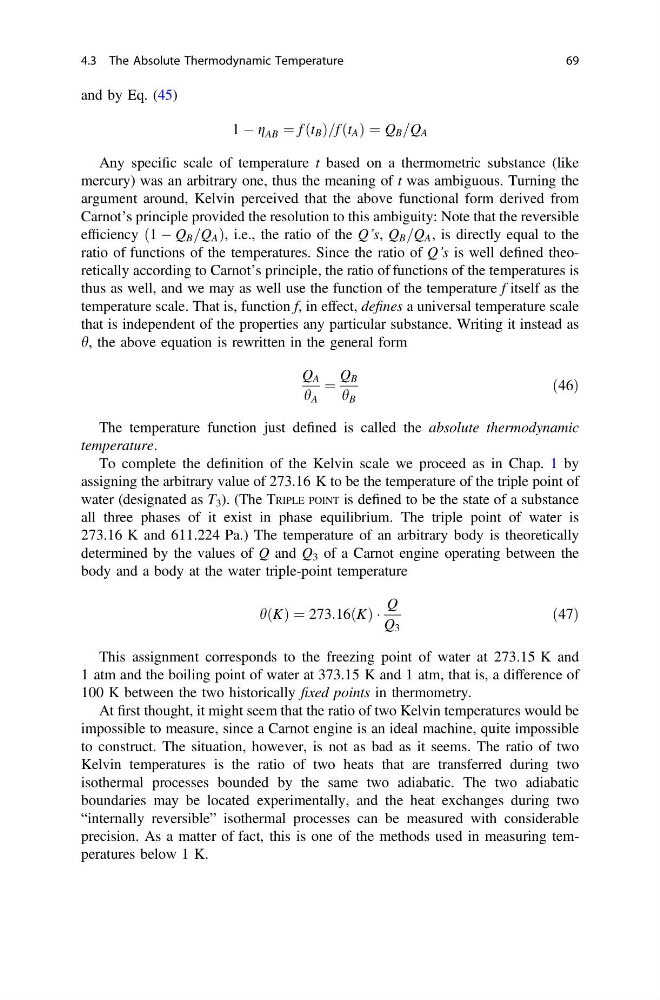
and by Eq. (45)
1 À g AB ¼ f t B
ð Þ=f t A
ð Þ ¼ Q B =Q A
Any specific scale of temperature t based on a thermometric substance (like
mercury) was an arbitrary one, thus the meaning of t was ambiguous. Turning the
argument around, Kelvin perceived that the above functional form derived from
Carnot’s principle provided the resolution to this ambiguity: Note that the reversible
efficiency 1 À Q B =Q A
ð
Þ , i.e., the ratio of the Q’s, Q B =Q A , is directly equal to the
ratio of functions of the temperatures. Since the ratio of Q’s is well defined theoretically according to Carnot’s principle, the ratio of functions of the temperatures is
thus as well, and we may as well use the function of the temperature f itself as the
temperature scale. That is, function f, in effect, defines a universal temperature scale
that is independent of the properties any particular substance. Writing it instead as
h, the above equation is rewritten in the general form
Q A
h A
¼
Q B
h B
ð46Þ
The temperature function just defined is called the absolute thermodynamic
temperature.
To complete the definition of the Kelvin scale we proceed as in Chap. 1 by
assigning the arbitrary value of 273.16 K to be the temperature of the triple point of
water (designated as T 3 ). (The TRIPLE POINT is defined to be the state of a substance
all three phases of it exist in phase equilibrium. The triple point of water is
273.16 K and 611.224 Pa.) The temperature of an arbitrary body is theoretically
determined by the values of Q and Q 3 of a Carnot engine operating between the
body and a body at the water triple-point temperature
hðKÞ ¼ 273:16ðKÞ Á
Q
Q 3
ð47Þ
This assignment corresponds to the freezing point of water at 273.15 K and
1 atm and the boiling point of water at 373.15 K and 1 atm, that is, a difference of
100 K between the two historically fixed points in thermometry.
At first thought, it might seem that the ratio of two Kelvin temperatures would be
impossible to measure, since a Carnot engine is an ideal machine, quite impossible
to construct. The situation, however, is not as bad as it seems. The ratio of two
Kelvin temperatures is the ratio of two heats that are transferred during two
isothermal processes bounded by the same two adiabatic. The two adiabatic
boundaries may be located experimentally, and the heat exchanges during two
“internally reversible” isothermal processes can be measured with considerable
precision. As a matter of fact, this is one of the methods used in measuring temperatures below 1 K.
4.3 The Absolute Thermodynamic Temperature
69
1 À g AB ¼ f t B
ð Þ=f t A
ð Þ ¼ Q B =Q A
Any specific scale of temperature t based on a thermometric substance (like
mercury) was an arbitrary one, thus the meaning of t was ambiguous. Turning the
argument around, Kelvin perceived that the above functional form derived from
Carnot’s principle provided the resolution to this ambiguity: Note that the reversible
efficiency 1 À Q B =Q A
ð
Þ , i.e., the ratio of the Q’s, Q B =Q A , is directly equal to the
ratio of functions of the temperatures. Since the ratio of Q’s is well defined theoretically according to Carnot’s principle, the ratio of functions of the temperatures is
thus as well, and we may as well use the function of the temperature f itself as the
temperature scale. That is, function f, in effect, defines a universal temperature scale
that is independent of the properties any particular substance. Writing it instead as
h, the above equation is rewritten in the general form
Q A
h A
¼
Q B
h B
ð46Þ
The temperature function just defined is called the absolute thermodynamic
temperature.
To complete the definition of the Kelvin scale we proceed as in Chap. 1 by
assigning the arbitrary value of 273.16 K to be the temperature of the triple point of
water (designated as T 3 ). (The TRIPLE POINT is defined to be the state of a substance
all three phases of it exist in phase equilibrium. The triple point of water is
273.16 K and 611.224 Pa.) The temperature of an arbitrary body is theoretically
determined by the values of Q and Q 3 of a Carnot engine operating between the
body and a body at the water triple-point temperature
hðKÞ ¼ 273:16ðKÞ Á
Q
Q 3
ð47Þ
This assignment corresponds to the freezing point of water at 273.15 K and
1 atm and the boiling point of water at 373.15 K and 1 atm, that is, a difference of
100 K between the two historically fixed points in thermometry.
At first thought, it might seem that the ratio of two Kelvin temperatures would be
impossible to measure, since a Carnot engine is an ideal machine, quite impossible
to construct. The situation, however, is not as bad as it seems. The ratio of two
Kelvin temperatures is the ratio of two heats that are transferred during two
isothermal processes bounded by the same two adiabatic. The two adiabatic
boundaries may be located experimentally, and the heat exchanges during two
“internally reversible” isothermal processes can be measured with considerable
precision. As a matter of fact, this is one of the methods used in measuring temperatures below 1 K.
4.3 The Absolute Thermodynamic Temperature
69