

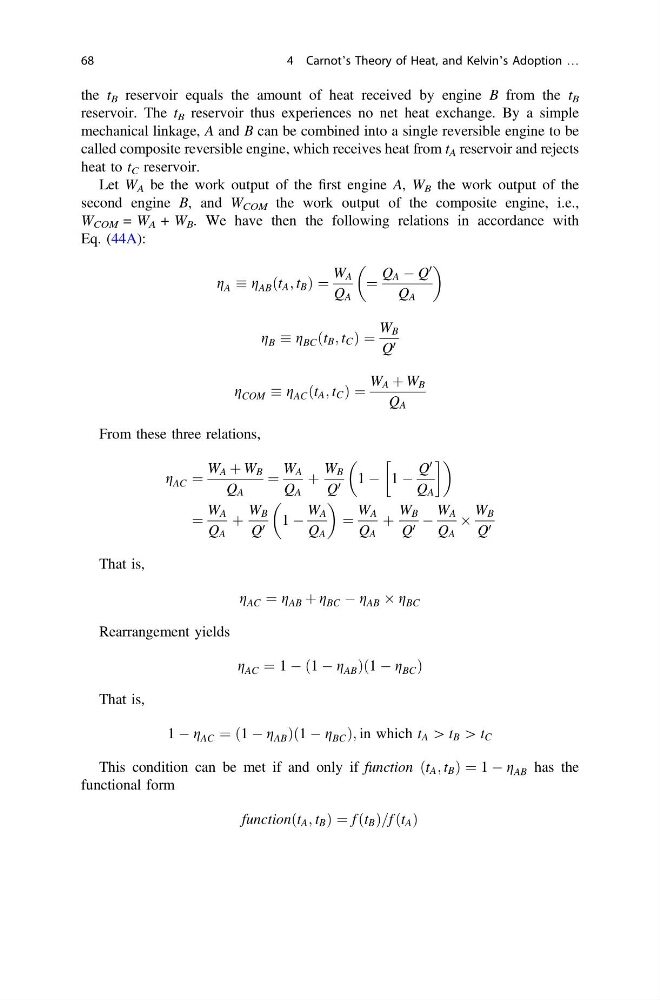
the t B reservoir equals the amount of heat received by engine B from the t B
reservoir. The t B reservoir thus experiences no net heat exchange. By a simple
mechanical linkage, A and B can be combined into a single reversible engine to be
called composite reversible engine, which receives heat from t A reservoir and rejects
heat to t C reservoir.
Let W A be the work output of the first engine A, W B the work output of the
second engine B, and W COM the work output of the composite engine, i.e.,
W COM = W A + W B . We have then the following relations in accordance with
Eq. (44A):
g A g AB t A ; t B
ð
Þ¼
W A
Q A
¼
Q A À Q
0
Q A
g B g BC t B ; t C
ð
Þ¼
W B
Q 0
g COM g AC t A ; t C
ð
Þ¼
W A þ W B
Q A
From these three relations,
g AC ¼
W A þ W B
Q A
¼
W A
Q A
þ
W B
Q 0 1 À 1 À
Q
0
Q A
!
¼
W A
Q A
þ
W B
Q 0 1 À
W A
Q A
¼
W A
Q A
þ
W B
Q 0 À
W A
Q A
Â
W B
Q 0
That is,
g AC ¼ g AB þ g BC À g AB Â g BC
Rearrangement yields
g AC ¼ 1 À 1 À g AB
ð
Þ1 À g BC
ð
Þ
That is,
1 À g AC ¼ 1 À g AB
ð
Þ1 À g BC
ð
Þ ; in which t A [ t B [ t C
This condition can be met if and only if function t A ; t B
ð
Þ¼1 À g AB has the
functional form
function t A ; t B
ð
Þ¼f t B
ð Þ=f t A
ð Þ
68
4 Carnot’s Theory of Heat, and Kelvin’s Adoption …
reservoir. The t B reservoir thus experiences no net heat exchange. By a simple
mechanical linkage, A and B can be combined into a single reversible engine to be
called composite reversible engine, which receives heat from t A reservoir and rejects
heat to t C reservoir.
Let W A be the work output of the first engine A, W B the work output of the
second engine B, and W COM the work output of the composite engine, i.e.,
W COM = W A + W B . We have then the following relations in accordance with
Eq. (44A):
g A g AB t A ; t B
ð
Þ¼
W A
Q A
¼
Q A À Q
0
Q A
g B g BC t B ; t C
ð
Þ¼
W B
Q 0
g COM g AC t A ; t C
ð
Þ¼
W A þ W B
Q A
From these three relations,
g AC ¼
W A þ W B
Q A
¼
W A
Q A
þ
W B
Q 0 1 À 1 À
Q
0
Q A
!
¼
W A
Q A
þ
W B
Q 0 1 À
W A
Q A
¼
W A
Q A
þ
W B
Q 0 À
W A
Q A
Â
W B
Q 0
That is,
g AC ¼ g AB þ g BC À g AB Â g BC
Rearrangement yields
g AC ¼ 1 À 1 À g AB
ð
Þ1 À g BC
ð
Þ
That is,
1 À g AC ¼ 1 À g AB
ð
Þ1 À g BC
ð
Þ ; in which t A [ t B [ t C
This condition can be met if and only if function t A ; t B
ð
Þ¼1 À g AB has the
functional form
function t A ; t B
ð
Þ¼f t B
ð Þ=f t A
ð Þ
68
4 Carnot’s Theory of Heat, and Kelvin’s Adoption …