

4.3.1 Carnot’s Reversible Efficiency
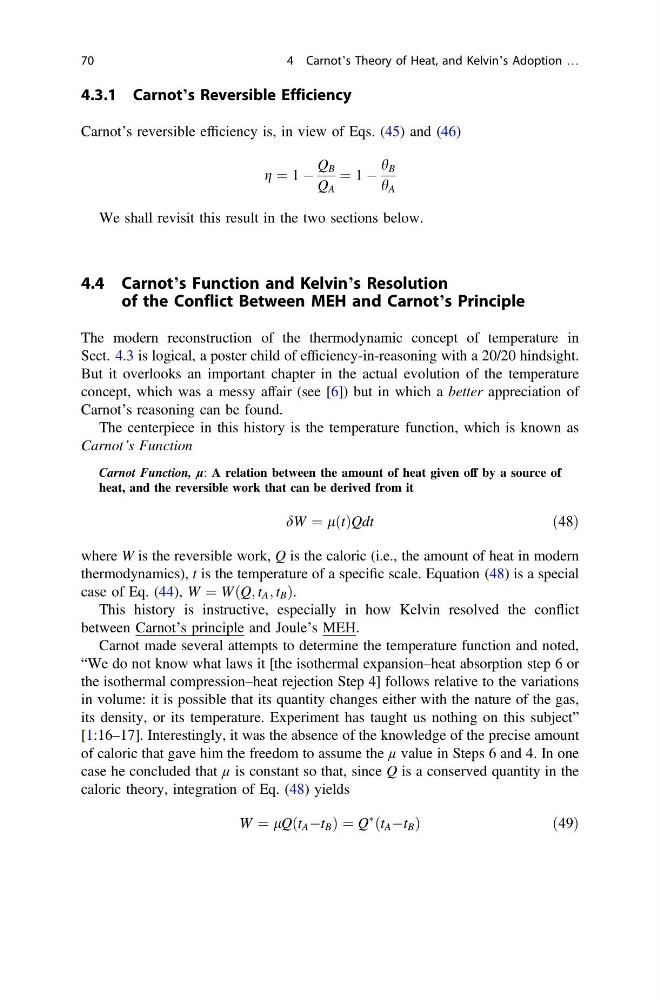
Carnot’s reversible efficiency is, in view of Eqs. (45) and (46)
g ¼ 1 À
Q B
Q A
¼ 1 À
h B
h A
We shall revisit this result in the two sections below.
4.4 Carnot’s Function and Kelvin’s Resolution
of the Conflict Between MEH and Carnot’s Principle
The modern reconstruction of the thermodynamic concept of temperature in
Sect. 4.3 is logical, a poster child of efficiency-in-reasoning with a 20/20 hindsight.
But it overlooks an important chapter in the actual evolution of the temperature
concept, which was a messy affair (see [6]) but in which a better appreciation of
Carnot’s reasoning can be found.
The centerpiece in this history is the temperature function, which is known as
Carnot’s Function
Carnot Function, µ: A relation between the amount of heat given off by a source of
heat, and the reversible work that can be derived from it
dW ¼ l t
ð ÞQdt
ð48Þ
where W is the reversible work, Q is the caloric (i.e., the amount of heat in modern
thermodynamics), t is the temperature of a specific scale. Equation (48) is a special
case of Eq. (44), W ¼ W Q; t A ; t B
ð
Þ .
This history is instructive, especially in how Kelvin resolved the conflict
between Carnot’s principle and Joule’s MEH.
Carnot made several attempts to determine the temperature function and noted,
“We do not know what laws it [the isothermal expansion–heat absorption step 6 or
the isothermal compression–heat rejection Step 4] follows relative to the variations
in volume: it is possible that its quantity changes either with the nature of the gas,
its density, or its temperature. Experiment has taught us nothing on this subject”
[1:16–17]. Interestingly, it was the absence of the knowledge of the precise amount
of caloric that gave him the freedom to assume the µ value in Steps 6 and 4. In one
case he concluded that µ is constant so that, since Q is a conserved quantity in the
caloric theory, integration of Eq. (48) yields
W ¼ lQ t A Àt B
ð
Þ¼Q
à t A Àt B
ð
Þ
ð49Þ
70
4 Carnot’s Theory of Heat, and Kelvin’s Adoption …
Carnot’s reversible efficiency is, in view of Eqs. (45) and (46)
g ¼ 1 À
Q B
Q A
¼ 1 À
h B
h A
We shall revisit this result in the two sections below.
4.4 Carnot’s Function and Kelvin’s Resolution
of the Conflict Between MEH and Carnot’s Principle
The modern reconstruction of the thermodynamic concept of temperature in
Sect. 4.3 is logical, a poster child of efficiency-in-reasoning with a 20/20 hindsight.
But it overlooks an important chapter in the actual evolution of the temperature
concept, which was a messy affair (see [6]) but in which a better appreciation of
Carnot’s reasoning can be found.
The centerpiece in this history is the temperature function, which is known as
Carnot’s Function
Carnot Function, µ: A relation between the amount of heat given off by a source of
heat, and the reversible work that can be derived from it
dW ¼ l t
ð ÞQdt
ð48Þ
where W is the reversible work, Q is the caloric (i.e., the amount of heat in modern
thermodynamics), t is the temperature of a specific scale. Equation (48) is a special
case of Eq. (44), W ¼ W Q; t A ; t B
ð
Þ .
This history is instructive, especially in how Kelvin resolved the conflict
between Carnot’s principle and Joule’s MEH.
Carnot made several attempts to determine the temperature function and noted,
“We do not know what laws it [the isothermal expansion–heat absorption step 6 or
the isothermal compression–heat rejection Step 4] follows relative to the variations
in volume: it is possible that its quantity changes either with the nature of the gas,
its density, or its temperature. Experiment has taught us nothing on this subject”
[1:16–17]. Interestingly, it was the absence of the knowledge of the precise amount
of caloric that gave him the freedom to assume the µ value in Steps 6 and 4. In one
case he concluded that µ is constant so that, since Q is a conserved quantity in the
caloric theory, integration of Eq. (48) yields
W ¼ lQ t A Àt B
ð
Þ¼Q
à t A Àt B
ð
Þ
ð49Þ
70
4 Carnot’s Theory of Heat, and Kelvin’s Adoption …