

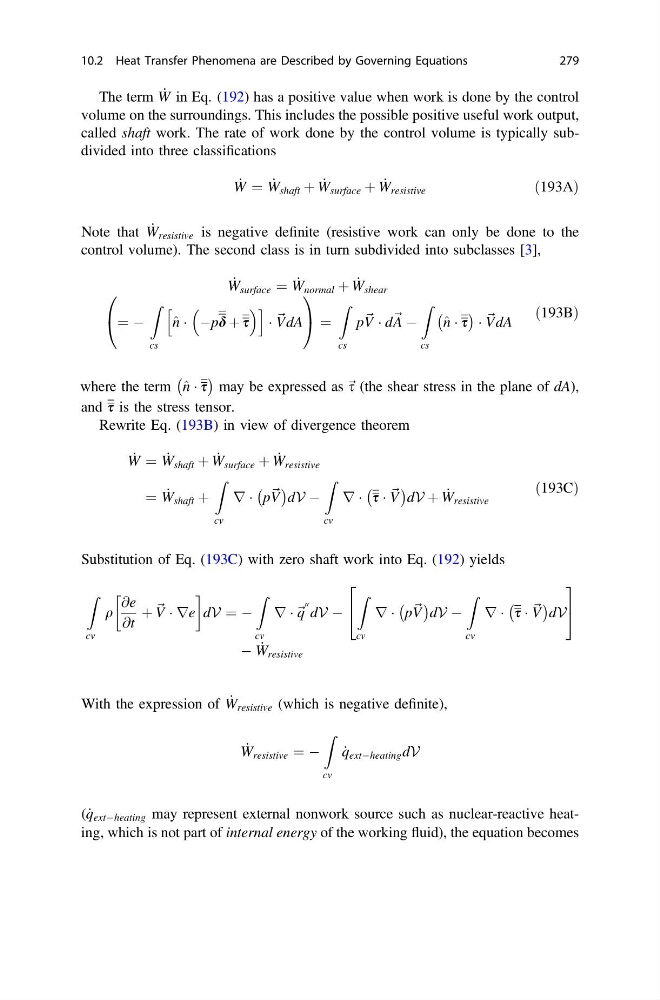
The term _
W in Eq. (192) has a positive value when work is done by the control
volume on the surroundings. This includes the possible positive useful work output,
called shaft work. The rate of work done by the control volume is typically subdivided into three classifications
_
W ¼ _
W shaft þ _
W surface þ _
W resistive
ð193AÞ
Note that _
W resistive is negative definite (resistive work can only be done to the
control volume). The second class is in turn subdivided into subclasses [3],
_
W surface ¼ _
W normal þ _
W shear
¼ À
Z
cs
^ n Á Àpd þ s
h
i
Á ~ VdA
0
@
1
A ¼
Z
cs
p ~ V Á d ~ A À
Z
cs
^ n Á s
À
Á Á ~ VdA
ð193BÞ
where the term ^ n Á s
À
Á
may be expressed as ~ s (the shear stress in the plane of dA),
and s is the stress tensor.
Rewrite Eq. (193B) in view of divergence theorem
_
W ¼ _
W shaft þ _
W surface þ _
W resistive
¼ _
W shaft þ
Z
cv
r Á p ~ V
À Á
dV À
Z
cv
r Á s Á ~ V
À
Á
dV þ _
W resistive
ð193CÞ
Substitution of Eq. (193C) with zero shaft work into Eq. (192) yields
Z
cv
q
@e
@t
þ ~ V Á re
!
dV ¼ À
Z
cv
r Á~ q
00 dV À
Z
cv
r Á p ~ V
À Á
dV À
Z
cv
r Á s Á ~ V
À
Á
dV
2
4
3
5
À _
W resistive
With the expression of _
W resistive (which is negative definite),
_
W resistive ¼ À
Z
cv
_
q extÀheating dV
( _
q extÀheating may represent external nonwork source such as nuclear-reactive heating, which is not part of internal energy of the working fluid), the equation becomes
10.2 Heat Transfer Phenomena are Described by Governing Equations
279
W in Eq. (192) has a positive value when work is done by the control
volume on the surroundings. This includes the possible positive useful work output,
called shaft work. The rate of work done by the control volume is typically subdivided into three classifications
_
W ¼ _
W shaft þ _
W surface þ _
W resistive
ð193AÞ
Note that _
W resistive is negative definite (resistive work can only be done to the
control volume). The second class is in turn subdivided into subclasses [3],
_
W surface ¼ _
W normal þ _
W shear
¼ À
Z
cs
^ n Á Àpd þ s
h
i
Á ~ VdA
0
@
1
A ¼
Z
cs
p ~ V Á d ~ A À
Z
cs
^ n Á s
À
Á Á ~ VdA
ð193BÞ
where the term ^ n Á s
À
Á
may be expressed as ~ s (the shear stress in the plane of dA),
and s is the stress tensor.
Rewrite Eq. (193B) in view of divergence theorem
_
W ¼ _
W shaft þ _
W surface þ _
W resistive
¼ _
W shaft þ
Z
cv
r Á p ~ V
À Á
dV À
Z
cv
r Á s Á ~ V
À
Á
dV þ _
W resistive
ð193CÞ
Substitution of Eq. (193C) with zero shaft work into Eq. (192) yields
Z
cv
q
@e
@t
þ ~ V Á re
!
dV ¼ À
Z
cv
r Á~ q
00 dV À
Z
cv
r Á p ~ V
À Á
dV À
Z
cv
r Á s Á ~ V
À
Á
dV
2
4
3
5
À _
W resistive
With the expression of _
W resistive (which is negative definite),
_
W resistive ¼ À
Z
cv
_
q extÀheating dV
( _
q extÀheating may represent external nonwork source such as nuclear-reactive heating, which is not part of internal energy of the working fluid), the equation becomes
10.2 Heat Transfer Phenomena are Described by Governing Equations
279