

dE
dt
¼ _
Q À _
W
ð23BÞ
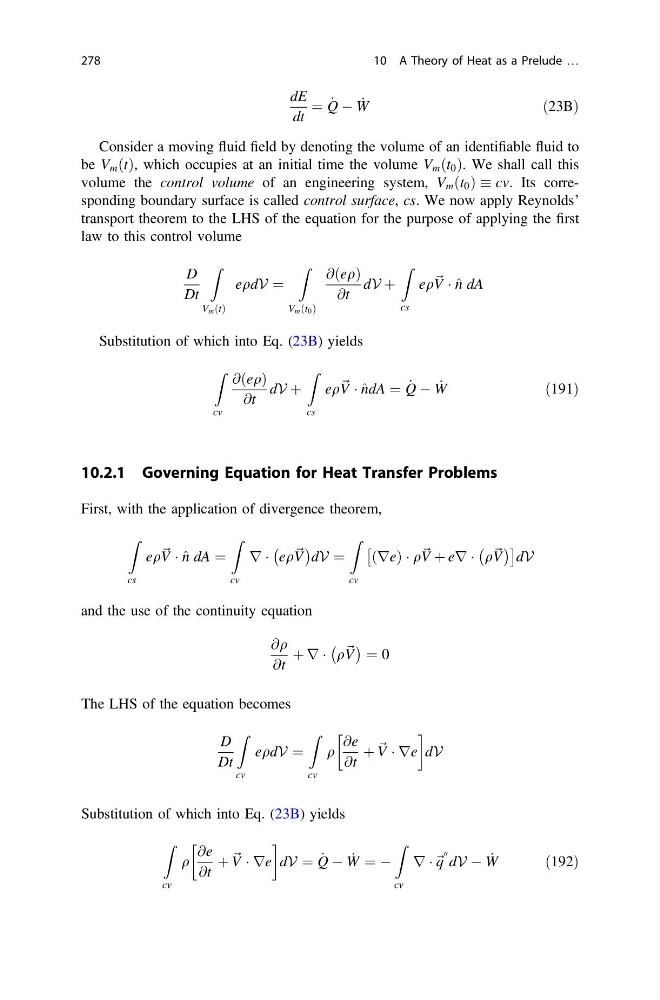
Consider a moving fluid field by denoting the volume of an identifiable fluid to
be V m t
ð Þ, which occupies at an initial time the volume V m t 0
ð Þ. We shall call this
volume the control volume of an engineering system, V m t 0
ð Þ cv. Its corresponding boundary surface is called control surface, cs. We now apply Reynolds’
transport theorem to the LHS of the equation for the purpose of applying the first
law to this control volume
D
Dt
Z
V m t
ð Þ
eqdV ¼
Z
V m t 0
ð Þ
@ eq
ð Þ
@t
dV þ
Z
cs
eq ~ V Á ^ n dA
Substitution of which into Eq. (23B) yields
Z
cv
@ eq
ð Þ
@t
dV þ
Z
cs
eq ~ V Á ^ ndA ¼ _
Q À _
W
ð191Þ
10.2.1 Governing Equation for Heat Transfer Problems
First, with the application of divergence theorem,
Z
cs
eq ~ V Á ^ n dA ¼
Z
cv
r Á eq ~ V
À
Á
dV ¼
Z
cv
re
ð ÞÁq ~ V þ er Á q ~ V
À Á
Â
Ã
dV
and the use of the continuity equation
@q
@t
þ r Á q ~ V
À Á ¼ 0
The LHS of the equation becomes
D
Dt
Z
cv
eqdV ¼
Z
cv
q
@e
@t
þ ~ V Á re
!
dV
Substitution of which into Eq. (23B) yields
Z
cv
q
@e
@t
þ ~ V Á re
!
dV ¼ _
Q À _
W ¼ À
Z
cv
r Á ~ q
00 dV À _
W
ð192Þ
278
10 A Theory of Heat as a Prelude …
dt
¼ _
Q À _
W
ð23BÞ
Consider a moving fluid field by denoting the volume of an identifiable fluid to
be V m t
ð Þ, which occupies at an initial time the volume V m t 0
ð Þ. We shall call this
volume the control volume of an engineering system, V m t 0
ð Þ cv. Its corresponding boundary surface is called control surface, cs. We now apply Reynolds’
transport theorem to the LHS of the equation for the purpose of applying the first
law to this control volume
D
Dt
Z
V m t
ð Þ
eqdV ¼
Z
V m t 0
ð Þ
@ eq
ð Þ
@t
dV þ
Z
cs
eq ~ V Á ^ n dA
Substitution of which into Eq. (23B) yields
Z
cv
@ eq
ð Þ
@t
dV þ
Z
cs
eq ~ V Á ^ ndA ¼ _
Q À _
W
ð191Þ
10.2.1 Governing Equation for Heat Transfer Problems
First, with the application of divergence theorem,
Z
cs
eq ~ V Á ^ n dA ¼
Z
cv
r Á eq ~ V
À
Á
dV ¼
Z
cv
re
ð ÞÁq ~ V þ er Á q ~ V
À Á
Â
Ã
dV
and the use of the continuity equation
@q
@t
þ r Á q ~ V
À Á ¼ 0
The LHS of the equation becomes
D
Dt
Z
cv
eqdV ¼
Z
cv
q
@e
@t
þ ~ V Á re
!
dV
Substitution of which into Eq. (23B) yields
Z
cv
q
@e
@t
þ ~ V Á re
!
dV ¼ _
Q À _
W ¼ À
Z
cv
r Á ~ q
00 dV À _
W
ð192Þ
278
10 A Theory of Heat as a Prelude …