

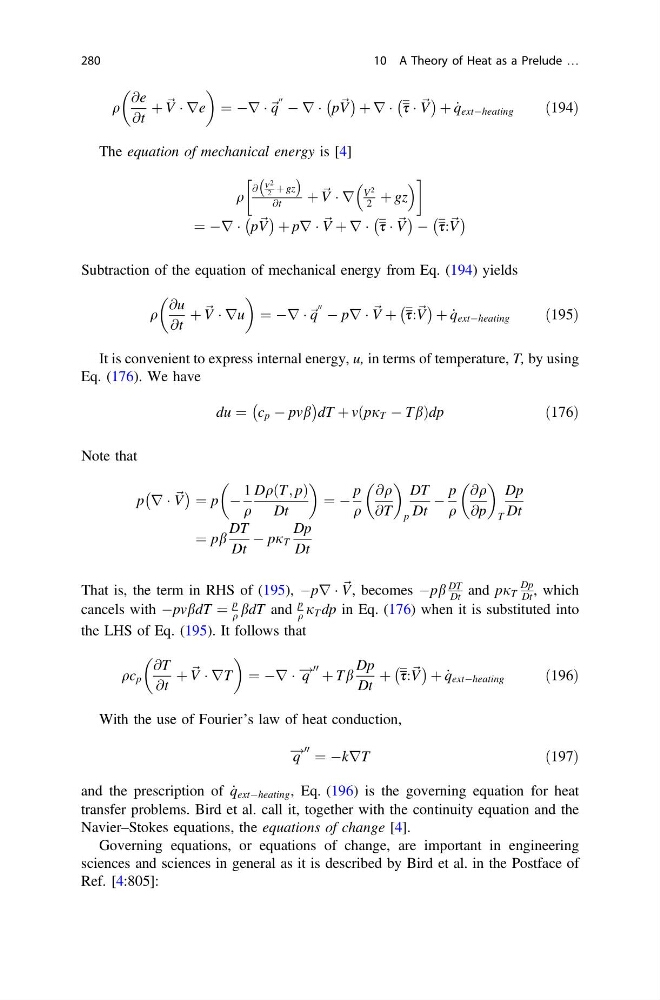
q
@e
@t
þ ~ V Á re
¼ Àr Á~ q
00 À r Á p ~ V
À Á þ r Á s Á ~ V
À
Á þ _
q extÀheating
ð194Þ
The equation of mechanical energy is [4]
q
@
V 2
2 þ gz
À
Á
@t
þ ~ V Á r
V
2
2 þ gz
!
¼ Àr Á p ~ V
À Á þ pr Á ~ V þ r Á s Á ~ V
À
Á À s: ~ V
À Á
Subtraction of the equation of mechanical energy from Eq. (194) yields
q
@u
@t
þ ~ V Á ru
¼ Àr Á~ q
00 À pr Á ~ V þ s: ~ V
À Á þ _
q extÀheating
ð195Þ
It is convenient to express internal energy, u, in terms of temperature, T, by using
Eq. (176). We have
du ¼ c p À pvb
À
Á
dT þ v pj T À Tb
ð
Þ dp
ð176Þ
Note that
p r Á ~ V
À
Á ¼ p À
1
q
Dq T; p
ð
Þ
Dt
¼ À
p
q
@q
@T
p
DT
Dt
À
p
q
@q
@p
T
Dp
Dt
¼ pb
DT
Dt
À pj T
Dp
Dt
That is, the term in RHS of (195), Àpr Á ~ V, becomes Àpb
DT
Dt and pj T
Dp
Dt , which
cancels with ÀpvbdT ¼
p
q bdT and
p
q j T dp in Eq. (176) when it is substituted into
the LHS of Eq. (195). It follows that
qc p
@T
@t
þ ~ V Á rT
¼ Àr Á q
! 00 þ Tb
Dp
Dt
þ s: ~ V
À Á þ _
q extÀheating
ð196Þ
With the use of Fourier’s law of heat conduction,
q
! 00 ¼ ÀkrT
ð197Þ
and the prescription of _
q extÀheating , Eq. (196) is the governing equation for heat
transfer problems. Bird et al. call it, together with the continuity equation and the
Navier–Stokes equations, the equations of change [4].
Governing equations, or equations of change, are important in engineering
sciences and sciences in general as it is described by Bird et al. in the Postface of
Ref. [4:805]:
280
10 A Theory of Heat as a Prelude …
@e
@t
þ ~ V Á re
¼ Àr Á~ q
00 À r Á p ~ V
À Á þ r Á s Á ~ V
À
Á þ _
q extÀheating
ð194Þ
The equation of mechanical energy is [4]
q
@
V 2
2 þ gz
À
Á
@t
þ ~ V Á r
V
2
2 þ gz
!
¼ Àr Á p ~ V
À Á þ pr Á ~ V þ r Á s Á ~ V
À
Á À s: ~ V
À Á
Subtraction of the equation of mechanical energy from Eq. (194) yields
q
@u
@t
þ ~ V Á ru
¼ Àr Á~ q
00 À pr Á ~ V þ s: ~ V
À Á þ _
q extÀheating
ð195Þ
It is convenient to express internal energy, u, in terms of temperature, T, by using
Eq. (176). We have
du ¼ c p À pvb
À
Á
dT þ v pj T À Tb
ð
Þ dp
ð176Þ
Note that
p r Á ~ V
À
Á ¼ p À
1
q
Dq T; p
ð
Þ
Dt
¼ À
p
q
@q
@T
p
DT
Dt
À
p
q
@q
@p
T
Dp
Dt
¼ pb
DT
Dt
À pj T
Dp
Dt
That is, the term in RHS of (195), Àpr Á ~ V, becomes Àpb
DT
Dt and pj T
Dp
Dt , which
cancels with ÀpvbdT ¼
p
q bdT and
p
q j T dp in Eq. (176) when it is substituted into
the LHS of Eq. (195). It follows that
qc p
@T
@t
þ ~ V Á rT
¼ Àr Á q
! 00 þ Tb
Dp
Dt
þ s: ~ V
À Á þ _
q extÀheating
ð196Þ
With the use of Fourier’s law of heat conduction,
q
! 00 ¼ ÀkrT
ð197Þ
and the prescription of _
q extÀheating , Eq. (196) is the governing equation for heat
transfer problems. Bird et al. call it, together with the continuity equation and the
Navier–Stokes equations, the equations of change [4].
Governing equations, or equations of change, are important in engineering
sciences and sciences in general as it is described by Bird et al. in the Postface of
Ref. [4:805]:
280
10 A Theory of Heat as a Prelude …