

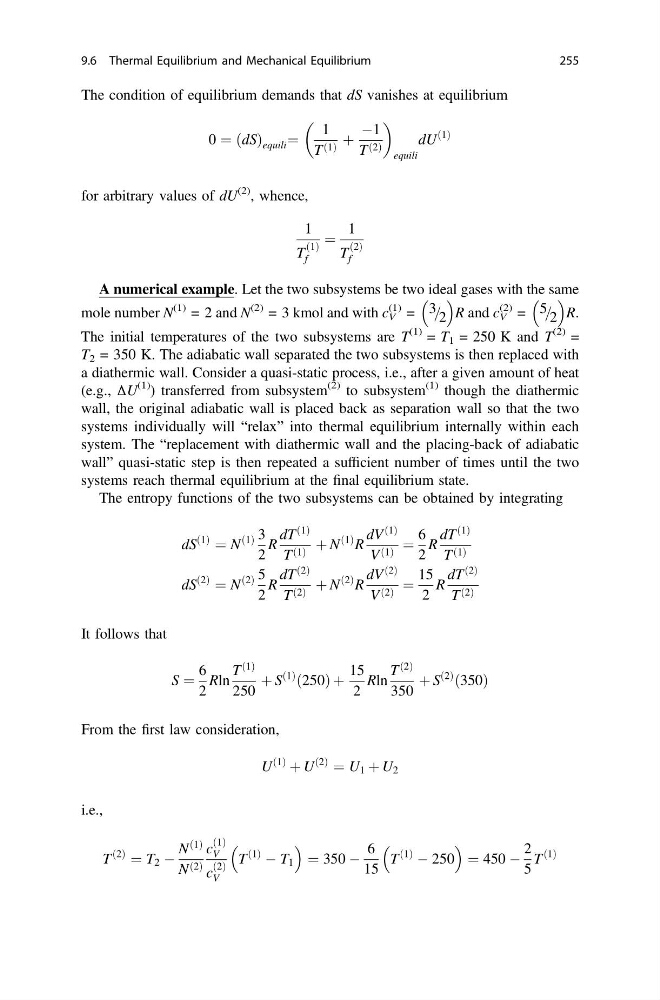
The condition of equilibrium demands that dS vanishes at equilibrium
0 ¼ dS
ð Þ equili ¼
1
T 1
ð Þ
þ
À1
T 2
ð Þ
equili
dU
1
ð Þ
for arbitrary values of dU
(2) , whence,
1
T
1
ð Þ
f
¼
1
T
2
ð Þ
f
A numerical example. Let the two subsystems be two ideal gases with the same
mole number N
(1) = 2 and N
(2) = 3 kmol and with c V
(1) = 3 = 2
R and c V
(2) = 5 = 2
R.
The initial temperatures of the two subsystems are T
(1) = T 1 = 250 K and T
(2) =
T 2 = 350 K. The adiabatic wall separated the two subsystems is then replaced with
a diathermic wall. Consider a quasi-static process, i.e., after a given amount of heat
(e.g., ΔU
(1) ) transferred from subsystem
(2) to subsystem
(1) though the diathermic
wall, the original adiabatic wall is placed back as separation wall so that the two
systems individually will “relax” into thermal equilibrium internally within each
system. The “replacement with diathermic wall and the placing-back of adiabatic
wall” quasi-static step is then repeated a sufficient number of times until the two
systems reach thermal equilibrium at the final equilibrium state.
The entropy functions of the two subsystems can be obtained by integrating
dS
1
ð Þ
¼ N
1
ð Þ 3
2
R
dT
1
ð Þ
T 1
ð Þ
þ N
1
ð Þ R
dV
1
ð Þ
V 1
ð Þ
¼
6
2
R
dT
1
ð Þ
T 1
ð Þ
dS
2
ð Þ
¼ N
2
ð Þ 5
2
R
dT
2
ð Þ
T 2
ð Þ
þ N
2
ð Þ R
dV
2
ð Þ
V 2
ð Þ
¼
15
2
R
dT
2
ð Þ
T 2
ð Þ
It follows that
S ¼
6
2
Rln
T
1
ð Þ
250
þ S
1
ð Þ
250
ð
Þþ
15
2
Rln
T
2
ð Þ
350
þ S
2
ð Þ
350
ð
Þ
From the first law consideration,
U
1
ð Þ
þ U
2
ð Þ
¼ U 1 þ U 2
i.e.,
T
2
ð Þ
¼ T 2 À
N
1
ð Þ
N 2
ð Þ
c
1
ð Þ
V
c
2
ð Þ
V
T
1
ð Þ
À T 1
¼ 350 À
6
15
T
1
ð Þ
À 250
¼ 450 À
2
5
T
1
ð Þ
9.6 Thermal Equilibrium and Mechanical Equilibrium
255
0 ¼ dS
ð Þ equili ¼
1
T 1
ð Þ
þ
À1
T 2
ð Þ
equili
dU
1
ð Þ
for arbitrary values of dU
(2) , whence,
1
T
1
ð Þ
f
¼
1
T
2
ð Þ
f
A numerical example. Let the two subsystems be two ideal gases with the same
mole number N
(1) = 2 and N
(2) = 3 kmol and with c V
(1) = 3 = 2
R and c V
(2) = 5 = 2
R.
The initial temperatures of the two subsystems are T
(1) = T 1 = 250 K and T
(2) =
T 2 = 350 K. The adiabatic wall separated the two subsystems is then replaced with
a diathermic wall. Consider a quasi-static process, i.e., after a given amount of heat
(e.g., ΔU
(1) ) transferred from subsystem
(2) to subsystem
(1) though the diathermic
wall, the original adiabatic wall is placed back as separation wall so that the two
systems individually will “relax” into thermal equilibrium internally within each
system. The “replacement with diathermic wall and the placing-back of adiabatic
wall” quasi-static step is then repeated a sufficient number of times until the two
systems reach thermal equilibrium at the final equilibrium state.
The entropy functions of the two subsystems can be obtained by integrating
dS
1
ð Þ
¼ N
1
ð Þ 3
2
R
dT
1
ð Þ
T 1
ð Þ
þ N
1
ð Þ R
dV
1
ð Þ
V 1
ð Þ
¼
6
2
R
dT
1
ð Þ
T 1
ð Þ
dS
2
ð Þ
¼ N
2
ð Þ 5
2
R
dT
2
ð Þ
T 2
ð Þ
þ N
2
ð Þ R
dV
2
ð Þ
V 2
ð Þ
¼
15
2
R
dT
2
ð Þ
T 2
ð Þ
It follows that
S ¼
6
2
Rln
T
1
ð Þ
250
þ S
1
ð Þ
250
ð
Þþ
15
2
Rln
T
2
ð Þ
350
þ S
2
ð Þ
350
ð
Þ
From the first law consideration,
U
1
ð Þ
þ U
2
ð Þ
¼ U 1 þ U 2
i.e.,
T
2
ð Þ
¼ T 2 À
N
1
ð Þ
N 2
ð Þ
c
1
ð Þ
V
c
2
ð Þ
V
T
1
ð Þ
À T 1
¼ 350 À
6
15
T
1
ð Þ
À 250
¼ 450 À
2
5
T
1
ð Þ
9.6 Thermal Equilibrium and Mechanical Equilibrium
255