

thermodynamic potential is the entropy, or T 0 S, which reaches a maximum at
equilibrium. The idea of the maximum entropy principle was first suggested by
Gibbs [2:354 (1878)]
It is an inference naturally suggested by the general increase of entropy which accompanies
the changes in any isolated material system that when the entropy of the system has reached
a maximum, the system will be in a state of equilibrium.
9.6.1 Thermal Equilibrium
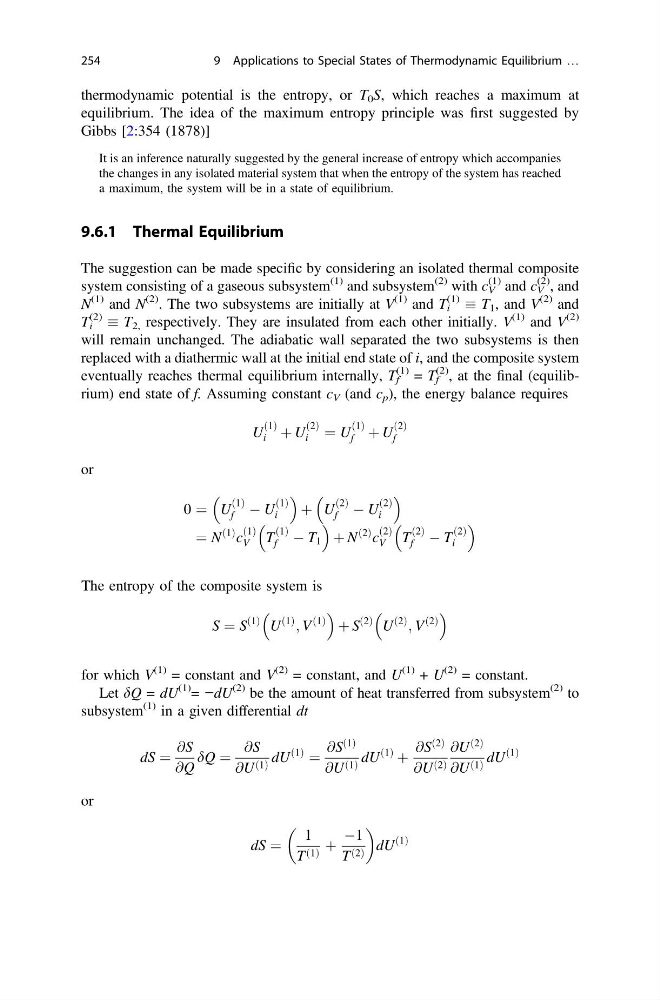
The suggestion can be made specific by considering an isolated thermal composite
system consisting of a gaseous subsystem
(1) and subsystem
(2) with c V
(1) and c V
(2) , and
N
(1) and N
(2) . The two subsystems are initially at V
(1) and T i
(1)
T 1 , and V
(2) and
T i
(2)
T 2, respectively. They are insulated from each other initially. V
(1) and V
(2)
will remain unchanged. The adiabatic wall separated the two subsystems is then
replaced with a diathermic wall at the initial end state of i, and the composite system
eventually reaches thermal equilibrium internally, T f
(1) = T f
(2) , at the final (equilibrium) end state of f. Assuming constant c V (and c p ), the energy balance requires
U
1
ð Þ
i þ U
ð2Þ
i
¼ U
ð1Þ
f þ U
ð2Þ
f
or
0 ¼ U
1
ð Þ
f À U
1
ð Þ
i
þ U
2
ð Þ
f À U
2
ð Þ
i
¼ N
1
ð Þ c
1
ð Þ
V
T
1
ð Þ
f À T 1
þ N
2
ð Þ c
2
ð Þ
V
T
2
ð Þ
f À T
2
ð Þ
i
The entropy of the composite system is
S ¼ S
1
ð Þ U
1
ð Þ
; V
1
ð Þ
þ S
2
ð Þ U
2
ð Þ
; V
2
ð Þ
for which V
(1) = constant and V
(2) = constant, and U
(1) + U
(2) = constant.
Let dQ = dU
(1) = −dU
(2) be the amount of heat transferred from subsystem
(2) to
subsystem
(1) in a given differential dt
dS ¼
@S
@Q
dQ ¼
@S
@U 1
ð Þ
dU
1
ð Þ
¼
@S
1
ð Þ
@U 1
ð Þ
dU
1
ð Þ
þ
@S
2
ð Þ
@U 2
ð Þ
@U
2
ð Þ
@U 1
ð Þ
dU
1
ð Þ
or
dS ¼
1
T 1
ð Þ
þ
À1
T 2
ð Þ
dU
1
ð Þ
254
9 Applications to Special States of Thermodynamic Equilibrium …
equilibrium. The idea of the maximum entropy principle was first suggested by
Gibbs [2:354 (1878)]
It is an inference naturally suggested by the general increase of entropy which accompanies
the changes in any isolated material system that when the entropy of the system has reached
a maximum, the system will be in a state of equilibrium.
9.6.1 Thermal Equilibrium
The suggestion can be made specific by considering an isolated thermal composite
system consisting of a gaseous subsystem
(1) and subsystem
(2) with c V
(1) and c V
(2) , and
N
(1) and N
(2) . The two subsystems are initially at V
(1) and T i
(1)
T 1 , and V
(2) and
T i
(2)
T 2, respectively. They are insulated from each other initially. V
(1) and V
(2)
will remain unchanged. The adiabatic wall separated the two subsystems is then
replaced with a diathermic wall at the initial end state of i, and the composite system
eventually reaches thermal equilibrium internally, T f
(1) = T f
(2) , at the final (equilibrium) end state of f. Assuming constant c V (and c p ), the energy balance requires
U
1
ð Þ
i þ U
ð2Þ
i
¼ U
ð1Þ
f þ U
ð2Þ
f
or
0 ¼ U
1
ð Þ
f À U
1
ð Þ
i
þ U
2
ð Þ
f À U
2
ð Þ
i
¼ N
1
ð Þ c
1
ð Þ
V
T
1
ð Þ
f À T 1
þ N
2
ð Þ c
2
ð Þ
V
T
2
ð Þ
f À T
2
ð Þ
i
The entropy of the composite system is
S ¼ S
1
ð Þ U
1
ð Þ
; V
1
ð Þ
þ S
2
ð Þ U
2
ð Þ
; V
2
ð Þ
for which V
(1) = constant and V
(2) = constant, and U
(1) + U
(2) = constant.
Let dQ = dU
(1) = −dU
(2) be the amount of heat transferred from subsystem
(2) to
subsystem
(1) in a given differential dt
dS ¼
@S
@Q
dQ ¼
@S
@U 1
ð Þ
dU
1
ð Þ
¼
@S
1
ð Þ
@U 1
ð Þ
dU
1
ð Þ
þ
@S
2
ð Þ
@U 2
ð Þ
@U
2
ð Þ
@U 1
ð Þ
dU
1
ð Þ
or
dS ¼
1
T 1
ð Þ
þ
À1
T 2
ð Þ
dU
1
ð Þ
254
9 Applications to Special States of Thermodynamic Equilibrium …