

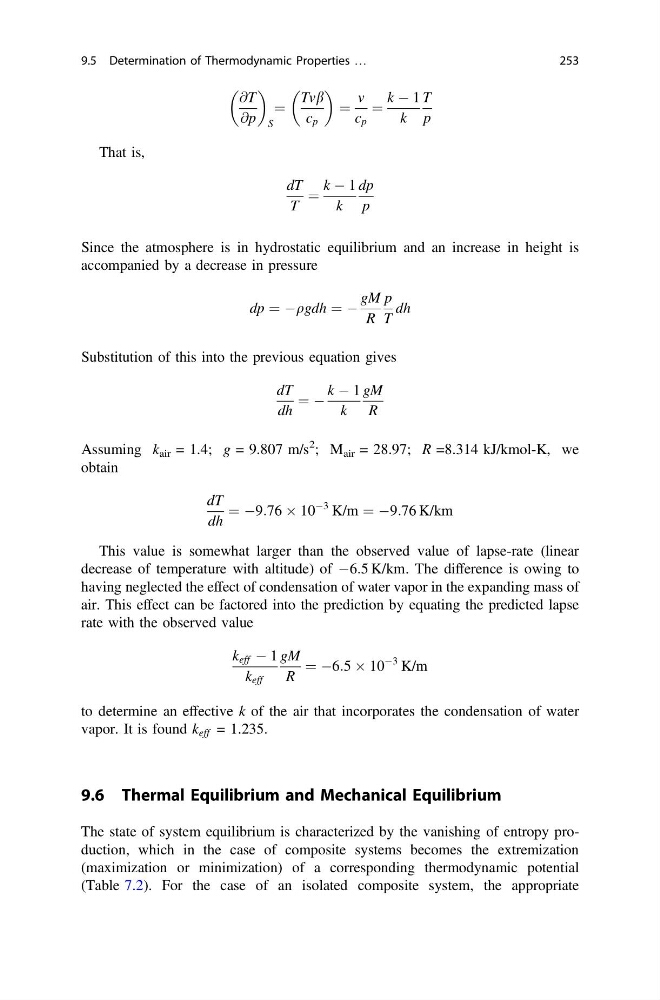
@T
@p
S
¼
Tvb
c p
¼
v
c p
¼
k À 1
k
T
p
That is,
dT
T
¼
k À 1
k
dp
p
Since the atmosphere is in hydrostatic equilibrium and an increase in height is
accompanied by a decrease in pressure
dp ¼ Àqgdh ¼ À
gM
R
p
T
dh
Substitution of this into the previous equation gives
dT
dh
¼ À
k À 1
k
gM
R
Assuming k air = 1.4; g = 9.807 m/s
2 ; M air = 28.97; R =8.314 kJ/kmol-K, we
obtain
dT
dh
¼ À9:76 Â 10
À3
K/m ¼ À9:76 K/km
This value is somewhat larger than the observed value of lapse-rate (linear
decrease of temperature with altitude) of À6:5 K/km. The difference is owing to
having neglected the effect of condensation of water vapor in the expanding mass of
air. This effect can be factored into the prediction by equating the predicted lapse
rate with the observed value
k eff À 1
k eff
gM
R
¼ À6:5 Â 10
À3
K/m
to determine an effective k of the air that incorporates the condensation of water
vapor. It is found k eff = 1.235.
9.6 Thermal Equilibrium and Mechanical Equilibrium
The state of system equilibrium is characterized by the vanishing of entropy production, which in the case of composite systems becomes the extremization
(maximization or minimization) of a corresponding thermodynamic potential
(Table 7.2). For the case of an isolated composite system, the appropriate
9.5 Determination of Thermodynamic Properties …
253
@p
S
¼
Tvb
c p
¼
v
c p
¼
k À 1
k
T
p
That is,
dT
T
¼
k À 1
k
dp
p
Since the atmosphere is in hydrostatic equilibrium and an increase in height is
accompanied by a decrease in pressure
dp ¼ Àqgdh ¼ À
gM
R
p
T
dh
Substitution of this into the previous equation gives
dT
dh
¼ À
k À 1
k
gM
R
Assuming k air = 1.4; g = 9.807 m/s
2 ; M air = 28.97; R =8.314 kJ/kmol-K, we
obtain
dT
dh
¼ À9:76 Â 10
À3
K/m ¼ À9:76 K/km
This value is somewhat larger than the observed value of lapse-rate (linear
decrease of temperature with altitude) of À6:5 K/km. The difference is owing to
having neglected the effect of condensation of water vapor in the expanding mass of
air. This effect can be factored into the prediction by equating the predicted lapse
rate with the observed value
k eff À 1
k eff
gM
R
¼ À6:5 Â 10
À3
K/m
to determine an effective k of the air that incorporates the condensation of water
vapor. It is found k eff = 1.235.
9.6 Thermal Equilibrium and Mechanical Equilibrium
The state of system equilibrium is characterized by the vanishing of entropy production, which in the case of composite systems becomes the extremization
(maximization or minimization) of a corresponding thermodynamic potential
(Table 7.2). For the case of an isolated composite system, the appropriate
9.5 Determination of Thermodynamic Properties …
253