

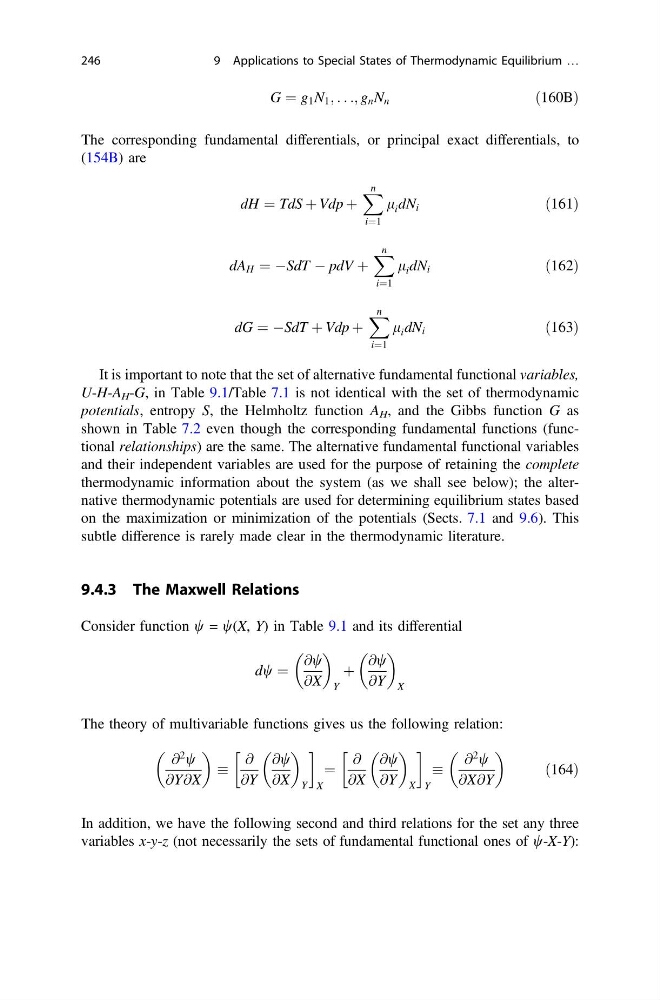
G ¼ g 1 N 1 ; . . .; g n N n
ð160BÞ
The corresponding fundamental differentials, or principal exact differentials, to
(154B) are
dH ¼ TdS þ Vdp þ
X n
i¼1
l i dN i
ð161Þ
dA H ¼ ÀSdT À pdV þ
X n
i¼1
l i dN i
ð162Þ
dG ¼ ÀSdT þ Vdp þ
X n
i¼1
l i dN i
ð163Þ
It is important to note that the set of alternative fundamental functional variables,
U-H-A H -G, in Table 9.1/Table 7.1 is not identical with the set of thermodynamic
potentials, entropy S, the Helmholtz function A H , and the Gibbs function G as
shown in Table 7.2 even though the corresponding fundamental functions (functional relationships) are the same. The alternative fundamental functional variables
and their independent variables are used for the purpose of retaining the complete
thermodynamic information about the system (as we shall see below); the alternative thermodynamic potentials are used for determining equilibrium states based
on the maximization or minimization of the potentials (Sects. 7.1 and 9.6). This
subtle difference is rarely made clear in the thermodynamic literature.
9.4.3 The Maxwell Relations
Consider function w = w(X, Y) in Table 9.1 and its differential
dw ¼
@w
@X
Y
þ
@w
@Y
X
The theory of multivariable functions gives us the following relation:
@
2 w
@Y@X
@
@Y
@w
@X
Y
!
X
¼
@
@X
@w
@Y
X
!
Y
@
2 w
@X@Y
ð164Þ
In addition, we have the following second and third relations for the set any three
variables x-y-z (not necessarily the sets of fundamental functional ones of w-X-Y):
246
9 Applications to Special States of Thermodynamic Equilibrium …
ð160BÞ
The corresponding fundamental differentials, or principal exact differentials, to
(154B) are
dH ¼ TdS þ Vdp þ
X n
i¼1
l i dN i
ð161Þ
dA H ¼ ÀSdT À pdV þ
X n
i¼1
l i dN i
ð162Þ
dG ¼ ÀSdT þ Vdp þ
X n
i¼1
l i dN i
ð163Þ
It is important to note that the set of alternative fundamental functional variables,
U-H-A H -G, in Table 9.1/Table 7.1 is not identical with the set of thermodynamic
potentials, entropy S, the Helmholtz function A H , and the Gibbs function G as
shown in Table 7.2 even though the corresponding fundamental functions (functional relationships) are the same. The alternative fundamental functional variables
and their independent variables are used for the purpose of retaining the complete
thermodynamic information about the system (as we shall see below); the alternative thermodynamic potentials are used for determining equilibrium states based
on the maximization or minimization of the potentials (Sects. 7.1 and 9.6). This
subtle difference is rarely made clear in the thermodynamic literature.
9.4.3 The Maxwell Relations
Consider function w = w(X, Y) in Table 9.1 and its differential
dw ¼
@w
@X
Y
þ
@w
@Y
X
The theory of multivariable functions gives us the following relation:
@
2 w
@Y@X
@
@Y
@w
@X
Y
!
X
¼
@
@X
@w
@Y
X
!
Y
@
2 w
@X@Y
ð164Þ
In addition, we have the following second and third relations for the set any three
variables x-y-z (not necessarily the sets of fundamental functional ones of w-X-Y):
246
9 Applications to Special States of Thermodynamic Equilibrium …