

Legendre transformation [1:137–149] into a new variable, i.e., an alternative fundamental functional variable, w.
Consider the case of the transformation of U-S-V into w-S-p, in which w is the
new dependent variable
w U À
@U
@V
S;N i
V ¼ U À Àp
ð ÞV ¼ U þ pV
ð100Þ
which is identified as the enthalpy H.
Consider the case of the transformation of U-S-V into w-T-V, one gets
w U À
@U
@S
V;N i
S ¼ U À TS
ð100Þ
which is the Helmholtz function A H (we already used the term in Sect. 7.1).
Consider next the case of the transformation of A H -T-V into w-T-p, one gets
w ¼ G
ð
Þ ¼A H À
@A H
@V
T;N i
Á V ¼ A H þ pV ¼ U À TS þ pV
ð101Þ
which will be called the Gibbs function, G.
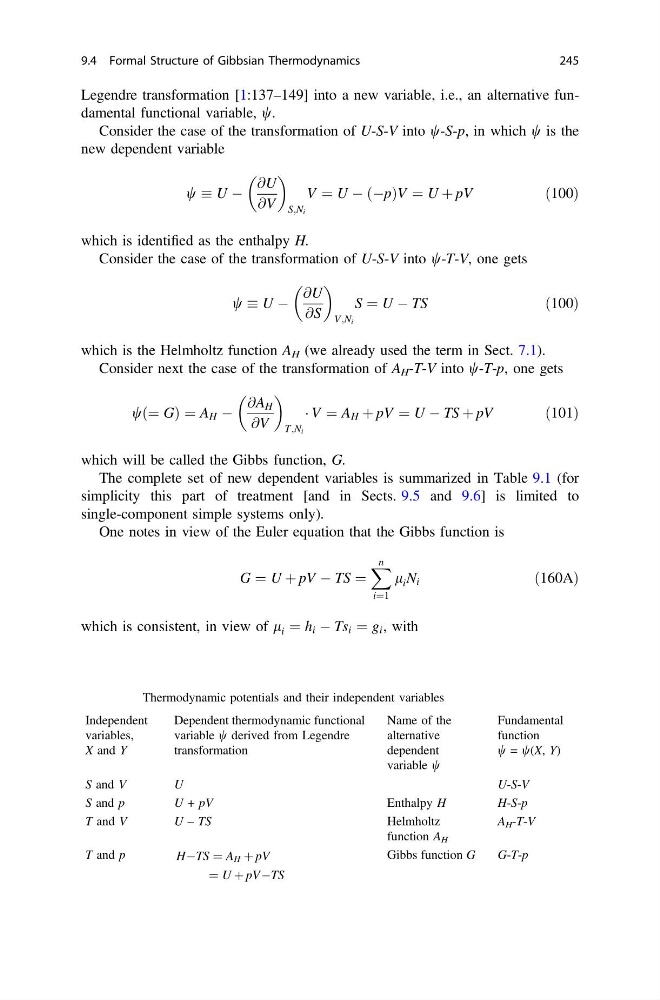
The complete set of new dependent variables is summarized in Table 9.1 (for
simplicity this part of treatment [and in Sects. 9.5 and 9.6] is limited to
single-component simple systems only).
One notes in view of the Euler equation that the Gibbs function is
G ¼ U þ pV À TS ¼
X n
i¼1
l i N i
ð160AÞ
which is consistent, in view of l i ¼ h i À Ts i ¼ g i , with
Table 9.1 Thermodynamic potentials and their independent variables
Independent
variables,
X and Y
Dependent thermodynamic functional
variable w derived from Legendre
transformation
Name of the
alternative
dependent
variable w
Fundamental
function
w = w(X, Y)
S and V
U
U -S-V
S and p
U+ pV
Enthalpy H
H -S-p
T and V
U– TS
Helmholtz
function A H
A H -T-V
T and p
HÀTS ¼ A H þ pV
¼ U þ pVÀTS
Gibbs function G
G-T-p
9.4 Formal Structure of Gibbsian Thermodynamics
245
Consider the case of the transformation of U-S-V into w-S-p, in which w is the
new dependent variable
w U À
@U
@V
S;N i
V ¼ U À Àp
ð ÞV ¼ U þ pV
ð100Þ
which is identified as the enthalpy H.
Consider the case of the transformation of U-S-V into w-T-V, one gets
w U À
@U
@S
V;N i
S ¼ U À TS
ð100Þ
which is the Helmholtz function A H (we already used the term in Sect. 7.1).
Consider next the case of the transformation of A H -T-V into w-T-p, one gets
w ¼ G
ð
Þ ¼A H À
@A H
@V
T;N i
Á V ¼ A H þ pV ¼ U À TS þ pV
ð101Þ
which will be called the Gibbs function, G.
The complete set of new dependent variables is summarized in Table 9.1 (for
simplicity this part of treatment [and in Sects. 9.5 and 9.6] is limited to
single-component simple systems only).
One notes in view of the Euler equation that the Gibbs function is
G ¼ U þ pV À TS ¼
X n
i¼1
l i N i
ð160AÞ
which is consistent, in view of l i ¼ h i À Ts i ¼ g i , with
Table 9.1 Thermodynamic potentials and their independent variables
Independent
variables,
X and Y
Dependent thermodynamic functional
variable w derived from Legendre
transformation
Name of the
alternative
dependent
variable w
Fundamental
function
w = w(X, Y)
S and V
U
U -S-V
S and p
U+ pV
Enthalpy H
H -S-p
T and V
U– TS
Helmholtz
function A H
A H -T-V
T and p
HÀTS ¼ A H þ pV
¼ U þ pVÀTS
Gibbs function G
G-T-p
9.4 Formal Structure of Gibbsian Thermodynamics
245