

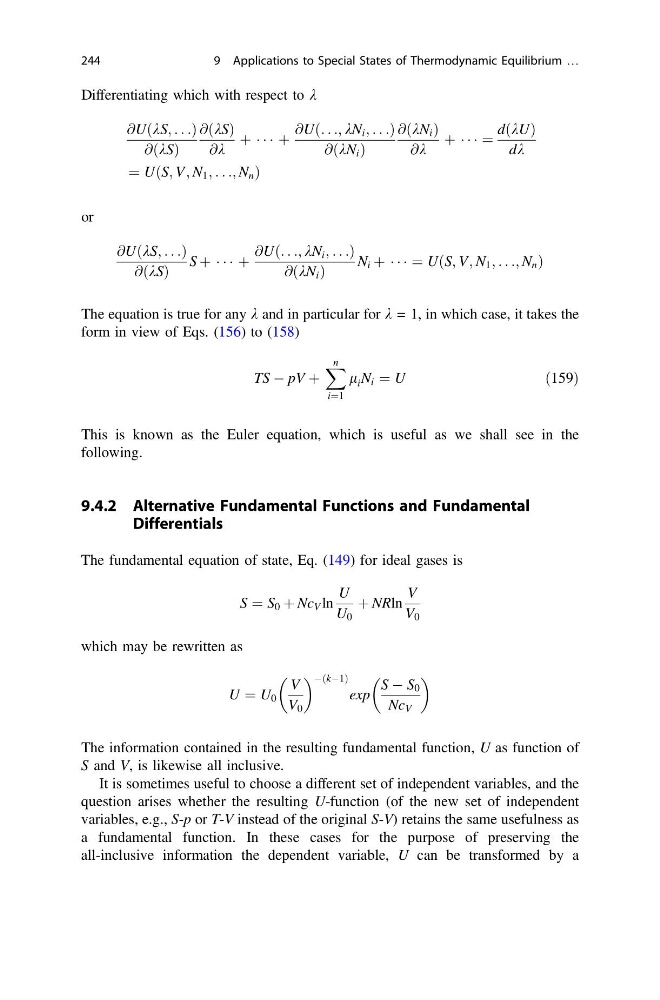
Differentiating which with respect to k
@U kS; . . .
ð
Þ
@ kS
ð Þ
@ kS
ð Þ
@k
þ Á Á Á þ
@U . . .; kN i ; . . .
ð
Þ
@ kN i
ð Þ
@ kN i
ð Þ
@k
þ Á Á Á ¼
d kU
ð Þ
dk
¼ U S; V; N 1 ; . . .; N n
ð
Þ
or
@U kS; . . .
ð
Þ
@ kS
ð Þ
S þ Á Á Á þ
@U . . .; kN i ; . . .
ð
Þ
@ kN i
ð Þ
N i þ Á Á Á ¼ U S; V; N 1 ; . . .; N n
ð
Þ
The equation is true for any k and in particular for k = 1, in which case, it takes the
form in view of Eqs. (156) to (158)
TS À pV þ
X n
i¼1
l i N i ¼ U
ð159Þ
This is known as the Euler equation, which is useful as we shall see in the
following.
9.4.2 Alternative Fundamental Functions and Fundamental
Differentials
The fundamental equation of state, Eq. (149) for ideal gases is
S ¼ S 0 þ Nc V ln
U
U 0
þ NRln
V
V 0
which may be rewritten as
U ¼ U 0
V
V 0
À kÀ1
ð
Þ
exp
S À S 0
Nc V
The information contained in the resulting fundamental function, U as function of
S and V, is likewise all inclusive.
It is sometimes useful to choose a different set of independent variables, and the
question arises whether the resulting U-function (of the new set of independent
variables, e.g., S-p or T-V instead of the original S-V) retains the same usefulness as
a fundamental function. In these cases for the purpose of preserving the
all-inclusive information the dependent variable, U can be transformed by a
244
9 Applications to Special States of Thermodynamic Equilibrium …
@U kS; . . .
ð
Þ
@ kS
ð Þ
@ kS
ð Þ
@k
þ Á Á Á þ
@U . . .; kN i ; . . .
ð
Þ
@ kN i
ð Þ
@ kN i
ð Þ
@k
þ Á Á Á ¼
d kU
ð Þ
dk
¼ U S; V; N 1 ; . . .; N n
ð
Þ
or
@U kS; . . .
ð
Þ
@ kS
ð Þ
S þ Á Á Á þ
@U . . .; kN i ; . . .
ð
Þ
@ kN i
ð Þ
N i þ Á Á Á ¼ U S; V; N 1 ; . . .; N n
ð
Þ
The equation is true for any k and in particular for k = 1, in which case, it takes the
form in view of Eqs. (156) to (158)
TS À pV þ
X n
i¼1
l i N i ¼ U
ð159Þ
This is known as the Euler equation, which is useful as we shall see in the
following.
9.4.2 Alternative Fundamental Functions and Fundamental
Differentials
The fundamental equation of state, Eq. (149) for ideal gases is
S ¼ S 0 þ Nc V ln
U
U 0
þ NRln
V
V 0
which may be rewritten as
U ¼ U 0
V
V 0
À kÀ1
ð
Þ
exp
S À S 0
Nc V
The information contained in the resulting fundamental function, U as function of
S and V, is likewise all inclusive.
It is sometimes useful to choose a different set of independent variables, and the
question arises whether the resulting U-function (of the new set of independent
variables, e.g., S-p or T-V instead of the original S-V) retains the same usefulness as
a fundamental function. In these cases for the purpose of preserving the
all-inclusive information the dependent variable, U can be transformed by a
244
9 Applications to Special States of Thermodynamic Equilibrium …