

9.4 Formal Structure of Gibbsian Thermodynamics
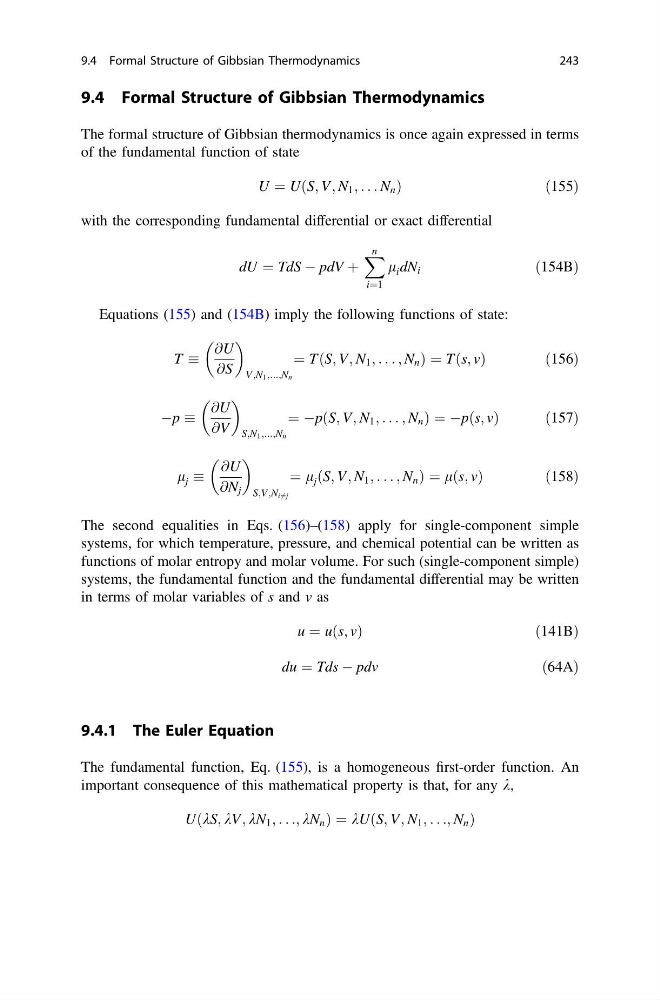
The formal structure of Gibbsian thermodynamics is once again expressed in terms
of the fundamental function of state
U ¼ U S; V; N 1 ; . . . N n
ð
Þ
ð 155Þ
with the corresponding fundamental differential or exact differential
dU ¼ TdS À pdV þ
X n
i¼1
l i dN i
ð154BÞ
Equations (155) and (154B) imply the following functions of state:
T
@U
@S
V;N 1 ;...;N n
¼ T S; V; N 1 ; . . . ; N n
ð
Þ ¼ T s; v
ð Þ
ð156Þ
Àp
@U
@V
S;N 1 ;...;N n
¼ Àp S; V; N 1 ; . . . ; N n
ð
Þ ¼ À p s; v
ð Þ
ð157Þ
l j
@U
@N j
S;V;N i6 ¼j
¼ l j S; V; N 1 ; . . . ; N n
ð
Þ ¼ l s; v
ð Þ
ð158Þ
The second equalities in Eqs. (156)–(158) apply for single-component simple
systems, for which temperature, pressure, and chemical potential can be written as
functions of molar entropy and molar volume. For such (single-component simple)
systems, the fundamental function and the fundamental differential may be written
in terms of molar variables of s and v as
u ¼ u s; v
ð Þ
ð141BÞ
du ¼ Tds À pdv
ð64AÞ
9.4.1 The Euler Equation
The fundamental function, Eq. (155), is a homogeneous first-order function. An
important consequence of this mathematical property is that, for any k,
U kS; kV; kN 1 ; . . .; kN n
ð
Þ ¼ kU S; V; N 1 ; . . .; N n
ð
Þ
9.4 Formal Structure of Gibbsian Thermodynamics
243
The formal structure of Gibbsian thermodynamics is once again expressed in terms
of the fundamental function of state
U ¼ U S; V; N 1 ; . . . N n
ð
Þ
ð 155Þ
with the corresponding fundamental differential or exact differential
dU ¼ TdS À pdV þ
X n
i¼1
l i dN i
ð154BÞ
Equations (155) and (154B) imply the following functions of state:
T
@U
@S
V;N 1 ;...;N n
¼ T S; V; N 1 ; . . . ; N n
ð
Þ ¼ T s; v
ð Þ
ð156Þ
Àp
@U
@V
S;N 1 ;...;N n
¼ Àp S; V; N 1 ; . . . ; N n
ð
Þ ¼ À p s; v
ð Þ
ð157Þ
l j
@U
@N j
S;V;N i6 ¼j
¼ l j S; V; N 1 ; . . . ; N n
ð
Þ ¼ l s; v
ð Þ
ð158Þ
The second equalities in Eqs. (156)–(158) apply for single-component simple
systems, for which temperature, pressure, and chemical potential can be written as
functions of molar entropy and molar volume. For such (single-component simple)
systems, the fundamental function and the fundamental differential may be written
in terms of molar variables of s and v as
u ¼ u s; v
ð Þ
ð141BÞ
du ¼ Tds À pdv
ð64AÞ
9.4.1 The Euler Equation
The fundamental function, Eq. (155), is a homogeneous first-order function. An
important consequence of this mathematical property is that, for any k,
U kS; kV; kN 1 ; . . .; kN n
ð
Þ ¼ kU S; V; N 1 ; . . .; N n
ð
Þ
9.4 Formal Structure of Gibbsian Thermodynamics
243