

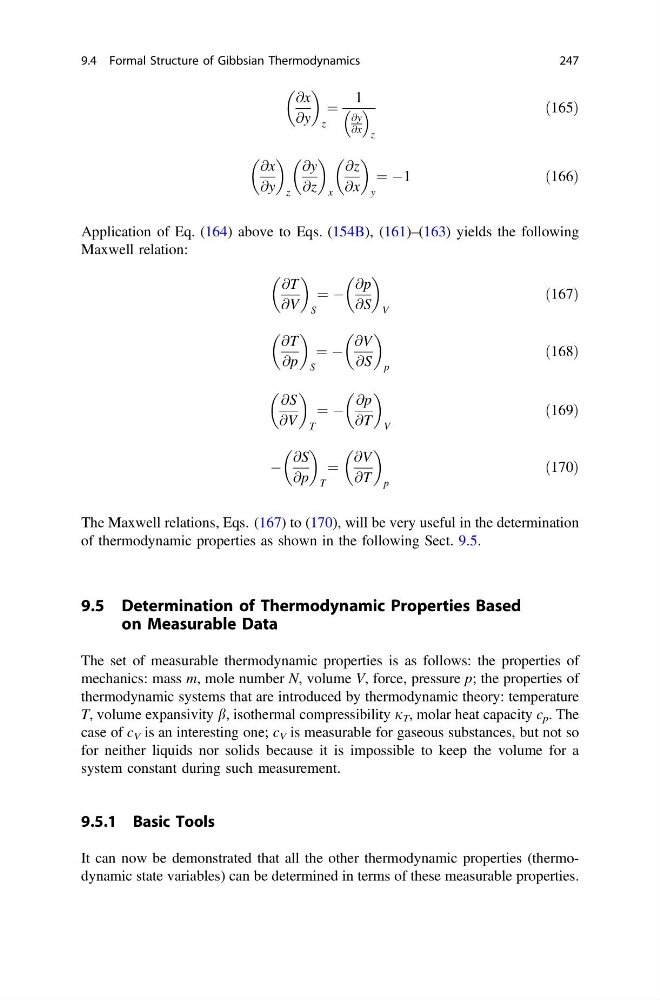
@x
@y
z
¼
1
@y
@x
z
ð165Þ
@x
@y
z
@y
@z
x
@z
@x
y
¼ À1
ð166Þ
Application of Eq. (164) above to Eqs. (154B), (161)–(163) yields the following
Maxwell relation:
@T
@V
S
¼ À
@p
@S
V
ð167Þ
@T
@p
S
¼ À
@V
@S
p
ð168Þ
@S
@V
T
¼ À
@p
@T
V
ð169Þ
À
@S
@p
T
¼
@V
@T
p
ð170Þ
The Maxwell relations, Eqs. (167) to (170), will be very useful in the determination
of thermodynamic properties as shown in the following Sect. 9.5.
9.5 Determination of Thermodynamic Properties Based
on Measurable Data
The set of measurable thermodynamic properties is as follows: the properties of
mechanics: mass m, mole number N, volume V, force, pressure p; the properties of
thermodynamic systems that are introduced by thermodynamic theory: temperature
T, volume expansivity b, isothermal compressibility j T , molar heat capacity c p . The
case of c V is an interesting one; c V is measurable for gaseous substances, but not so
for neither liquids nor solids because it is impossible to keep the volume for a
system constant during such measurement.
9.5.1 Basic Tools
It can now be demonstrated that all the other thermodynamic properties (thermodynamic state variables) can be determined in terms of these measurable properties.
9.4 Formal Structure of Gibbsian Thermodynamics
247
@y
z
¼
1
@y
@x
z
ð165Þ
@x
@y
z
@y
@z
x
@z
@x
y
¼ À1
ð166Þ
Application of Eq. (164) above to Eqs. (154B), (161)–(163) yields the following
Maxwell relation:
@T
@V
S
¼ À
@p
@S
V
ð167Þ
@T
@p
S
¼ À
@V
@S
p
ð168Þ
@S
@V
T
¼ À
@p
@T
V
ð169Þ
À
@S
@p
T
¼
@V
@T
p
ð170Þ
The Maxwell relations, Eqs. (167) to (170), will be very useful in the determination
of thermodynamic properties as shown in the following Sect. 9.5.
9.5 Determination of Thermodynamic Properties Based
on Measurable Data
The set of measurable thermodynamic properties is as follows: the properties of
mechanics: mass m, mole number N, volume V, force, pressure p; the properties of
thermodynamic systems that are introduced by thermodynamic theory: temperature
T, volume expansivity b, isothermal compressibility j T , molar heat capacity c p . The
case of c V is an interesting one; c V is measurable for gaseous substances, but not so
for neither liquids nor solids because it is impossible to keep the volume for a
system constant during such measurement.
9.5.1 Basic Tools
It can now be demonstrated that all the other thermodynamic properties (thermodynamic state variables) can be determined in terms of these measurable properties.
9.4 Formal Structure of Gibbsian Thermodynamics
247