

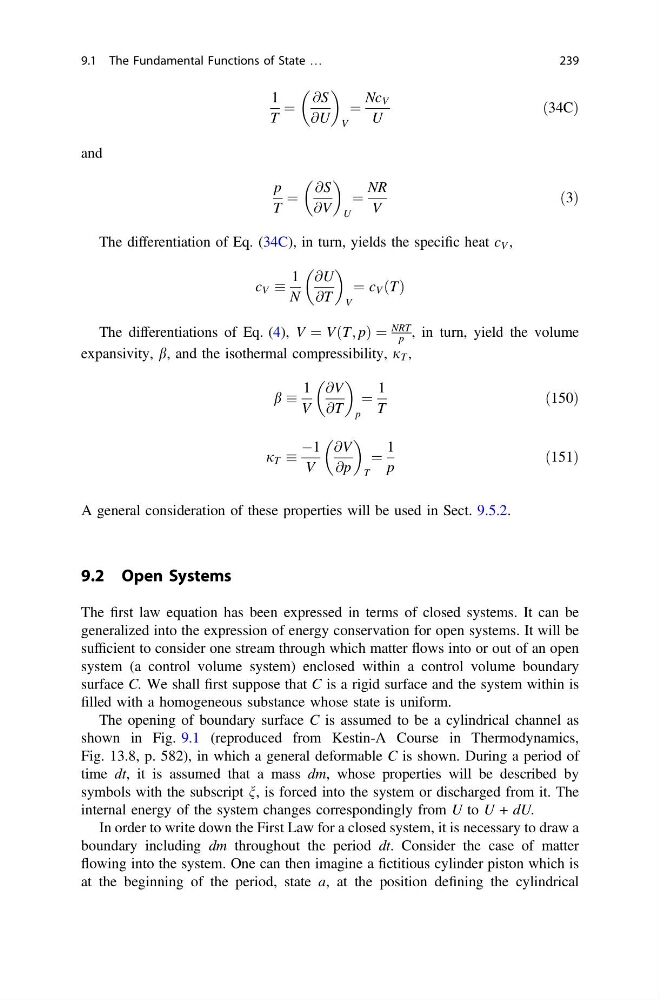
1
T
¼
@S
@U
V
¼
Nc V
U
ð34CÞ
and
p
T
¼
@S
@V
U
¼
NR
V
ð3Þ
The differentiation of Eq. (34C), in turn, yields the specific heat c V ,
c V
1
N
@U
@T
V
¼ c V T
ð Þ
The differentiations of Eq. (4), V ¼ V T; p
ð
Þ ¼
NRT
p , in turn, yield the volume
expansivity, b, and the isothermal compressibility, j T ,
b
1
V
@V
@T
p
¼
1
T
ð150Þ
j T
À1
V
@V
@p
T
¼
1
p
ð151Þ
A general consideration of these properties will be used in Sect. 9.5.2.
9.2 Open Systems
The first law equation has been expressed in terms of closed systems. It can be
generalized into the expression of energy conservation for open systems. It will be
sufficient to consider one stream through which matter flows into or out of an open
system (a control volume system) enclosed within a control volume boundary
surface C. We shall first suppose that C is a rigid surface and the system within is
filled with a homogeneous substance whose state is uniform.
The opening of boundary surface C is assumed to be a cylindrical channel as
shown in Fig. 9.1 (reproduced from Kestin-A Course in Thermodynamics,
Fig. 13.8, p. 582), in which a general deformable C is shown. During a period of
time dt, it is assumed that a mass dm, whose properties will be described by
symbols with the subscript n, is forced into the system or discharged from it. The
internal energy of the system changes correspondingly from U to U + dU.
In order to write down the First Law for a closed system, it is necessary to draw a
boundary including dm throughout the period dt. Consider the case of matter
flowing into the system. One can then imagine a fictitious cylinder piston which is
at the beginning of the period, state a, at the position defining the cylindrical
9.1 The Fundamental Functions of State …
239
T
¼
@S
@U
V
¼
Nc V
U
ð34CÞ
and
p
T
¼
@S
@V
U
¼
NR
V
ð3Þ
The differentiation of Eq. (34C), in turn, yields the specific heat c V ,
c V
1
N
@U
@T
V
¼ c V T
ð Þ
The differentiations of Eq. (4), V ¼ V T; p
ð
Þ ¼
NRT
p , in turn, yield the volume
expansivity, b, and the isothermal compressibility, j T ,
b
1
V
@V
@T
p
¼
1
T
ð150Þ
j T
À1
V
@V
@p
T
¼
1
p
ð151Þ
A general consideration of these properties will be used in Sect. 9.5.2.
9.2 Open Systems
The first law equation has been expressed in terms of closed systems. It can be
generalized into the expression of energy conservation for open systems. It will be
sufficient to consider one stream through which matter flows into or out of an open
system (a control volume system) enclosed within a control volume boundary
surface C. We shall first suppose that C is a rigid surface and the system within is
filled with a homogeneous substance whose state is uniform.
The opening of boundary surface C is assumed to be a cylindrical channel as
shown in Fig. 9.1 (reproduced from Kestin-A Course in Thermodynamics,
Fig. 13.8, p. 582), in which a general deformable C is shown. During a period of
time dt, it is assumed that a mass dm, whose properties will be described by
symbols with the subscript n, is forced into the system or discharged from it. The
internal energy of the system changes correspondingly from U to U + dU.
In order to write down the First Law for a closed system, it is necessary to draw a
boundary including dm throughout the period dt. Consider the case of matter
flowing into the system. One can then imagine a fictitious cylinder piston which is
at the beginning of the period, state a, at the position defining the cylindrical
9.1 The Fundamental Functions of State …
239