

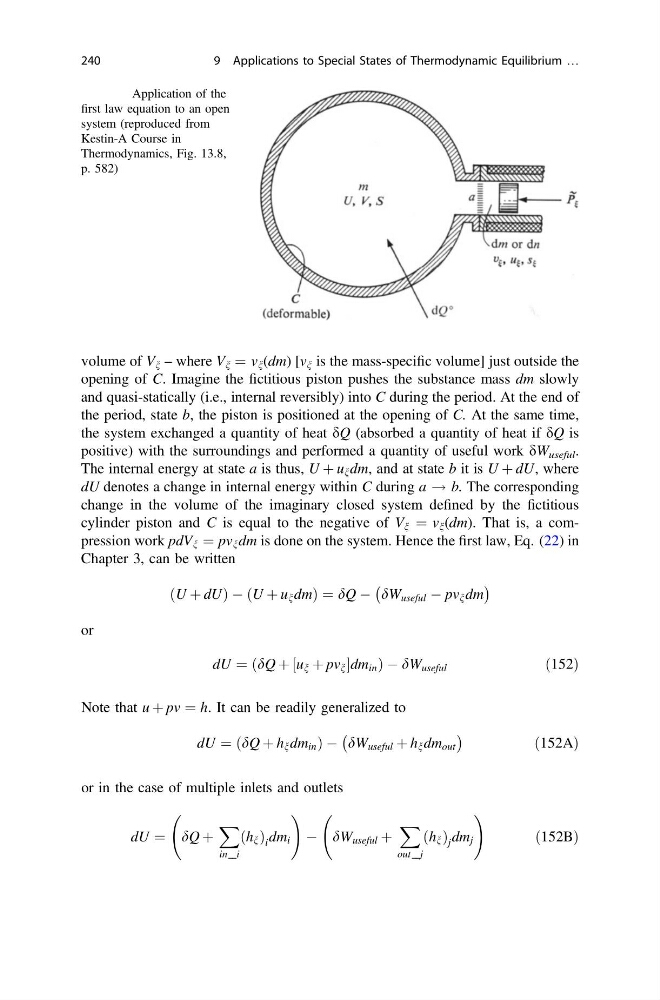
volume of V n – where V n ¼ v n (dm) [v n is the mass-specific volume] just outside the
opening of C. Imagine the fictitious piston pushes the substance mass dm slowly
and quasi-statically (i.e., internal reversibly) into C during the period. At the end of
the period, state b, the piston is positioned at the opening of C. At the same time,
the system exchanged a quantity of heat dQ (absorbed a quantity of heat if dQ is
positive) with the surroundings and performed a quantity of useful work dW useful .
The internal energy at state a is thus, U þ u n dm, and at state b it is U þ dU, where
dU denotes a change in internal energy within C during a ! b. The corresponding
change in the volume of the imaginary closed system defined by the fictitious
cylinder piston and C is equal to the negative of V n ¼ v n (dm). That is, a compression work pdV n ¼ pv n dm is done on the system. Hence the first law, Eq. (22) in
Chapter 3, can be written
U þ dU
ð
ÞÀ U þ u n dm
ð
Þ¼dQ À dW useful À pv n dm
À
Á
or
dU ¼ dQ þ u n þ pv n
½
dm in
ð
Þ À dW useful
ð152Þ
Note that u þ pv ¼ h. It can be readily generalized to
dU ¼ dQ þ h n dm in
ð
ÞÀ dW useful þ h n dm out
À
Á
ð152AÞ
or in the case of multiple inlets and outlets
dU ¼ dQ þ
X
in i
h n
ð Þ i dm i
!
À dW useful þ
X
out j
h n
ð Þ j dm j
!
ð152BÞ
Fig. 9.1 Application of the
first law equation to an open
system (reproduced from
Kestin-A Course in
Thermodynamics, Fig. 13.8,
p. 582)
240
9 Applications to Special States of Thermodynamic Equilibrium …
opening of C. Imagine the fictitious piston pushes the substance mass dm slowly
and quasi-statically (i.e., internal reversibly) into C during the period. At the end of
the period, state b, the piston is positioned at the opening of C. At the same time,
the system exchanged a quantity of heat dQ (absorbed a quantity of heat if dQ is
positive) with the surroundings and performed a quantity of useful work dW useful .
The internal energy at state a is thus, U þ u n dm, and at state b it is U þ dU, where
dU denotes a change in internal energy within C during a ! b. The corresponding
change in the volume of the imaginary closed system defined by the fictitious
cylinder piston and C is equal to the negative of V n ¼ v n (dm). That is, a compression work pdV n ¼ pv n dm is done on the system. Hence the first law, Eq. (22) in
Chapter 3, can be written
U þ dU
ð
ÞÀ U þ u n dm
ð
Þ¼dQ À dW useful À pv n dm
À
Á
or
dU ¼ dQ þ u n þ pv n
½
dm in
ð
Þ À dW useful
ð152Þ
Note that u þ pv ¼ h. It can be readily generalized to
dU ¼ dQ þ h n dm in
ð
ÞÀ dW useful þ h n dm out
À
Á
ð152AÞ
or in the case of multiple inlets and outlets
dU ¼ dQ þ
X
in i
h n
ð Þ i dm i
!
À dW useful þ
X
out j
h n
ð Þ j dm j
!
ð152BÞ
Fig. 9.1 Application of the
first law equation to an open
system (reproduced from
Kestin-A Course in
Thermodynamics, Fig. 13.8,
p. 582)
240
9 Applications to Special States of Thermodynamic Equilibrium …