

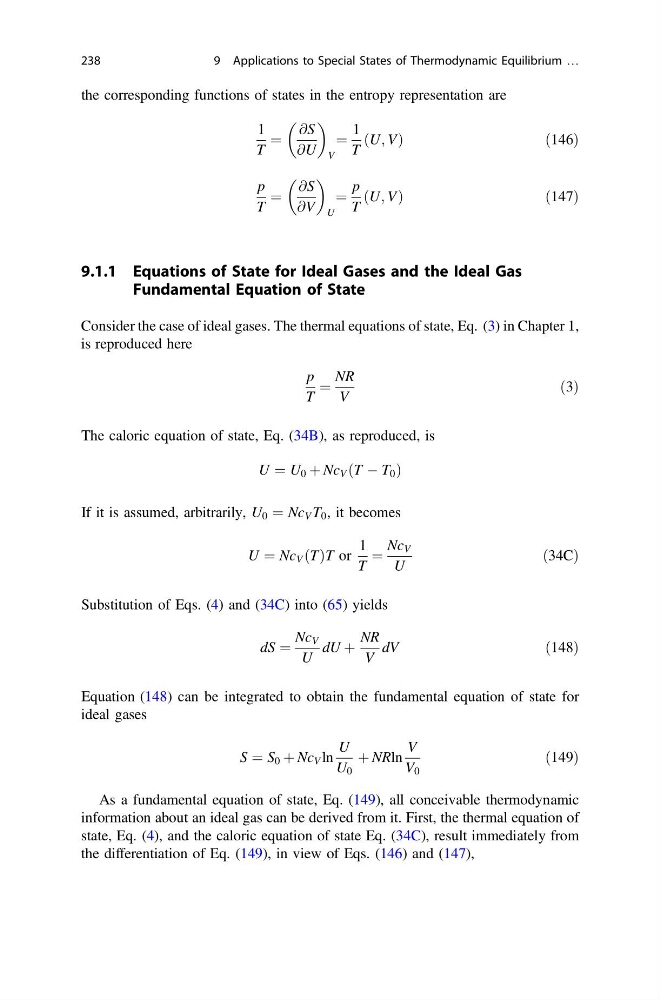
the corresponding functions of states in the entropy representation are
1
T
¼
@S
@U
V
¼
1
T
U; V
ð
Þ
ð146Þ
p
T
¼
@S
@V
U
¼
p
T
U; V
ð
Þ
ð147Þ
9.1.1 Equations of State for Ideal Gases and the Ideal Gas
Fundamental Equation of State
Consider the case of ideal gases. The thermal equations of state, Eq. (3) in Chapter 1,
is reproduced here
p
T
¼
NR
V
ð3Þ
The caloric equation of state, Eq. (34B), as reproduced, is
U ¼ U 0 þ Nc V T À T 0
ð
Þ
If it is assumed, arbitrarily, U 0 ¼ Nc V T 0 , it becomes
U ¼ Nc V T
ð ÞT or
1
T
¼
Nc V
U
ð34CÞ
Substitution of Eqs. (4) and (34C) into (65) yields
dS ¼
Nc V
U
dU þ
NR
V
dV
ð148Þ
Equation (148) can be integrated to obtain the fundamental equation of state for
ideal gases
S ¼ S 0 þ Nc V ln
U
U 0
þ NRln
V
V 0
ð149Þ
As a fundamental equation of state, Eq. (149), all conceivable thermodynamic
information about an ideal gas can be derived from it. First, the thermal equation of
state, Eq. (4), and the caloric equation of state Eq. (34C), result immediately from
the differentiation of Eq. (149), in view of Eqs. (146) and (147),
238
9 Applications to Special States of Thermodynamic Equilibrium …
1
T
¼
@S
@U
V
¼
1
T
U; V
ð
Þ
ð146Þ
p
T
¼
@S
@V
U
¼
p
T
U; V
ð
Þ
ð147Þ
9.1.1 Equations of State for Ideal Gases and the Ideal Gas
Fundamental Equation of State
Consider the case of ideal gases. The thermal equations of state, Eq. (3) in Chapter 1,
is reproduced here
p
T
¼
NR
V
ð3Þ
The caloric equation of state, Eq. (34B), as reproduced, is
U ¼ U 0 þ Nc V T À T 0
ð
Þ
If it is assumed, arbitrarily, U 0 ¼ Nc V T 0 , it becomes
U ¼ Nc V T
ð ÞT or
1
T
¼
Nc V
U
ð34CÞ
Substitution of Eqs. (4) and (34C) into (65) yields
dS ¼
Nc V
U
dU þ
NR
V
dV
ð148Þ
Equation (148) can be integrated to obtain the fundamental equation of state for
ideal gases
S ¼ S 0 þ Nc V ln
U
U 0
þ NRln
V
V 0
ð149Þ
As a fundamental equation of state, Eq. (149), all conceivable thermodynamic
information about an ideal gas can be derived from it. First, the thermal equation of
state, Eq. (4), and the caloric equation of state Eq. (34C), result immediately from
the differentiation of Eq. (149), in view of Eqs. (146) and (147),
238
9 Applications to Special States of Thermodynamic Equilibrium …