

thermodynamic information about the system is ascertainable from it.” The reader is
reminded again that this statement is correct in so far as all conceivable information
about the system in and by itself not with regard to how the system interacts with its
surroundings in the interconnected universe. This chapter treats the problems of the
former kind while Chap. 10 will comment on the matter of the latter.
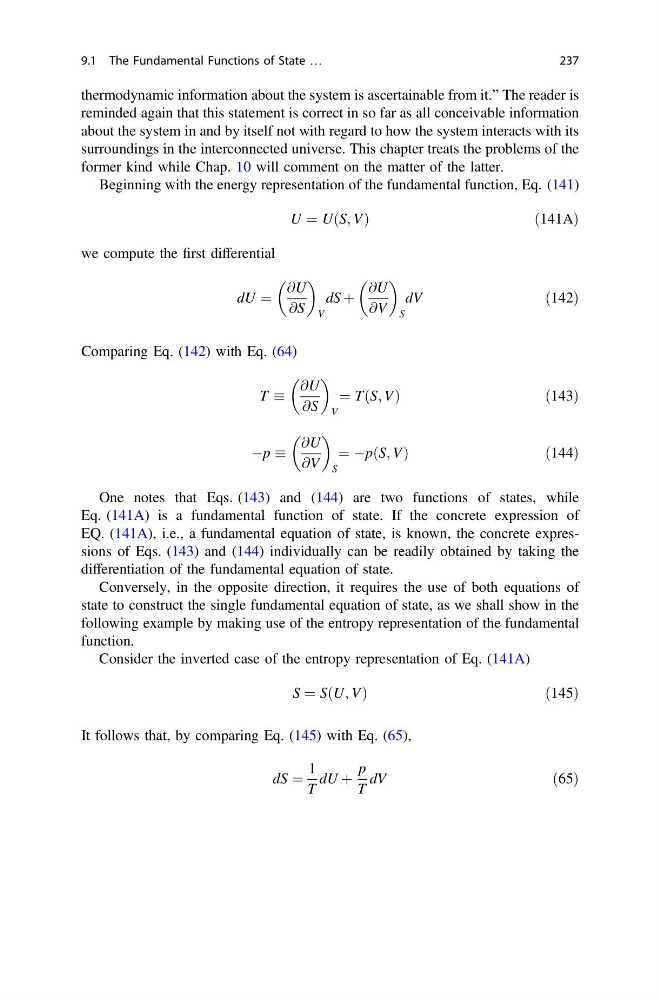
Beginning with the energy representation of the fundamental function, Eq. (141)
U ¼ U S; V
ð
Þ
ð141AÞ
we compute the first differential
dU ¼
@U
@S
V
dS þ
@U
@V
S
dV
ð142Þ
Comparing Eq. (142) with Eq. (64)
T
@U
@S
V
¼ T S; V
ð
Þ
ð143Þ
Àp
@U
@V
S
¼ Àp S; V
ð
Þ
ð144Þ
One notes that Eqs. (143) and (144) are two functions of states, while
Eq. (141A) is a fundamental function of state. If the concrete expression of
EQ. (141A), i.e., a fundamental equation of state, is known, the concrete expressions of Eqs. (143) and (144) individually can be readily obtained by taking the
differentiation of the fundamental equation of state.
Conversely, in the opposite direction, it requires the use of both equations of
state to construct the single fundamental equation of state, as we shall show in the
following example by making use of the entropy representation of the fundamental
function.
Consider the inverted case of the entropy representation of Eq. (141A)
S ¼ S U; V
ð
Þ
ð145Þ
It follows that, by comparing Eq. (145) with Eq. (65),
dS ¼
1
T
dU þ
p
T
dV
ð65Þ
9.1 The Fundamental Functions of State …
237
reminded again that this statement is correct in so far as all conceivable information
about the system in and by itself not with regard to how the system interacts with its
surroundings in the interconnected universe. This chapter treats the problems of the
former kind while Chap. 10 will comment on the matter of the latter.
Beginning with the energy representation of the fundamental function, Eq. (141)
U ¼ U S; V
ð
Þ
ð141AÞ
we compute the first differential
dU ¼
@U
@S
V
dS þ
@U
@V
S
dV
ð142Þ
Comparing Eq. (142) with Eq. (64)
T
@U
@S
V
¼ T S; V
ð
Þ
ð143Þ
Àp
@U
@V
S
¼ Àp S; V
ð
Þ
ð144Þ
One notes that Eqs. (143) and (144) are two functions of states, while
Eq. (141A) is a fundamental function of state. If the concrete expression of
EQ. (141A), i.e., a fundamental equation of state, is known, the concrete expressions of Eqs. (143) and (144) individually can be readily obtained by taking the
differentiation of the fundamental equation of state.
Conversely, in the opposite direction, it requires the use of both equations of
state to construct the single fundamental equation of state, as we shall show in the
following example by making use of the entropy representation of the fundamental
function.
Consider the inverted case of the entropy representation of Eq. (141A)
S ¼ S U; V
ð
Þ
ð145Þ
It follows that, by comparing Eq. (145) with Eq. (65),
dS ¼
1
T
dU þ
p
T
dV
ð65Þ
9.1 The Fundamental Functions of State …
237