

9.1 The Fundamental Functions of State
and the Fundamental Differentials
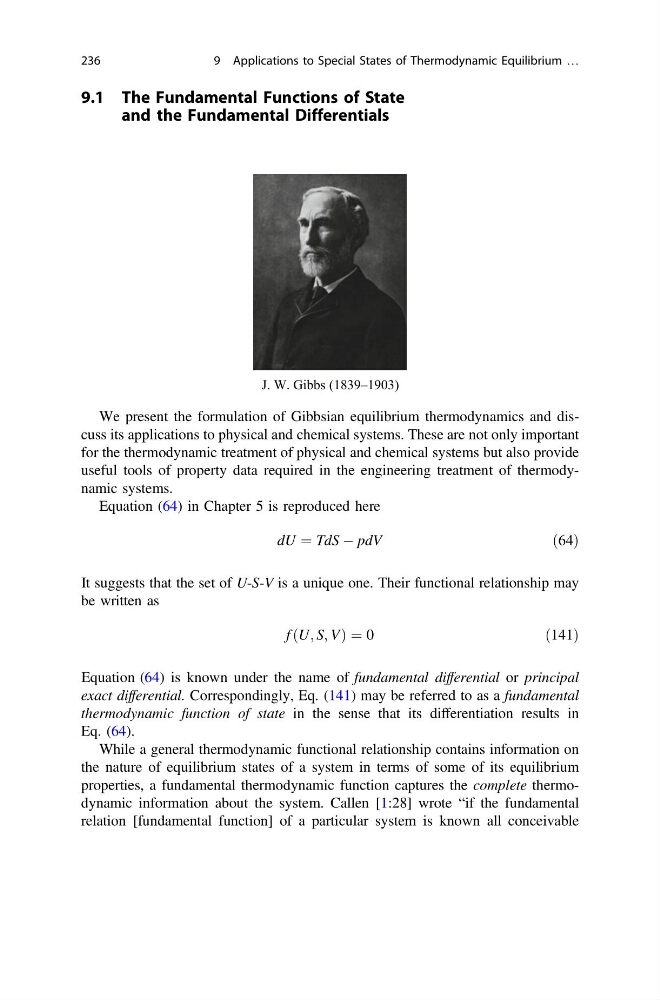
J. W. Gibbs (1839–1903)
We present the formulation of Gibbsian equilibrium thermodynamics and discuss its applications to physical and chemical systems. These are not only important
for the thermodynamic treatment of physical and chemical systems but also provide
useful tools of property data required in the engineering treatment of thermodynamic systems.
Equation (64) in Chapter 5 is reproduced here
dU ¼ TdS À pdV
ð64Þ
It suggests that the set of U-S-V is a unique one. Their functional relationship may
be written as
f U; S; V
ð
Þ¼0
ð141Þ
Equation (64) is known under the name of fundamental differential or principal
exact differential. Correspondingly, Eq. (141) may be referred to as a fundamental
thermodynamic function of state in the sense that its differentiation results in
Eq. (64).
While a general thermodynamic functional relationship contains information on
the nature of equilibrium states of a system in terms of some of its equilibrium
properties, a fundamental thermodynamic function captures the complete thermodynamic information about the system. Callen [1:28] wrote “if the fundamental
relation [fundamental function] of a particular system is known all conceivable
236
9 Applications to Special States of Thermodynamic Equilibrium …
and the Fundamental Differentials
J. W. Gibbs (1839–1903)
We present the formulation of Gibbsian equilibrium thermodynamics and discuss its applications to physical and chemical systems. These are not only important
for the thermodynamic treatment of physical and chemical systems but also provide
useful tools of property data required in the engineering treatment of thermodynamic systems.
Equation (64) in Chapter 5 is reproduced here
dU ¼ TdS À pdV
ð64Þ
It suggests that the set of U-S-V is a unique one. Their functional relationship may
be written as
f U; S; V
ð
Þ¼0
ð141Þ
Equation (64) is known under the name of fundamental differential or principal
exact differential. Correspondingly, Eq. (141) may be referred to as a fundamental
thermodynamic function of state in the sense that its differentiation results in
Eq. (64).
While a general thermodynamic functional relationship contains information on
the nature of equilibrium states of a system in terms of some of its equilibrium
properties, a fundamental thermodynamic function captures the complete thermodynamic information about the system. Callen [1:28] wrote “if the fundamental
relation [fundamental function] of a particular system is known all conceivable
236
9 Applications to Special States of Thermodynamic Equilibrium …