

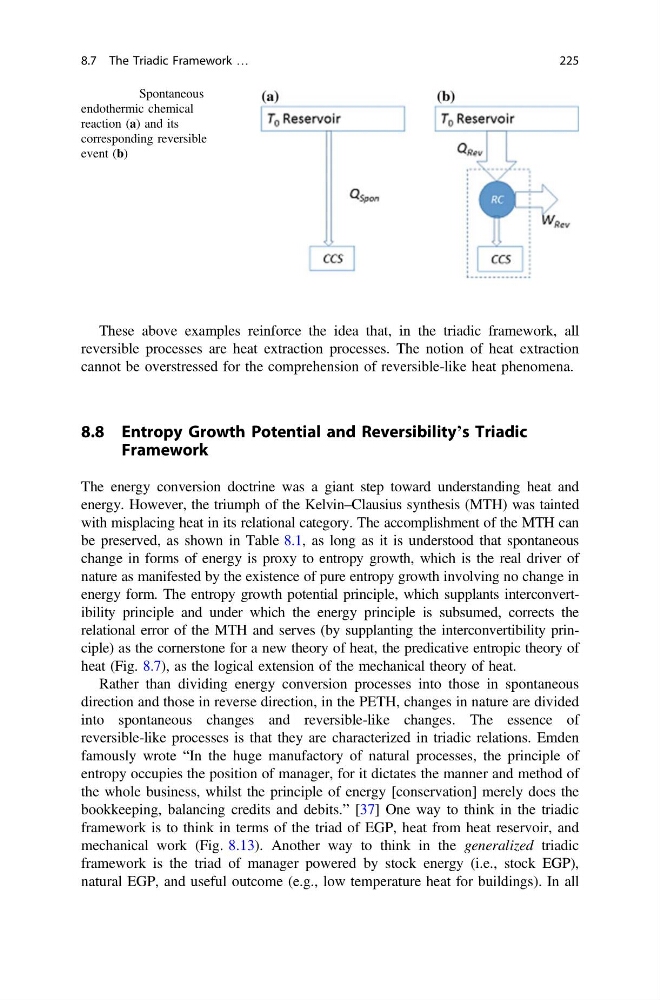
These above examples reinforce the idea that, in the triadic framework, all
reversible processes are heat extraction processes. The notion of heat extraction
cannot be overstressed for the comprehension of reversible-like heat phenomena.
8.8 Entropy Growth Potential and Reversibility’s Triadic
Framework
The energy conversion doctrine was a giant step toward understanding heat and
energy. However, the triumph of the Kelvin–Clausius synthesis (MTH) was tainted
with misplacing heat in its relational category. The accomplishment of the MTH can
be preserved, as shown in Table 8.1, as long as it is understood that spontaneous
change in forms of energy is proxy to entropy growth, which is the real driver of
nature as manifested by the existence of pure entropy growth involving no change in
energy form. The entropy growth potential principle, which supplants interconvertibility principle and under which the energy principle is subsumed, corrects the
relational error of the MTH and serves (by supplanting the interconvertibility principle) as the cornerstone for a new theory of heat, the predicative entropic theory of
heat (Fig. 8.7), as the logical extension of the mechanical theory of heat.
Rather than dividing energy conversion processes into those in spontaneous
direction and those in reverse direction, in the PETH, changes in nature are divided
into spontaneous changes and reversible-like changes. The essence of
reversible-like processes is that they are characterized in triadic relations. Emden
famously wrote “In the huge manufactory of natural processes, the principle of
entropy occupies the position of manager, for it dictates the manner and method of
the whole business, whilst the principle of energy [conservation] merely does the
bookkeeping, balancing credits and debits.” [37] One way to think in the triadic
framework is to think in terms of the triad of EGP, heat from heat reservoir, and
mechanical work (Fig. 8.13). Another way to think in the generalized triadic
framework is the triad of manager powered by stock energy (i.e., stock EGP),
natural EGP, and useful outcome (e.g., low temperature heat for buildings). In all
Fig. 8.12 Spontaneous
endothermic chemical
reaction (a) and its
corresponding reversible
event (b)
8.7 The Triadic Framework …
225
reversible processes are heat extraction processes. The notion of heat extraction
cannot be overstressed for the comprehension of reversible-like heat phenomena.
8.8 Entropy Growth Potential and Reversibility’s Triadic
Framework
The energy conversion doctrine was a giant step toward understanding heat and
energy. However, the triumph of the Kelvin–Clausius synthesis (MTH) was tainted
with misplacing heat in its relational category. The accomplishment of the MTH can
be preserved, as shown in Table 8.1, as long as it is understood that spontaneous
change in forms of energy is proxy to entropy growth, which is the real driver of
nature as manifested by the existence of pure entropy growth involving no change in
energy form. The entropy growth potential principle, which supplants interconvertibility principle and under which the energy principle is subsumed, corrects the
relational error of the MTH and serves (by supplanting the interconvertibility principle) as the cornerstone for a new theory of heat, the predicative entropic theory of
heat (Fig. 8.7), as the logical extension of the mechanical theory of heat.
Rather than dividing energy conversion processes into those in spontaneous
direction and those in reverse direction, in the PETH, changes in nature are divided
into spontaneous changes and reversible-like changes. The essence of
reversible-like processes is that they are characterized in triadic relations. Emden
famously wrote “In the huge manufactory of natural processes, the principle of
entropy occupies the position of manager, for it dictates the manner and method of
the whole business, whilst the principle of energy [conservation] merely does the
bookkeeping, balancing credits and debits.” [37] One way to think in the triadic
framework is to think in terms of the triad of EGP, heat from heat reservoir, and
mechanical work (Fig. 8.13). Another way to think in the generalized triadic
framework is the triad of manager powered by stock energy (i.e., stock EGP),
natural EGP, and useful outcome (e.g., low temperature heat for buildings). In all
Fig. 8.12 Spontaneous
endothermic chemical
reaction (a) and its
corresponding reversible
event (b)
8.7 The Triadic Framework …
225