

First consider the case of Q Rev having the same sign as Q Spon . As always the
inequality Q Rev [ Q Spon applies, i.e., Q Rev is a smaller negative number than Q Spon
with a corresponding ΔS being a small negative number as shown in Fig. 8.10b.
The same remark that was made for the isolated composite systems applies here.
The true “cost” of work production is not the energy in terms of the enthalpy of the
spontaneous heat dissipation, but the spontaneity that corresponds to this enthalpy
of combustion. Spontaneity or free heat is the true measure of the value of the
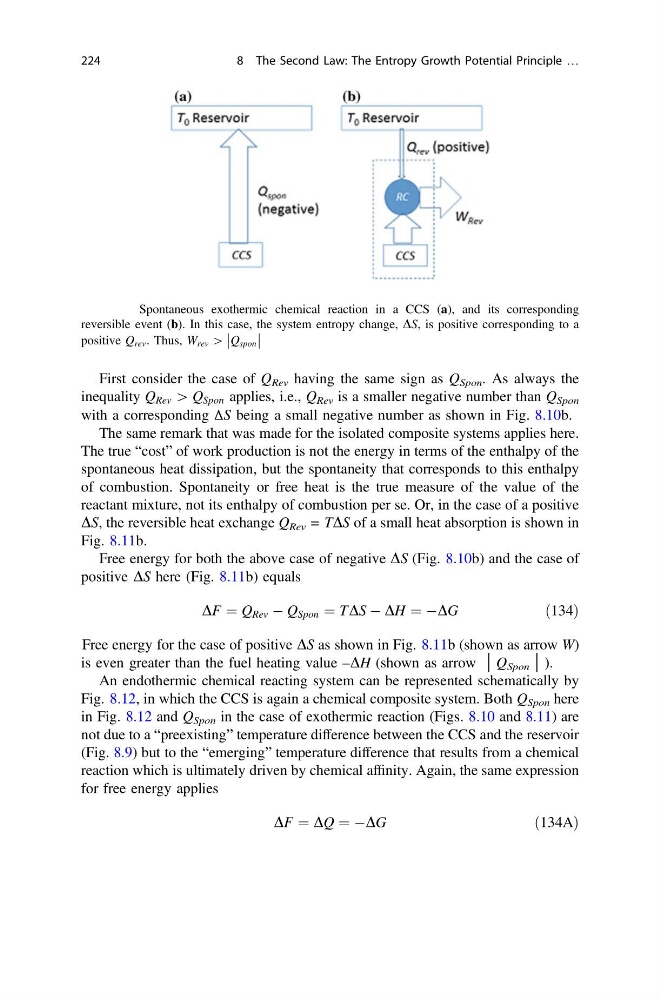
reactant mixture, not its enthalpy of combustion per se. Or, in the case of a positive
DS, the reversible heat exchange Q Rev = TDS of a small heat absorption is shown in
Fig. 8.11b.
Free energy for both the above case of negative DS (Fig. 8.10b) and the case of
positive DS here (Fig. 8.11b) equals
DF ¼ Q Rev À Q Spon ¼ TDS À DH ¼ ÀDG
ð134Þ
Free energy for the case of positive DS as shown in Fig. 8.11b (shown as arrow W)
is even greater than the fuel heating value –DH (shown as arrow │Q Spon │).
An endothermic chemical reacting system can be represented schematically by
Fig. 8.12, in which the CCS is again a chemical composite system. Both Q Spon here
in Fig. 8.12 and Q Spon in the case of exothermic reaction (Figs. 8.10 and 8.11) are
not due to a “preexisting” temperature difference between the CCS and the reservoir
(Fig. 8.9) but to the “emerging” temperature difference that results from a chemical
reaction which is ultimately driven by chemical affinity. Again, the same expression
for free energy applies
DF ¼ DQ ¼ ÀDG
ð134AÞ
Fig. 8.11 Spontaneous exothermic chemical reaction in a CCS (a), and its corresponding
reversible event (b). In this case, the system entropy change, DS, is positive corresponding to a
positive Q rev . Thus, W rev [ Q spon
224
8 The Second Law: The Entropy Growth Potential Principle …
inequality Q Rev [ Q Spon applies, i.e., Q Rev is a smaller negative number than Q Spon
with a corresponding ΔS being a small negative number as shown in Fig. 8.10b.
The same remark that was made for the isolated composite systems applies here.
The true “cost” of work production is not the energy in terms of the enthalpy of the
spontaneous heat dissipation, but the spontaneity that corresponds to this enthalpy
of combustion. Spontaneity or free heat is the true measure of the value of the
reactant mixture, not its enthalpy of combustion per se. Or, in the case of a positive
DS, the reversible heat exchange Q Rev = TDS of a small heat absorption is shown in
Fig. 8.11b.
Free energy for both the above case of negative DS (Fig. 8.10b) and the case of
positive DS here (Fig. 8.11b) equals
DF ¼ Q Rev À Q Spon ¼ TDS À DH ¼ ÀDG
ð134Þ
Free energy for the case of positive DS as shown in Fig. 8.11b (shown as arrow W)
is even greater than the fuel heating value –DH (shown as arrow │Q Spon │).
An endothermic chemical reacting system can be represented schematically by
Fig. 8.12, in which the CCS is again a chemical composite system. Both Q Spon here
in Fig. 8.12 and Q Spon in the case of exothermic reaction (Figs. 8.10 and 8.11) are
not due to a “preexisting” temperature difference between the CCS and the reservoir
(Fig. 8.9) but to the “emerging” temperature difference that results from a chemical
reaction which is ultimately driven by chemical affinity. Again, the same expression
for free energy applies
DF ¼ DQ ¼ ÀDG
ð134AÞ
Fig. 8.11 Spontaneous exothermic chemical reaction in a CCS (a), and its corresponding
reversible event (b). In this case, the system entropy change, DS, is positive corresponding to a
positive Q rev . Thus, W rev [ Q spon
224
8 The Second Law: The Entropy Growth Potential Principle …