

Q Rev À Q Spon ¼ À
T 0
T MEAN
HV À ÀHV
ð
Þ
And
DF
ð Þ comb gas ¼ D ^
Q ¼ Q Rev À Q Spon ¼ HV 1 À
T 0
T MEAN
ð133Þ
Equation (133) will be referred to as the generalized Carnot–Kelvin formula.
This simple formula, which assumes the same form of the Carnot–Kelvin formula,
Eq. (54A), is one of the new results of free energy derived here. Note that in
Eq. (133) DF B = 0, thus
DF
ð Þ AB ¼ DF A
The same notation applies to Eqs. (134) and (134A) below.
8.7.5 Chemical Composite Systems: Gibbs Free Energy
Changes to chemical or physical composite systems at the same temperature with
its surrounding (T = T 0 ) are driven by affinities of various kinds. An exothermic
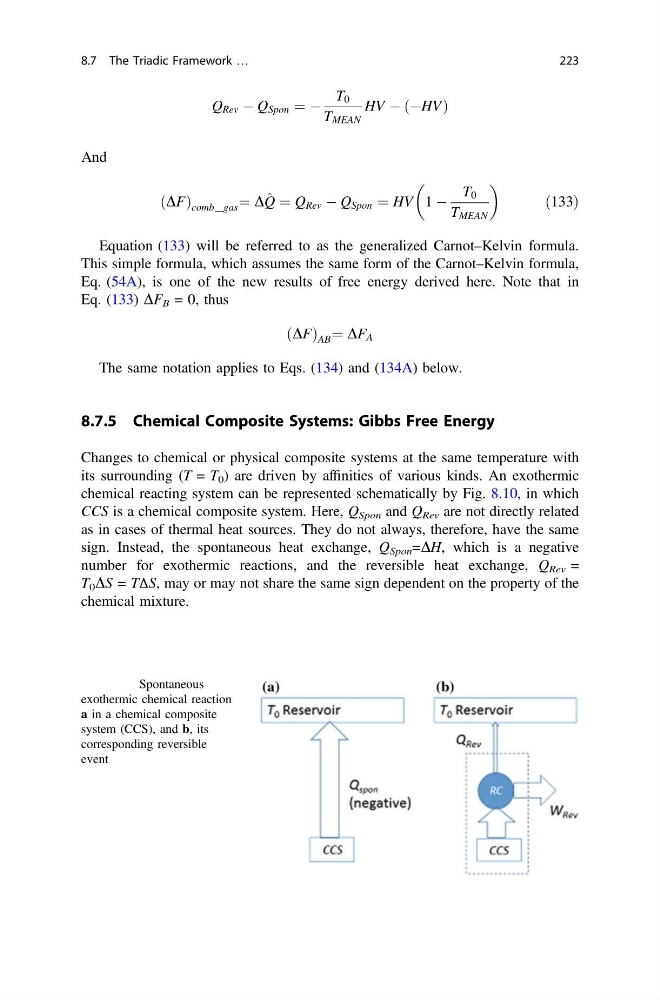
chemical reacting system can be represented schematically by Fig. 8.10, in which
CCS is a chemical composite system. Here, Q Spon and Q Rev are not directly related
as in cases of thermal heat sources. They do not always, therefore, have the same
sign. Instead, the spontaneous heat exchange, Q Spon =DH, which is a negative
number for exothermic reactions, and the reversible heat exchange, Q Rev =
T 0 DS = TΔS, may or may not share the same sign dependent on the property of the
chemical mixture.
Fig. 8.10 Spontaneous
exothermic chemical reaction
a in a chemical composite
system (CCS), and b, its
corresponding reversible
event
8.7 The Triadic Framework …
223
T 0
T MEAN
HV À ÀHV
ð
Þ
And
DF
ð Þ comb gas ¼ D ^
Q ¼ Q Rev À Q Spon ¼ HV 1 À
T 0
T MEAN
ð133Þ
Equation (133) will be referred to as the generalized Carnot–Kelvin formula.
This simple formula, which assumes the same form of the Carnot–Kelvin formula,
Eq. (54A), is one of the new results of free energy derived here. Note that in
Eq. (133) DF B = 0, thus
DF
ð Þ AB ¼ DF A
The same notation applies to Eqs. (134) and (134A) below.
8.7.5 Chemical Composite Systems: Gibbs Free Energy
Changes to chemical or physical composite systems at the same temperature with
its surrounding (T = T 0 ) are driven by affinities of various kinds. An exothermic
chemical reacting system can be represented schematically by Fig. 8.10, in which
CCS is a chemical composite system. Here, Q Spon and Q Rev are not directly related
as in cases of thermal heat sources. They do not always, therefore, have the same
sign. Instead, the spontaneous heat exchange, Q Spon =DH, which is a negative
number for exothermic reactions, and the reversible heat exchange, Q Rev =
T 0 DS = TΔS, may or may not share the same sign dependent on the property of the
chemical mixture.
Fig. 8.10 Spontaneous
exothermic chemical reaction
a in a chemical composite
system (CCS), and b, its
corresponding reversible
event
8.7 The Triadic Framework …
223