

D P S
ð
Þ Rev ¼ DS þ
ÀQ Rev
T 0
¼ DS þ
ÀT 0 DS
T 0
¼ 0
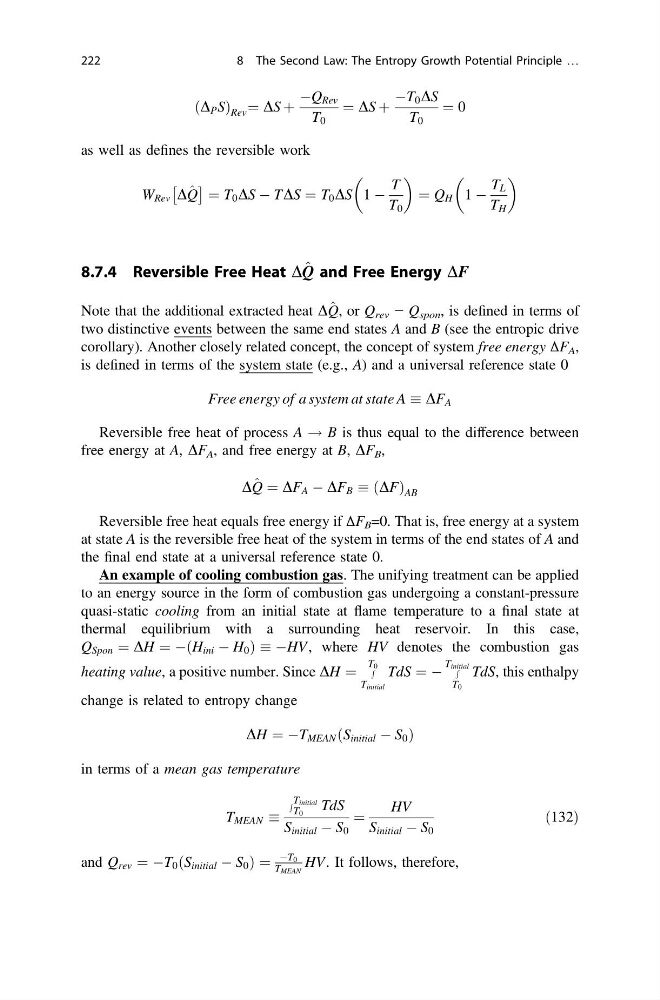
as well as defines the reversible work
W Rev D ^
Q
 à ¼ T 0 DS À TDS ¼ T 0 DS 1 À
T
T 0
¼ Q H 1 À
T L
T H
8.7.4 Reversible Free Heat D ^
Q and Free Energy DF
Note that the additional extracted heat D ^
Q, or Q rev − Q spon , is defined in terms of
two distinctive events between the same end states A and B (see the entropic drive
corollary). Another closely related concept, the concept of system free energy ΔF A ,
is defined in terms of the system state (e.g., A) and a universal reference state 0
Free energy of a system at state A DF A
Reversible free heat of process A ! B is thus equal to the difference between
free energy at A, DF A , and free energy at B, DF B ,
D ^
Q ¼ DF A À DF B DF
ð Þ AB
Reversible free heat equals free energy if ΔF B =0. That is, free energy at a system
at state A is the reversible free heat of the system in terms of the end states of A and
the final end state at a universal reference state 0.
An example of cooling combustion gas. The unifying treatment can be applied
to an energy source in the form of combustion gas undergoing a constant-pressure
quasi-static cooling from an initial state at flame temperature to a final state at
thermal equilibrium with a surrounding heat reservoir. In this case,
Q Spon ¼ DH ¼ À H ini À H 0
ð
ÞÀ HV, where HV denotes the combustion gas
heating value, a positive number. Since DH ¼
R
T 0
T initial
TdS ¼ À
R
T initial
T 0
TdS, this enthalpy
change is related to entropy change
DH ¼ ÀT MEAN S initial À S 0
ð
Þ
in terms of a mean gas temperature
T MEAN
R T initial
T 0
TdS
S initial À S 0
¼
HV
S initial À S 0
ð132Þ
and Q rev ¼ ÀT 0 ðS initial À S 0 Þ ¼
ÀT 0
T MEAN
HV. It follows, therefore,
222
8 The Second Law: The Entropy Growth Potential Principle …
ð
Þ Rev ¼ DS þ
ÀQ Rev
T 0
¼ DS þ
ÀT 0 DS
T 0
¼ 0
as well as defines the reversible work
W Rev D ^
Q
 à ¼ T 0 DS À TDS ¼ T 0 DS 1 À
T
T 0
¼ Q H 1 À
T L
T H
8.7.4 Reversible Free Heat D ^
Q and Free Energy DF
Note that the additional extracted heat D ^
Q, or Q rev − Q spon , is defined in terms of
two distinctive events between the same end states A and B (see the entropic drive
corollary). Another closely related concept, the concept of system free energy ΔF A ,
is defined in terms of the system state (e.g., A) and a universal reference state 0
Free energy of a system at state A DF A
Reversible free heat of process A ! B is thus equal to the difference between
free energy at A, DF A , and free energy at B, DF B ,
D ^
Q ¼ DF A À DF B DF
ð Þ AB
Reversible free heat equals free energy if ΔF B =0. That is, free energy at a system
at state A is the reversible free heat of the system in terms of the end states of A and
the final end state at a universal reference state 0.
An example of cooling combustion gas. The unifying treatment can be applied
to an energy source in the form of combustion gas undergoing a constant-pressure
quasi-static cooling from an initial state at flame temperature to a final state at
thermal equilibrium with a surrounding heat reservoir. In this case,
Q Spon ¼ DH ¼ À H ini À H 0
ð
ÞÀ HV, where HV denotes the combustion gas
heating value, a positive number. Since DH ¼
R
T 0
T initial
TdS ¼ À
R
T initial
T 0
TdS, this enthalpy
change is related to entropy change
DH ¼ ÀT MEAN S initial À S 0
ð
Þ
in terms of a mean gas temperature
T MEAN
R T initial
T 0
TdS
S initial À S 0
¼
HV
S initial À S 0
ð132Þ
and Q rev ¼ ÀT 0 ðS initial À S 0 Þ ¼
ÀT 0
T MEAN
HV. It follows, therefore,
222
8 The Second Law: The Entropy Growth Potential Principle …