

energy and, thus, we should accord the application of natural EGP with different
measurements, e.g., whether energy derived from natural EGP should be excluded from
“energy input” in coefficient of performance, COP ¼ Heat supplied or removed=
Energy input. That is, for many applications, especially low-temperature application, a creative way of counting energy can promote the use of natural EGP while
reserving the use of stock EGP only for managing generalized triadic processes.
Treatment of these kinds of problems will be made elsewhere.
8.7.3 Additional Examples of Heat Extraction
The triadic framework of PETH is applied to a number of classical examples to
reinforce the idea that all reversible and reversible-like processes are heat extraction
processes.
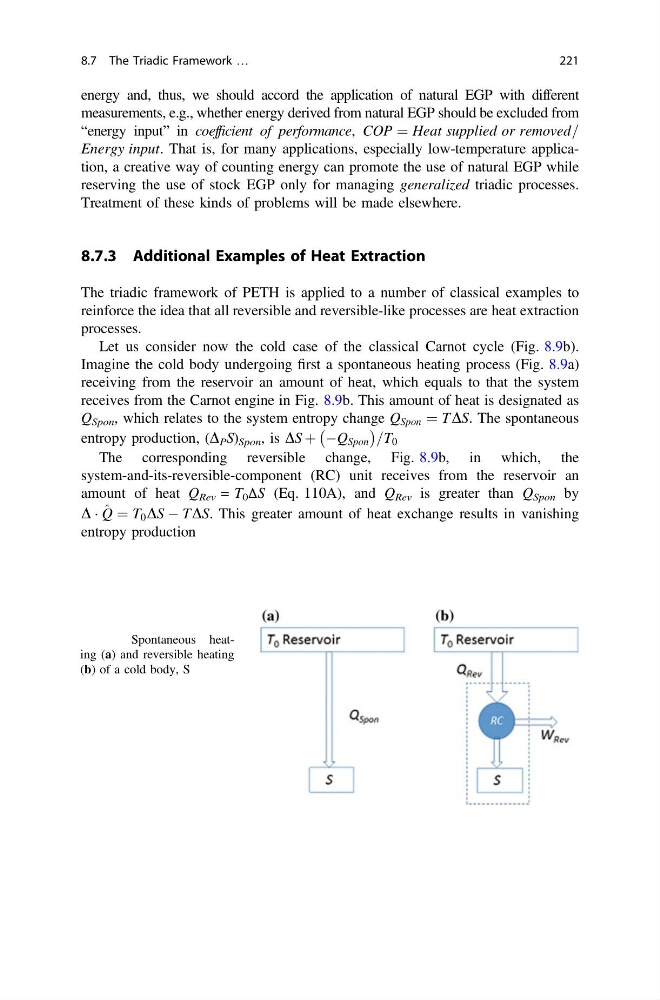
Let us consider now the cold case of the classical Carnot cycle (Fig. 8.9b).
Imagine the cold body undergoing first a spontaneous heating process (Fig. 8.9a)
receiving from the reservoir an amount of heat, which equals to that the system
receives from the Carnot engine in Fig. 8.9b. This amount of heat is designated as
Q Spon , which relates to the system entropy change Q Spon ¼ TDS. The spontaneous
entropy production, (D P S) Spon , is DS þ ÀQ Spon
À
Á =T 0
The corresponding reversible change, Fig. 8.9b, in which, the
system-and-its-reversible-component (RC) unit receives from the reservoir an
amount of heat Q Rev = T 0 ΔS (Eq. 110A), and Q Rev is greater than Q Spon by
D Á ^
Q ¼ T 0 DS À TDS. This greater amount of heat exchange results in vanishing
entropy production
Fig. 8.9 Spontaneous heating (a) and reversible heating
(b) of a cold body, S
8.7 The Triadic Framework …
221
measurements, e.g., whether energy derived from natural EGP should be excluded from
“energy input” in coefficient of performance, COP ¼ Heat supplied or removed=
Energy input. That is, for many applications, especially low-temperature application, a creative way of counting energy can promote the use of natural EGP while
reserving the use of stock EGP only for managing generalized triadic processes.
Treatment of these kinds of problems will be made elsewhere.
8.7.3 Additional Examples of Heat Extraction
The triadic framework of PETH is applied to a number of classical examples to
reinforce the idea that all reversible and reversible-like processes are heat extraction
processes.
Let us consider now the cold case of the classical Carnot cycle (Fig. 8.9b).
Imagine the cold body undergoing first a spontaneous heating process (Fig. 8.9a)
receiving from the reservoir an amount of heat, which equals to that the system
receives from the Carnot engine in Fig. 8.9b. This amount of heat is designated as
Q Spon , which relates to the system entropy change Q Spon ¼ TDS. The spontaneous
entropy production, (D P S) Spon , is DS þ ÀQ Spon
À
Á =T 0
The corresponding reversible change, Fig. 8.9b, in which, the
system-and-its-reversible-component (RC) unit receives from the reservoir an
amount of heat Q Rev = T 0 ΔS (Eq. 110A), and Q Rev is greater than Q Spon by
D Á ^
Q ¼ T 0 DS À TDS. This greater amount of heat exchange results in vanishing
entropy production
Fig. 8.9 Spontaneous heating (a) and reversible heating
(b) of a cold body, S
8.7 The Triadic Framework …
221