

DS S B À S A ¼ Nc V ln
T B
T A
þ NRln
V B
V A
¼ NRln2
Imagine that in the reversible event as described by Fermi the piston is now
connected to a cam-weight (work reservoir) mechanism that balances the force
exerted by the gas on the piston––and the walls of the system are now diathermic
and the whole composite system is submerged in a heat reservoir/bath at T 1 (see
Fig. 6.2 and Fig. 8.3). Repeat the consideration of gaseous expansion to double the
initial volume. The near balance of net force on the piston results in slow expansion
of gas along the same quasi-static path of the original continuous free expansion.
Note that the process in the present case is reversible due to the nearly balanced net
force and the slowness of expansion and correspondingly the slow heat extraction
from the T 1 bath, the amount of which is
Q Rev ¼
Z
2V 1
V 1
TdS ¼ T 1 DS ¼ NRT 1 ln2
A simple calculation of the resulting isothermal gaseous expansion shows
W Rev ¼
Z
2V 1
V 1
pdV ¼ NRT 1
Z
2V 1
V 1
dV
V
¼ NRT 1 ln2 ¼ D ^
Q
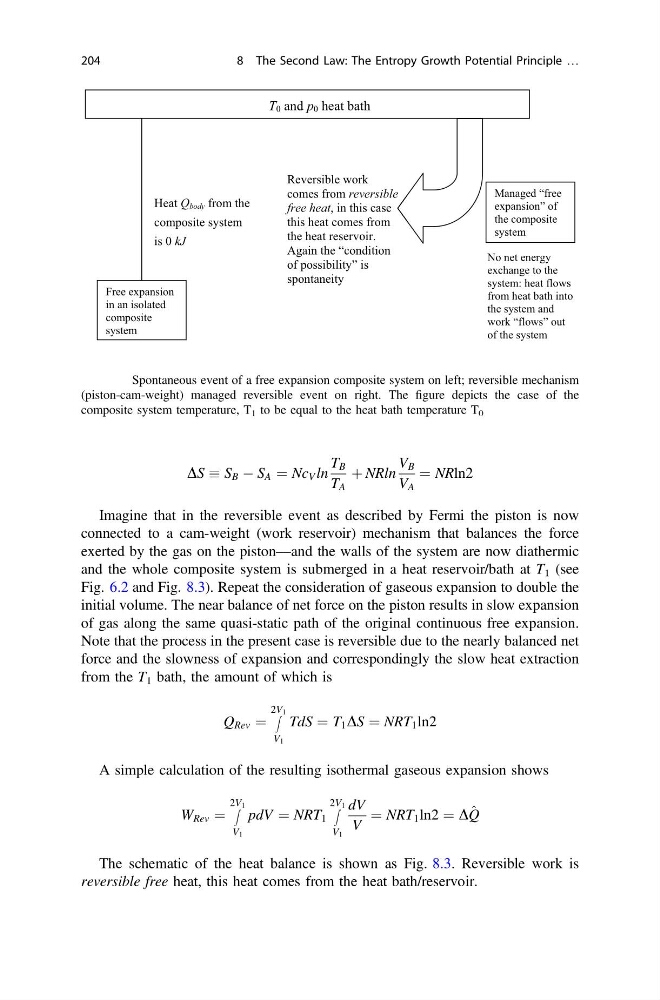
The schematic of the heat balance is shown as Fig. 8.3. Reversible work is
reversible free heat, this heat comes from the heat bath/reservoir.
T 0 and p 0 heat bath
Free expansion
in an isolated
composite
system
Managed “free
expansion” of
the composite
system
Heat Q body from the
composite system
is 0 kJ
No net energy
exchange to the
system: heat flows
from heat bath into
the system and
work “flows” out
of the system
Reversible work
comes from reversible
free heat, in this case
this heat comes from
the heat reservoir.
Again the “condition
of possibility” is
spontaneity
Fig. 8.3 Spontaneous event of a free expansion composite system on left; reversible mechanism
(piston-cam-weight) managed reversible event on right. The figure depicts the case of the
composite system temperature, T 1 to be equal to the heat bath temperature T 0
204
8 The Second Law: The Entropy Growth Potential Principle …
T B
T A
þ NRln
V B
V A
¼ NRln2
Imagine that in the reversible event as described by Fermi the piston is now
connected to a cam-weight (work reservoir) mechanism that balances the force
exerted by the gas on the piston––and the walls of the system are now diathermic
and the whole composite system is submerged in a heat reservoir/bath at T 1 (see
Fig. 6.2 and Fig. 8.3). Repeat the consideration of gaseous expansion to double the
initial volume. The near balance of net force on the piston results in slow expansion
of gas along the same quasi-static path of the original continuous free expansion.
Note that the process in the present case is reversible due to the nearly balanced net
force and the slowness of expansion and correspondingly the slow heat extraction
from the T 1 bath, the amount of which is
Q Rev ¼
Z
2V 1
V 1
TdS ¼ T 1 DS ¼ NRT 1 ln2
A simple calculation of the resulting isothermal gaseous expansion shows
W Rev ¼
Z
2V 1
V 1
pdV ¼ NRT 1
Z
2V 1
V 1
dV
V
¼ NRT 1 ln2 ¼ D ^
Q
The schematic of the heat balance is shown as Fig. 8.3. Reversible work is
reversible free heat, this heat comes from the heat bath/reservoir.
T 0 and p 0 heat bath
Free expansion
in an isolated
composite
system
Managed “free
expansion” of
the composite
system
Heat Q body from the
composite system
is 0 kJ
No net energy
exchange to the
system: heat flows
from heat bath into
the system and
work “flows” out
of the system
Reversible work
comes from reversible
free heat, in this case
this heat comes from
the heat reservoir.
Again the “condition
of possibility” is
spontaneity
Fig. 8.3 Spontaneous event of a free expansion composite system on left; reversible mechanism
(piston-cam-weight) managed reversible event on right. The figure depicts the case of the
composite system temperature, T 1 to be equal to the heat bath temperature T 0
204
8 The Second Law: The Entropy Growth Potential Principle …