

A moment of reflection shows that if the temperature of the reservoir T Reservoir is
different from the gas temperature T, reversible work will be given by the same
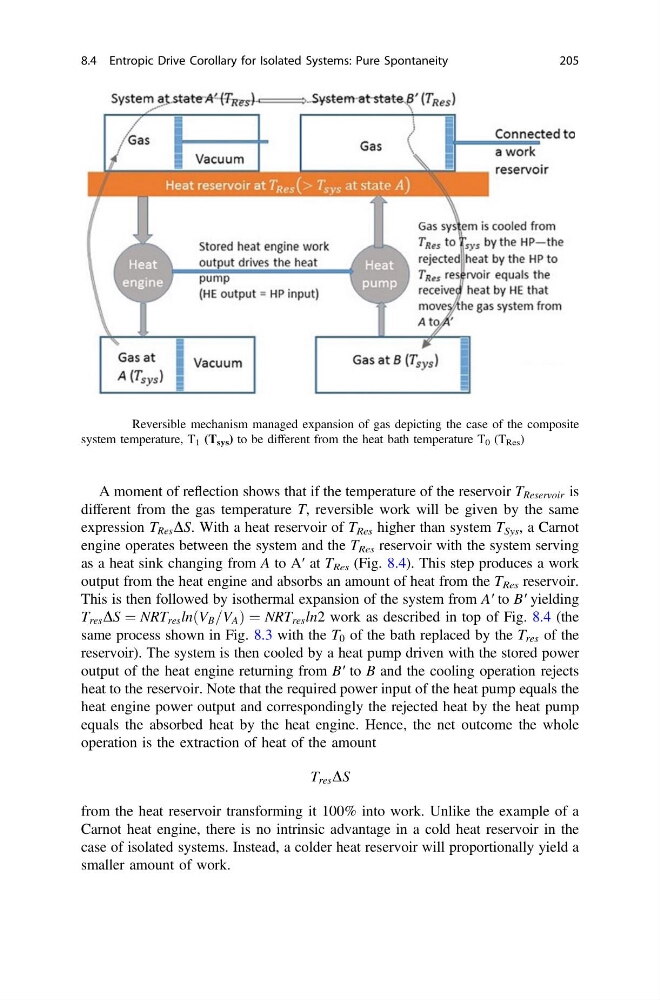
expression T Res DS. With a heat reservoir of T Res higher than system T Sys , a Carnot
engine operates between the system and the T Res reservoir with the system serving
as a heat sink changing from A to A′ at T Res (Fig. 8.4). This step produces a work
output from the heat engine and absorbs an amount of heat from the T Res reservoir.
This is then followed by isothermal expansion of the system from A′ to B′ yielding
T res DS ¼ NRT res ln V B =V A
ð
Þ¼NRT res ln2 work as described in top of Fig. 8.4 (the
same process shown in Fig. 8.3 with the T 0 of the bath replaced by the T res of the
reservoir). The system is then cooled by a heat pump driven with the stored power
output of the heat engine returning from B′ to B and the cooling operation rejects
heat to the reservoir. Note that the required power input of the heat pump equals the
heat engine power output and correspondingly the rejected heat by the heat pump
equals the absorbed heat by the heat engine. Hence, the net outcome the whole
operation is the extraction of heat of the amount
T res DS
from the heat reservoir transforming it 100% into work. Unlike the example of a
Carnot heat engine, there is no intrinsic advantage in a cold heat reservoir in the
case of isolated systems. Instead, a colder heat reservoir will proportionally yield a
smaller amount of work.
Fig. 8.4 Reversible mechanism managed expansion of gas depicting the case of the composite
system temperature, T 1 (T sys ) to be different from the heat bath temperature T 0 (T Res )
8.4 Entropic Drive Corollary for Isolated Systems: Pure Spontaneity
205
different from the gas temperature T, reversible work will be given by the same
expression T Res DS. With a heat reservoir of T Res higher than system T Sys , a Carnot
engine operates between the system and the T Res reservoir with the system serving
as a heat sink changing from A to A′ at T Res (Fig. 8.4). This step produces a work
output from the heat engine and absorbs an amount of heat from the T Res reservoir.
This is then followed by isothermal expansion of the system from A′ to B′ yielding
T res DS ¼ NRT res ln V B =V A
ð
Þ¼NRT res ln2 work as described in top of Fig. 8.4 (the
same process shown in Fig. 8.3 with the T 0 of the bath replaced by the T res of the
reservoir). The system is then cooled by a heat pump driven with the stored power
output of the heat engine returning from B′ to B and the cooling operation rejects
heat to the reservoir. Note that the required power input of the heat pump equals the
heat engine power output and correspondingly the rejected heat by the heat pump
equals the absorbed heat by the heat engine. Hence, the net outcome the whole
operation is the extraction of heat of the amount
T res DS
from the heat reservoir transforming it 100% into work. Unlike the example of a
Carnot heat engine, there is no intrinsic advantage in a cold heat reservoir in the
case of isolated systems. Instead, a colder heat reservoir will proportionally yield a
smaller amount of work.
Fig. 8.4 Reversible mechanism managed expansion of gas depicting the case of the composite
system temperature, T 1 (T sys ) to be different from the heat bath temperature T 0 (T Res )
8.4 Entropic Drive Corollary for Isolated Systems: Pure Spontaneity
205